1. Introduction
This manual provides detailed instructions for the installation, operation, and maintenance of your ASRock B860M Live Mixer WiFi motherboard. Designed for content creators, this motherboard offers robust connectivity and reliable performance for demanding tasks. Please read this manual thoroughly before proceeding with installation or operation.

Figure 1: Front view of the ASRock B860M Live Mixer WiFi motherboard. This image highlights the CPU socket, RAM slots, and various heatsinks.
2. Key Features
The ASRock B860M Live Mixer WiFi motherboard is equipped with advanced features to support high-performance computing and content creation:
- Power Phase Design: Features a 10+1+1+1+1 power phase design with Dr.MOS for VCore+GT+SA, ensuring stable power delivery to the CPU.
- DDR5 Memory Support: Supports 4 x DDR5 DIMMs in dual channel configuration, with speeds up to 8666+ (OC) MHz.
- Graphics Output: Multiple display options including 1 HDMI, 1 DisplayPort, and 1 Thunderbolt 4 Type-C port.
- Audio Quality: Integrated Realtek ALC1220 7.1 CH HD Audio Codec with Nahimic Audio for immersive sound.
- Enhanced Capacitors: Utilizes exclusive 20K Capacitors with 1000uF capacitance for improved durability and stability.
- High-Speed Connectivity: Includes WiFi 6E and 2.5G LAN for fast and reliable network connections.
Video 1: Overview of ASRock Intel B860 Series Motherboards. This video highlights key features and design aspects of the B860 motherboard series, including power delivery and connectivity options.
3. Setup and Installation
Follow these steps for proper installation of your motherboard and components.
3.1 Unboxing and Inspection
Carefully remove the motherboard and all accessories from the packaging. Inspect for any visible damage.
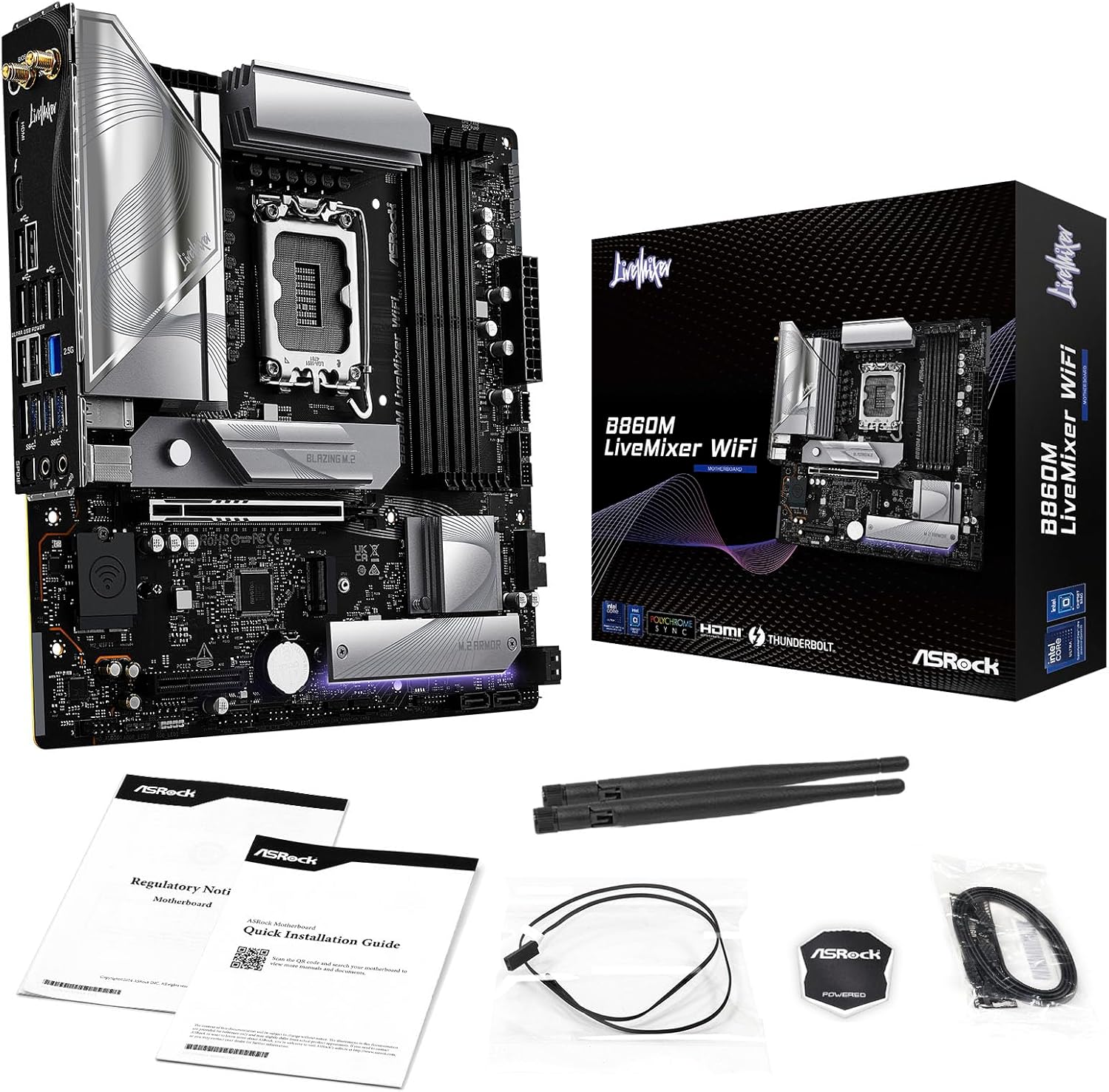
Figure 2: Contents of the ASRock B860M Live Mixer WiFi motherboard package. This image displays the motherboard, documentation, Wi-Fi antennas, and other accessories included.
3.2 CPU Installation (LGA1851)
- Locate the LGA1851 CPU socket on the motherboard.
- Open the CPU socket lever and remove the protective cover.
- Align your Intel Core Ultra processor with the socket, ensuring the notches on the CPU match the keys on the socket. Gently place the CPU into the socket without forcing it.
- Close the CPU socket lever to secure the processor.
3.3 Memory (DDR5) Installation
- Locate the four DDR5 DIMM slots.
- Open the clips at both ends of the DIMM slot.
- Align the memory module with the slot, ensuring the notch on the module matches the key in the slot.
- Press down firmly on both ends of the memory module until the clips snap into place.
3.4 Storage Installation (M.2 and SATA)
The motherboard supports multiple M.2 slots and SATA3 6.0 Gb/s ports.
- M.2 SSD: Locate the M.2 slots (e.g., Blazing M.2, M.2 Armor). Insert the M.2 SSD into the slot at an angle, then push it down and secure it with the provided screw or tool-less mechanism.
- SATA Drives: Connect SATA data cables from your storage drives (HDDs/SSDs) to the SATA3 6.0 Gb/s ports on the motherboard. Connect power cables from your power supply to the drives.

Figure 3: Angled view of the ASRock B860M Live Mixer WiFi motherboard, highlighting the M.2 slots and their heatsinks for high-speed storage.
3.5 Expansion Cards (PCIe 5.0)
Insert your graphics card or other PCIe expansion cards into the appropriate PCIe 5.0 slot. Ensure it is seated firmly and secured with a screw to your chassis.
3.6 Power Connections
Connect the 24-pin ATX power connector and the 8-pin (or 4+4-pin) CPU power connector from your power supply to the corresponding ports on the motherboard.
3.7 Rear I/O Connections
Connect your peripherals to the rear I/O panel. This includes USB devices, display cables (HDMI, DisplayPort, Thunderbolt 4 Type-C), Ethernet cable, and audio devices.

Figure 4: Detailed view of the rear I/O panel on the ASRock B860M Live Mixer WiFi motherboard, showing various USB ports, display outputs, Ethernet, and audio jacks.
Video 2: Demonstrates the ultimate connectivity features for creators on ASRock motherboards, including Thunderbolt and high-speed networking.
4. Operating Instructions
After successful installation, power on your system. The motherboard will perform a Power-On Self-Test (POST). You can access the BIOS/UEFI setup utility by pressing the Delete or F2 key during POST.
4.1 BIOS/UEFI Setup
The BIOS/UEFI interface allows you to configure system settings, including boot order, memory profiles (XMP), fan speeds, and overclocking options. Refer to the on-screen instructions within the BIOS for navigation and adjustments.
4.2 BIOS Update Procedure
Updating your BIOS can improve system stability, compatibility, and performance. ASRock provides tools like USB BIOS Flashback and Instant Flash for this purpose.
Video 3: A detailed tutorial on how to update the motherboard BIOS using ASRock's USB BIOS Flashback and Instant Flash methods. This is crucial for maintaining system compatibility and performance.
For detailed steps on using USB BIOS Flashback or Instant Flash, please refer to the video tutorial above or the dedicated section in the full user manual available on the ASRock support website.
5. Maintenance
Regular maintenance ensures the longevity and optimal performance of your motherboard.
- Dust Removal: Periodically clean dust from inside your PC case, especially from heatsinks and fans, using compressed air.
- BIOS Updates: Keep your BIOS updated to the latest version to ensure compatibility with new hardware and software, and to benefit from performance improvements and bug fixes.
- Driver Updates: Install the latest drivers for your motherboard chipset, audio, network, and other components from the ASRock website.
- Cable Management: Ensure proper cable management to maintain good airflow within the case, preventing overheating.
6. Troubleshooting
If you encounter issues, consider the following common troubleshooting steps:
- No Power: Check all power connections (24-pin ATX, 8-pin CPU, GPU power). Ensure your power supply is switched on.
- No Display: Verify that your monitor is connected to the correct graphics output port (motherboard or discrete GPU). Reseat your graphics card and RAM modules.
- System Instability/Crashes: Check RAM seating and try running with one stick of RAM at a time. Ensure CPU cooler is properly installed. Update BIOS and drivers.
- Boot Issues: Check boot order in BIOS/UEFI. Ensure your storage drive is detected.
- Peripheral Not Detected: Try different USB ports. Install necessary drivers for the peripheral.
For more advanced troubleshooting, consult the full user manual or ASRock's online support resources.
7. Specifications
| Feature | Detail |
|---|---|
| Brand | ASRock |
| Model Name | B860M LIVEMIXER WIFI |
| CPU Socket | LGA 1851 |
| Compatible Processors | Intel Core Ultra |
| Chipset Type | Intel B860 |
| RAM Memory Technology | DDR5 |
| Memory Clock Speed | 8666 MHz (OC) |
| Memory Storage Capacity | Up to 256 GB |
| Graphics Output Options | 1 HDMI, 1 DisplayPort, 1 Thunderbolt 4 Type-C |
| Audio Codec | Realtek ALC1220 7.1 CH HD Audio Codec, Nahimic Audio |
| LAN | 2.5G LAN |
| Wireless Connectivity | WiFi 6E |
| Power Phase | 10+1+1+1+1 Power Phase, Dr.MOS for VCore+GT+SA |
| Capacitors | Exclusive 20K Cap with 1000uF Capacitance |
| Form Factor | Micro ATX |
| Package Dimensions | 11.73 x 10.51 x 2.4 inches |
| Item Weight | 3.25 pounds |
8. Warranty and Support
For warranty information, technical support, and driver downloads, please visit the official ASRock website:
You can also find additional support and FAQs on the ASRock store page: ASRock America Store
Protection plans are available for purchase separately to extend coverage for your product.


