1. Introduction
This manual provides essential information for the safe and effective operation, setup, and maintenance of your CUIPPWRJ Manta5 SE Drone. This drone features a Squashed-X frame design, AE227-1960KV motors, GPS functionality, and is compatible with 6S batteries, making it suitable for both cinematic and freestyle flying. Please read this manual thoroughly before operating the drone.
2. Safety Information
Operating a drone requires responsibility and adherence to safety guidelines. Failure to follow these instructions may result in injury, damage to the drone, or property damage.
- Local Regulations: Always fly in accordance with local laws and regulations. Check for no-fly zones and altitude restrictions.
- Pre-Flight Check: Before each flight, inspect the drone for any damage, loose propellers, or connection issues.
- Environment: Fly in open areas, away from people, animals, buildings, and power lines. Avoid flying in strong winds or adverse weather conditions.
- Battery Safety: Use only compatible 6S batteries. Handle batteries with care, avoid overcharging or over-discharging, and store them in a safe, fireproof location.
- Propeller Safety: Keep hands and face clear of rotating propellers. Always remove propellers before performing maintenance or configuration.
- Line of Sight: Maintain visual line of sight with the drone at all times, even when using FPV.
- Age Recommendation: This product is recommended for users aged 36 months to 18 years, with adult supervision for younger users.
3. Package Contents
Verify that all components are present and in good condition upon unboxing:
- CUIPPWRJ Manta5 SE Drone (Squashed-X Frame with AE227-1960KV Motors)
- GPS Module
- ELRS Receiver (for 'Analog W Elrs W Gps' variant)
- Propellers (quantity may vary)
- Antenna (for FPV and control link)
- User Manual (this document)
Note: Batteries and charger are typically sold separately. Ensure you have a compatible 6S battery and charger.
4. Setup
4.1 Initial Inspection
Carefully remove the drone from its packaging. Inspect the frame, motors, wiring, and camera for any visible damage that may have occurred during shipping.
4.2 Propeller Installation
Attach the propellers to the motors. Ensure that each propeller is installed on the correct motor (clockwise or counter-clockwise rotation) and tightened securely. Refer to the markings on the propellers and motor shafts.
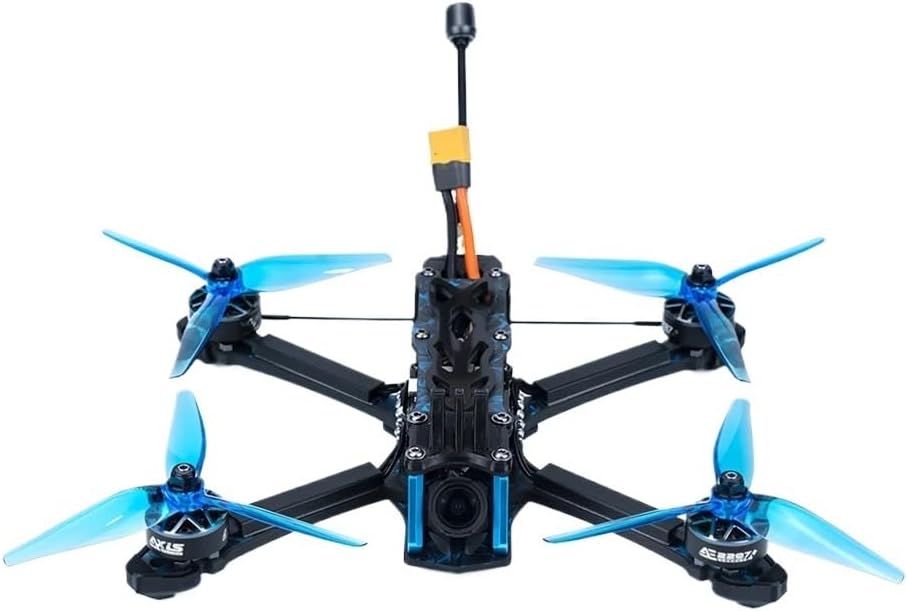
Figure 1: The CUIPPWRJ Manta5 SE Drone, featuring its Squashed-X frame, AE227-1960KV motors, and translucent blue propellers. The FPV camera is visible at the front, and the antenna and battery connector are at the top. This image illustrates the fully assembled drone ready for flight.
4.3 Battery Connection
Connect a fully charged 6S LiPo battery to the drone's XT60 connector. Ensure the connection is firm and secure. The drone will power on, and you may hear a series of beeps indicating initialization.
4.4 ELRS Receiver Binding (if applicable)
If your drone variant includes an ELRS receiver, follow the specific binding procedure for your ELRS module and radio transmitter. Typically, this involves putting the receiver into binding mode (often by powering it on/off three times) and initiating the binding process on your transmitter.
4.5 GPS Calibration
For optimal GPS performance, perform a compass calibration before the first flight and whenever flying in a new location. Refer to your flight controller's firmware documentation (e.g., Betaflight, ArduPilot) for detailed calibration steps. This usually involves rotating the drone on multiple axes.
5. Operating
5.1 Pre-Flight Checks
- Ensure battery is fully charged and securely connected.
- Verify propellers are correctly installed and tightened.
- Check for clear flight path and safe environment.
- Confirm radio transmitter is powered on and bound to the drone.
- Check FPV feed (if applicable) for clarity and signal strength.
- Wait for GPS lock (indicated by LED status or OSD) before arming, especially for GPS-assisted flight modes.
5.2 Take-off and Landing
Arm the motors using your radio transmitter's designated switch. Slowly increase throttle to lift off. For landing, gently decrease throttle while maintaining control, aiming for a soft touchdown. Disarm motors immediately after landing.
5.3 Flight Modes
The Manta5 SE supports various flight modes suitable for cinematic and freestyle flying. These modes are typically configured in your flight controller software (e.g., Betaflight). Common modes include:
- Acro Mode (Rate Mode): Provides full manual control, ideal for freestyle maneuvers.
- Angle Mode (Self-Leveling): Assists with leveling the drone, suitable for beginners or stable cinematic shots.
- GPS Hold/Return to Home: Utilizes the GPS module for position holding or automatically returning to the take-off point.
5.4 FPV System (First-Person View)
If your drone is equipped with an FPV system, ensure your FPV goggles or monitor are powered on and tuned to the correct video frequency. The FPV system provides real-time video feedback for an immersive flying experience.
6. Maintenance
Regular maintenance ensures the longevity and performance of your drone.
- Cleaning: After each flight, especially in dusty or dirty environments, gently clean the drone's frame, motors, and camera lens with a soft brush or compressed air.
- Propeller Inspection: Check propellers for cracks, bends, or nicks. Damaged propellers can cause instability and reduce flight efficiency. Replace them immediately if damaged.
- Motor Inspection: Ensure motors spin freely and quietly. Check for any debris lodged in the motor bells.
- Wiring and Connectors: Periodically inspect all wiring for fraying or loose connections. Ensure battery connectors are clean and free of corrosion.
- Frame Integrity: Check the Squashed-X frame for any cracks or stress points, especially after hard landings or crashes.
- Firmware Updates: Keep your flight controller firmware updated to benefit from performance improvements and bug fixes.
7. Troubleshooting
This section addresses common issues you might encounter.
| Problem | Possible Cause | Solution |
|---|---|---|
| Drone does not power on | Dead battery, loose connection, damaged power cable | Charge battery, check all power connections, inspect cables for damage. |
| Unstable flight / Drifting | Damaged propellers, incorrect calibration, motor issue, unbalanced drone | Replace damaged propellers, recalibrate accelerometer/gyro, check motor function, ensure even weight distribution. |
| No FPV video feed | Incorrect VTX channel, loose camera/VTX connection, damaged VTX/camera | Verify VTX channel matches goggles/monitor, check all video connections, inspect components for damage. |
| No GPS lock | Poor satellite visibility, GPS module not connected, incorrect configuration | Move to an open area, ensure GPS module is securely connected, verify GPS settings in flight controller software. |
| Drone not arming | Throttle too high, safety switch not engaged, low battery voltage, arming disabled in flight controller | Lower throttle, engage arming switch, check battery voltage, review flight controller arming settings. |
If you encounter issues not listed here, consult online resources for your flight controller firmware or contact customer support.
8. Specifications
- Model: CUIPPWRJ123
- Frame Type: Squashed-X
- Motors: AE227-1960KV
- Battery Compatibility: 6S LiPo
- Navigation: Integrated GPS
- Receiver: ELRS (for 'Analog W Elrs W Gps' variant)
- Dimensions (Package): 1.18 x 0.79 x 0.39 inches
- Item Weight: 14.1 ounces
- Manufacturer: CUIPPWRJ
- Recommended Age: 36 months - 18 years
9. Warranty and Support
For warranty information and technical support, please refer to the documentation provided with your purchase or contact CUIPPWRJ customer service directly. Keep your proof of purchase for any warranty claims.