
Symcode Desktop QR Omnidirectional Barcode Scanner
Symcode Desktop QR Omnidirectional Barcode Scanner User Manual
Model: Desktop QR Omnidirectional Barcode Scanner
1. Product Overview
The Symcode Desktop QR Omnidirectional Barcode Scanner is designed for efficient and hands-free scanning of various barcode types. This device is suitable for environments requiring quick and accurate data capture, such as retail stores, libraries, and inventory management systems. It supports both 1D and 2D barcodes, including QR codes, and features automatic sensing for ease of use.

Image: Front-side view of the Symcode Desktop QR Omnidirectional Barcode Scanner, showing its compact design and scan window.
Key Components:
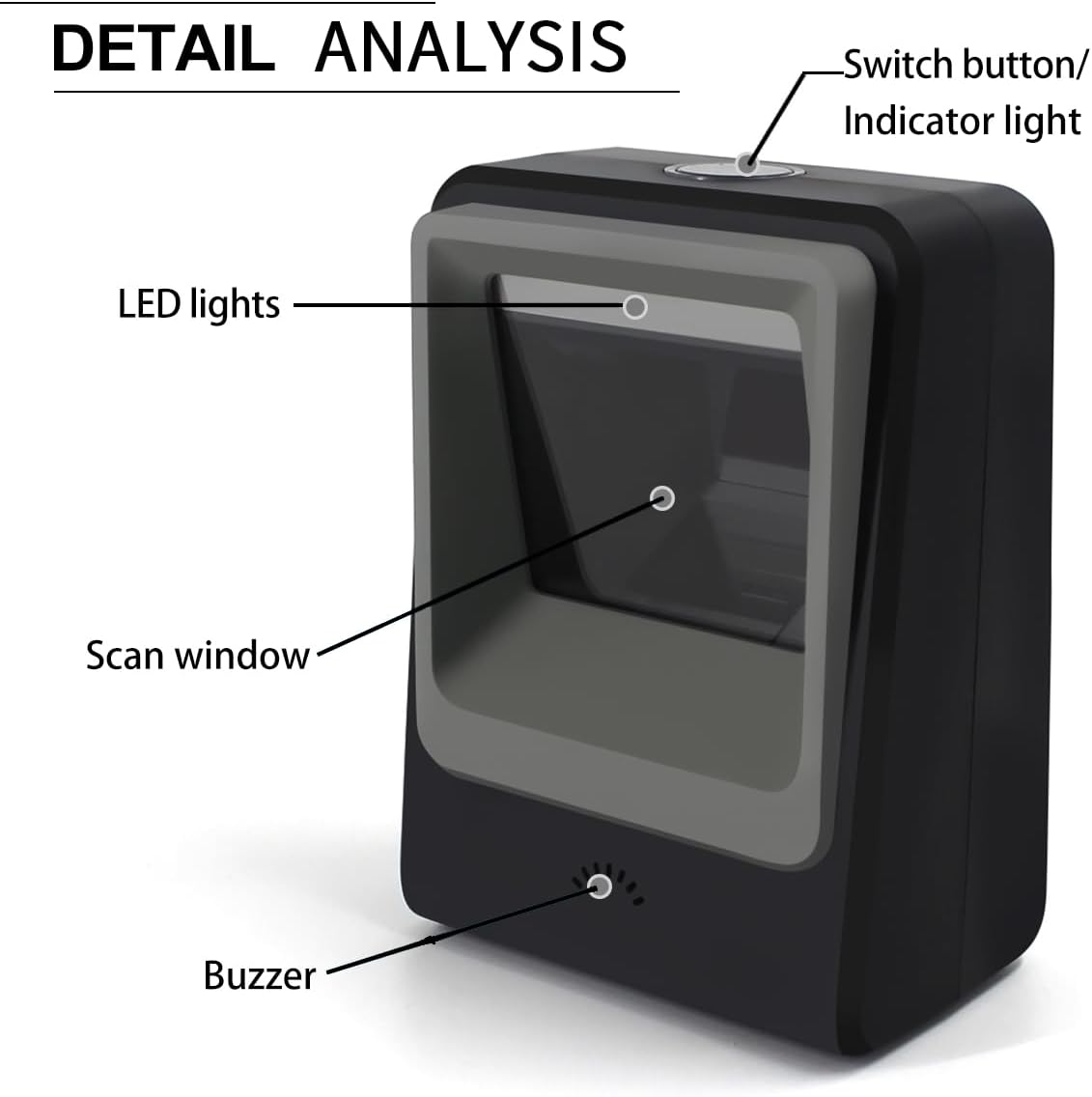
Image: Detailed diagram highlighting the scanner's components: Switch button/Indicator light, LED lights, Scan window, and Buzzer.
- Switch Button/Indicator Light: Controls power and indicates operational status.
- LED Lights: Illuminates the scanning area.
- Scan Window: The area through which barcodes are read.
- Buzzer: Provides audible feedback for successful scans or errors.
2. Features
- Versatile Scanning: Capable of reading 1D, 2D, and QR barcodes, including damaged or distorted codes.

Image: The scanner demonstrating its ability to read both 1D and 2D barcodes, including QR codes, from digital displays and printed labels.
- Hands-Free Operation: Features an infrared auto-sensing sensor that automatically activates the scanner when a barcode is presented, and enters sleep mode when inactive.

Image: Illustration of the scanner's automatic sleep and wake-up function, activating when an item is placed in front of it.
- Plug and Play Setup: Requires no software installation; simply connect via USB to a compatible device.
- Broad Compatibility: Works with Windows XP/7/8/10, Mac OS, and Linux operating systems.

Image: The scanner connected to a laptop, illustrating its plug-and-play functionality and compatibility with multiple operating systems and devices.
- Durable Construction: Designed with an anti-slip base for stability and constructed from ABS engineering plastics for enhanced durability, capable of withstanding drops from up to 1.5 meters (approximately 5 feet).

Image: Visual representation of the scanner's anti-shock design, demonstrating its resilience to drops from a height of 1.5 meters.
- Multiple Connectivity Options: Supports USB, Serial, and TTL transmission for flexible integration into various systems.

Image: Diagram illustrating the scanner's support for USB, Serial, and TTL transmission methods, connecting to a computer display.
3. Setup Instructions
- Unpack the Scanner: Carefully remove the scanner from its packaging.
- Connect to Power/Data: Insert the USB cable into the scanner's port and connect the other end to an available USB port on your computer or host device.
- System Recognition: The operating system (Windows, Mac OS, Linux) should automatically detect and configure the scanner as a standard HID keyboard device. No additional drivers or software are typically required.
- Test Functionality: Open a text editor (e.g., Notepad, Word) or a compatible application. Place a known barcode in front of the scanner's window. The scanner should emit a light, scan the barcode, and the data should appear in your open application. A successful scan is usually indicated by a beep from the buzzer.
If the scanner does not function immediately, ensure the USB cable is securely connected and try a different USB port. For specific configuration settings, refer to the programming guide (if provided separately) or contact support.
4. Operating Instructions
The Symcode Desktop QR Omnidirectional Barcode Scanner is designed for hands-free, automatic operation.
- Automatic Scanning: The scanner utilizes an infrared auto-sensing sensor. When an object with a barcode is placed within its scanning field, the scanner will automatically activate its light and attempt to read the barcode.
- Positioning Barcodes: For optimal performance, present the barcode to the scanner's window. The omnidirectional design allows for scanning from various angles without precise alignment.
- Scan Confirmation: Upon a successful scan, the scanner will typically emit a short beep and the indicator light may flash. The scanned data will be transmitted to your connected device as if typed from a keyboard.
- Sleep Mode: When no barcode is detected for a period, the scanner will automatically enter a low-power sleep mode, turning off its scanning light. It will reactivate instantly when a barcode is presented again.
5. Maintenance
Proper maintenance ensures the longevity and optimal performance of your barcode scanner.
- Cleaning the Scan Window: Regularly clean the scan window with a soft, lint-free cloth. If necessary, dampen the cloth slightly with water or a mild, non-abrasive cleaner. Avoid harsh chemicals or abrasive materials that could scratch the window.
- General Cleaning: Wipe the exterior of the scanner with a soft, dry cloth. Do not immerse the scanner in water or any cleaning solutions.
- Cable Care: Ensure the USB cable is not kinked, twisted, or subjected to excessive strain. Damaged cables can affect connectivity.
- Storage: Store the scanner in a clean, dry environment away from extreme temperatures and direct sunlight when not in use.
6. Troubleshooting
| Problem | Possible Cause | Solution |
|---|---|---|
| Scanner does not power on or respond. | USB cable not connected properly or faulty USB port. | Ensure the USB cable is securely plugged into both the scanner and the host device. Try a different USB port on your computer. |
| Scanner powers on but does not scan. | Barcode is damaged, poorly printed, or not within the scanning range/angle. Scanner is in sleep mode. | Ensure the barcode is clear and flat. Adjust the distance and angle. The scanner should wake up automatically when a barcode is presented. If not, check for obstructions on the sensor. |
| Scanned data is incorrect or incomplete. | Partial scan, incorrect barcode symbology settings (unlikely for default setup), or interference. | Rescan the barcode, ensuring it is fully within the scan window. If issues persist, consult the product's advanced configuration guide (if available) for symbology settings. |
| No data appears in the application after scanning. | Application not in focus, or scanner not recognized as a keyboard input device. | Ensure the target application (e.g., text editor, POS software) is active and ready to receive input. Verify the scanner is recognized by your operating system (check Device Manager on Windows). |
7. Specifications
| Feature | Detail |
|---|---|
| Product Dimensions | 4.25"D x 2.75"W x 6"H (10.8 cm D x 7 cm W x 15.2 cm H) Image: Dimensional drawing of the scanner, indicating its depth, width, and height measurements. |
| Item Weight | 7.1 ounces (approx. 201 grams) |
| Connectivity Technology | USB Cable (also supports Serial, TTL) |
| Power Source | USB Barcode Reader (Bus-powered) |
| Compatible Devices | Laptop, PC, iPad, Phone (with appropriate adapters/OTG support) |
| Operating Systems | Windows XP/7/8/10, Mac OS, Linux, Android |
| Barcode Types Supported | 1D: UPC/EAN, UPC-A, UPC-E, Code39, ISBN, Interleaved 2 of 5, Code93, Code 128, Codabar, EAN-8, EAN-13, GS1 Databar, Industrial 2 of 5, MSI. 2D: PDF417, Data Matrix, QR Code, Aztec, Maxicode, Hanxin. |
| Manufacturer | Symcode |
8. Warranty and Support
For information regarding the product warranty, please refer to the documentation included with your purchase or contact Symcode customer support directly. Support contact details are typically available on the manufacturer's official website or product packaging.
Manufacturer: Symcode
Related documentsDesktop QR Omnidirectional Barcode Scanner

Ask a question about this manual
Ask about setup, troubleshooting, compatibility, parts, safety, or missing instructions. Manuals+ will review the question and use this page’s manual context to help answer it.