Introduction to the Service Manual
This document is a reproduction of the original service manual for the Singer 14SH654 and 14SH644 serger models. It provides detailed instructions and diagrams essential for the proper maintenance, repair, and adjustment of these machines. This manual is intended for technicians and experienced users who require in-depth information beyond basic operation.
The manual is presented in an easy-to-read 5 1/2" x 8 1/2" format, comprising 28 pages with a sturdy cardstock cover. All drawings and text are clear and concise, ensuring accurate guidance for service procedures.
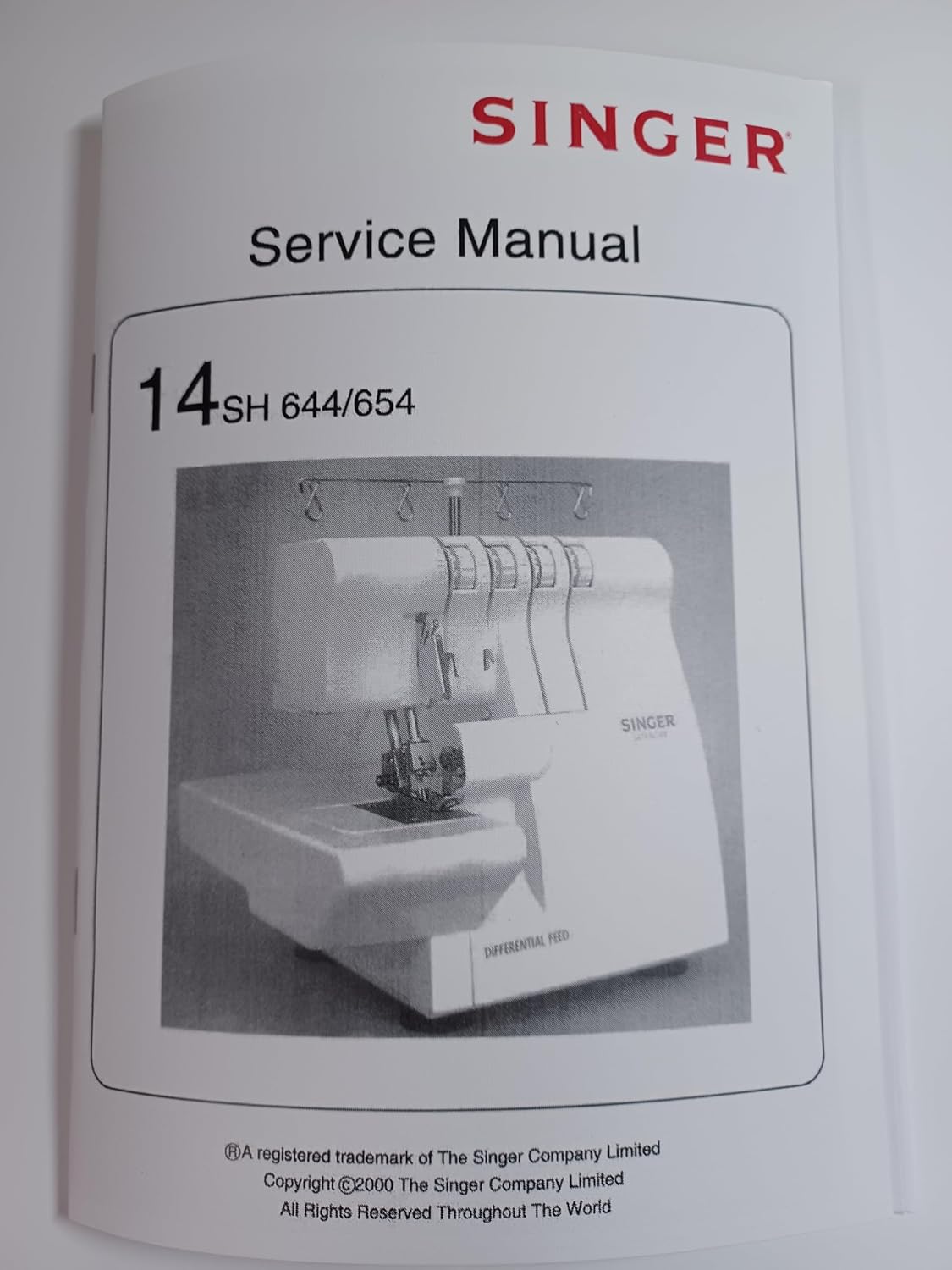
Image: Front cover of the Singer 14SH654 Serger Service Manual, displaying the Singer logo and model numbers 14SH 644/654, with an illustration of the serger machine.
Specifications
This section details the technical specifications of the Singer 14SH654 and 14SH644 serger machines, crucial for understanding their operational parameters and for accurate servicing.
- Sewing Speed: 1,300 rpm maximum
- Stitch Length (feed amount): 1 - 4mm
- Differential Feed Ratio: 0.7 - 1.2 (with differential feed machine)
- Overedge Stitch Width: Rolled hemming 1.5mm, ordinary overedge 3.0 - 7mm (standard 3.5mm)
- Needle Bar Stroke: 27mm
- Presser Foot Rise: 4.5mm
- Needle: Rolled hemming - Singer Cat. No. 2022 #11; Ordinary overedge - Singer Cat. No. 2022 #1, #14
- Model: 14U644, 14U654
- Number of Threads: 4
- Machine Dimensions (mm): Width 329, Depth 270, Height 265
- Weight (Kg): 6.0 (14U644), 6.2 (14U654)

Image: An open page from the service manual, displaying a table of specifications for the Singer 14SH654 and 14SH644 serger models, including sewing speed, stitch length, and dimensions.
Adjustments and Procedures
This section covers critical adjustments and procedures necessary for the optimal performance and repair of the serger machines. Each sub-section provides detailed steps and diagrams.
Setting Needle Bar at Correct Height
Accurate needle bar height is fundamental for proper stitching. This procedure outlines the steps to ensure the needle bar is positioned correctly, which impacts loop formation and thread tension.
Cams Adjustment
The cams play a vital role in the machine's timing and movement of various components. This part of the manual details how to inspect and adjust the feed cam, needle bar eccentric cam, lower looper cam, and upper looper cam for precise operation.

Image: An open page from the service manual, illustrating detailed diagrams and instructions for adjusting the various cams within the serger mechanism, including feed cam and looper cams.
Looper Adjustments (Lower and Upper)
Proper alignment and timing of the lower and upper loopers are crucial for forming balanced stitches. This section provides instructions for adjusting their positions and clearances to prevent skipped stitches or thread breakage.

Image: An open page from the service manual, showing diagrams and text for adjusting the lower and upper loopers of the serger, including clearance measurements.
Feed System Adjustments
This includes adjustments for both standard and differential feed mechanisms, ensuring consistent fabric feeding and preventing stretching or puckering of materials.
Presser Foot and Knife Adjustments
Instructions for setting the presser foot pressure and aligning the knives (both stationary and movable) are provided to ensure clean cuts and proper fabric handling.

Image: An open page from the service manual, detailing adjustments for the front cover thread guide bracket and the stationary knife holder, with corresponding diagrams showing stitch formation and knife positioning.
Seam Width Finger and Needle Guard Settings
Guidance on how to set the seam width finger for desired stitch width and adjust the needle guard for safety and optimal needle protection.
Motor Belt Tension and One-Turn Tension Dial Adjustments
Procedures for adjusting the motor belt tension to ensure smooth power transmission and calibrating the one-turn tension dial for accurate thread tension control.
Troubleshooting Guide
This section provides a comprehensive guide to diagnosing and resolving common issues encountered with the Singer 14SH654 and 14SH644 serger machines. It helps identify the root cause of problems such as skipped stitches, thread breakage, uneven tension, or poor fabric feeding, and offers solutions based on the machine's mechanics.
Users are advised to consult the detailed adjustment sections for specific corrective actions once a problem is identified.
General Information and Appendices
This part of the manual includes supplementary information vital for comprehensive servicing.
How to Use Service Gauge
Instructions on the proper application and interpretation of the service gauge, a tool essential for precise measurements and adjustments during maintenance.
External Parts Overview
A detailed overview of the external components of the serger, aiding in identification and understanding their functions in relation to service procedures.
Appendices
Additional technical data, diagrams, or reference charts that support the service and repair processes are included in the appendices.
Important Safety Precautions
Always ensure to disconnect the power plug from the electrical outlet before performing any maintenance, repair, or adjustment procedures on the machine.
- Do not touch the machine with wet hands or a wet cloth.
- When turning the machine pulley, always turn it towards the operator.
- Refer to the parts chart for identification of lower looper and upper looper components.


