
Iryreafer gas chainsaw
Iryreafer 58CC Gas Powered Chainsaw User Manual
Model: gas chainsaw
Brand: Iryreafer
Introduction
This manual provides essential information for the safe operation, assembly, maintenance, and troubleshooting of your Iryreafer 58CC Gas Powered Chainsaw. Please read this manual thoroughly before operating the chainsaw to ensure proper use and to prevent injury or damage. Keep this manual for future reference.

Image: The Iryreafer 58CC Gas Powered Chainsaw, showcasing its 20-inch bar, 58cc engine, and various included accessories such as a toolkit, funnel, and user manual.
Safety Instructions
Always prioritize safety when operating power tools. Failure to follow safety guidelines can result in serious injury or death. This section outlines critical safety precautions.
- Personal Protective Equipment (PPE): Always wear appropriate PPE, including a helmet, eye protection (safety glasses or goggles), hearing protection, heavy-duty gloves, and sturdy, non-slip footwear.
- Work Area: Ensure the work area is clear of bystanders, children, pets, and any obstacles that could interfere with operation or cause tripping. Maintain a safe distance from others.
- Firm Grip: Always maintain a firm grip on both handles of the chainsaw during operation. Use both hands.
- Operator Condition: Never operate the chainsaw when fatigued, ill, or under the influence of alcohol, drugs, or medication that could impair judgment or coordination.
- Familiarization: Familiarize yourself with all controls, safety features, and the chain brake mechanism before starting the engine. Practice engaging and disengaging the chain brake.
- Chain Condition: Keep the saw chain sharp and properly tensioned. A dull or loose chain can increase the risk of kickback and reduce cutting efficiency.
- Kickback Awareness: Be aware of the potential for kickback, which can occur when the moving chain at the tip of the guide bar contacts an object, or when the wood closes in and pinches the saw chain in the cut. Avoid cutting with the tip of the guide bar.
- Fuel Handling: Handle fuel with extreme care. Fuel is highly flammable. Refuel in a well-ventilated area with the engine off and cool. Do not smoke while refueling.
- Storage: Store the chainsaw safely when not in use, with the chain brake engaged, out of reach of children and unauthorized users. Drain fuel if storing for extended periods.
Components Overview
Familiarize yourself with the main components of your chainsaw to understand its operation and maintenance points.

Image: A detailed diagram labeling key components of the chainsaw, including the Front Guard, Fuel Tank, Air Cleaner, Choke Knob, Engine On/Off switch, Throttle Interlock, Silicone Material, Guide Bar, Saw Chain, and Aluminum Material.
Assembly
Follow these steps carefully to assemble your chainsaw before its first use. Ensure all parts are present and undamaged.

Image: Visual guide for assembly steps 1 through 4, showing the installation of the bumper spike, removal of guide bar nuts and clutch cover, positioning of the guide bar, and initial placement of the saw chain over the drive sprocket.
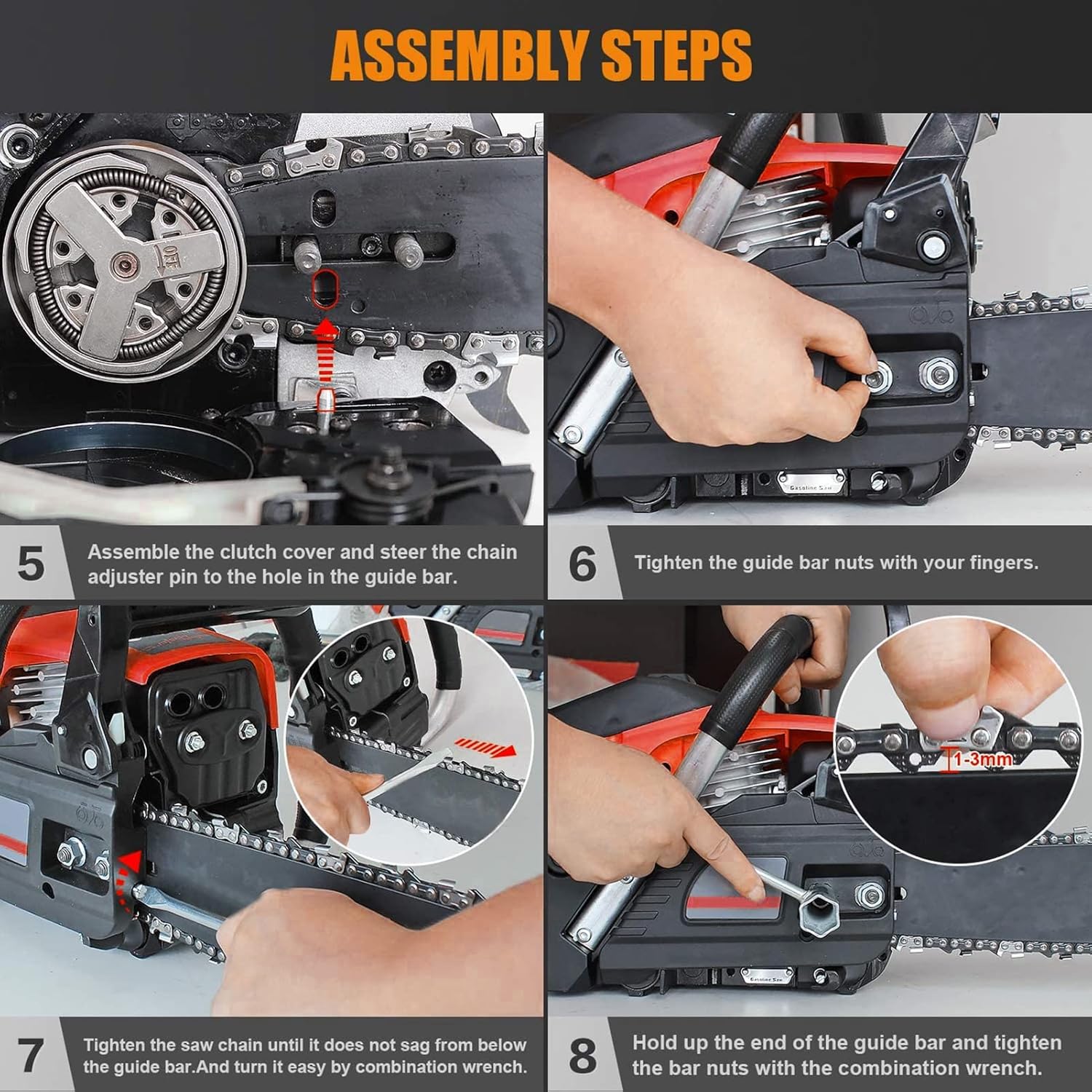
Image: Visual guide for assembly steps 5 through 8, detailing the assembly of the clutch cover, hand-tightening of guide bar nuts, adjustment of chain tension to 1-3mm, and final tightening of bar nuts with a combination wrench.
- Install Bumper Spike: Pull the chain brake back (disengaged position). Install the bumper spike onto the chainsaw body.
- Remove Guide Bar Nuts and Clutch Cover: Use the provided combination wrench to loosen and remove the guide bar nuts. Then, remove the clutch cover.
- Position Guide Bar: Place the guide bar over the bar bolts. Ensure the guide bar is steered to the position under the clutch.
- Install Saw Chain: Lift the saw chain and place it over the drive sprocket. Carefully guide the chain into the groove of the guide bar. Ensure the cutting edges of the chain links are facing the correct direction for cutting.
- Assemble Clutch Cover: Re-attach the clutch cover. Steer the chain adjuster pin into the corresponding hole in the guide bar.
- Tighten Guide Bar Nuts (Initial): Hand-tighten the guide bar nuts to hold the clutch cover and guide bar in place. Do not fully tighten yet.
- Adjust Chain Tension: While holding up the tip of the guide bar, tighten the saw chain until it does not sag from below the guide bar. The chain should be snug but still able to be pulled around the guide bar by hand. The gap between the chain and the guide bar should be approximately 1-3mm. Use the combination wrench to adjust the tension screw if needed.
- Final Tightening: Once the chain tension is correct, hold up the end of the guide bar and fully tighten the bar nuts with the combination wrench.
Fueling Instructions
Proper fuel mixture is crucial for the chainsaw's performance, longevity, and to prevent engine damage. This chainsaw requires a specific gasoline-oil mixture.

Image: Illustration of the fueling process for the gasoline chainsaw, showing a funnel being used to pour the pre-mixed fuel into the fuel tank. The image also specifies the 25:1 ratio for 92# gasoline and 2T two-stroke engine oil.
This chainsaw requires a mixture of gasoline and 2-stroke engine oil. The recommended ratio is 25:1 (gasoline to 2T two-stroke engine oil). Use gasoline with an octane rating of 92# or higher.
- Prepare Fuel Mixture: In a separate, approved fuel container, mix 92# (or higher) gasoline with 2-stroke engine oil at a 25:1 ratio. Shake well to ensure thorough mixing.
- Ensure Safety: Always ensure the engine is off and cool before fueling. Move to a well-ventilated outdoor area away from ignition sources.
- Open Fuel Tank: Carefully open the fuel tank lid.
- Fill Tank: Using a funnel, carefully pour the pre-mixed fuel into the fuel tank. Do not overfill; leave a small air gap to allow for fuel expansion.
- Secure Lid: Securely close the fuel tank lid. Wipe up any spilled fuel immediately.
Operating Instructions
Before starting, ensure all safety checks are complete, the chain is properly tensioned, and the chain oil reservoir is filled.
Starting the Engine
- Placement: Place the chainsaw on a firm, flat surface, ensuring the guide bar and chain are clear of any obstructions.
- Engage Chain Brake: Push the chain brake lever forward to engage the chain brake. This prevents the chain from moving during startup.
- Choke (Cold Start): For a cold engine, pull out the choke knob fully. For a warm engine, the choke may not be necessary.
- Primer Bulb: Press the primer bulb several times until fuel is visible in the return line.
- Starter Cord: Hold the chainsaw firmly with one hand on the front handle and pull the starter cord firmly and smoothly until the engine fires or attempts to start (usually a few pulls).
- Disengage Choke: Once the engine fires or attempts to start, push the choke knob in (to the run position).
- Final Start: Pull the starter cord again until the engine starts and runs smoothly.
- Warm-up: Allow the engine to warm up for a few moments at idle speed before disengaging the chain brake and beginning operation.
Cutting Techniques
Always maintain a balanced stance and firm grip on both handles. Be aware of kickback potential and plan your cuts carefully.

Image: The Iryreafer 58CC Gas Powered Chainsaw actively cutting through a log, demonstrating its power and efficiency in tree felling tasks.
- Stance: Stand with your feet shoulder-width apart, maintaining good balance.
- Grip: Hold the chainsaw firmly with both hands, thumbs wrapped around the handles.
- Cutting Angle: Approach the wood at an appropriate angle, allowing the chain to do the work. Do not force the saw.
- Avoid Kickback Zone: Never cut with the tip of the guide bar, as this is the primary kickback zone.
- Felling Trees: For felling trees, plan your escape route, make a notch cut, and then a felling cut from the opposite side. Always ensure the tree falls in the intended direction.
- Limbing and Bucking: Be mindful of branches under tension and logs that may roll. Use proper techniques to avoid pinching the guide bar.
Maintenance
Regular maintenance ensures optimal performance, extends the life of your chainsaw, and helps prevent accidents.
Automatic Chain Oiler
This chainsaw features an automatic chain oiler to reduce wear and extend chain and guide bar life. Ensure the oil reservoir is filled with appropriate chain lubricant (bar and chain oil) before each use. Check the oil level frequently during operation.
Chain Sharpening and Tension
A sharp chain is essential for efficient and safe cutting. A dull chain can cause the saw to work harder, leading to overheating and increased kickback risk. Regularly check chain tension and sharpen as needed. Refer to the assembly section for tensioning guidelines. A properly tensioned chain should be snug against the guide bar but still allow you to pull it around by hand.
Air Filter Cleaning
Clean the air filter regularly, especially after prolonged use or in dusty conditions, to maintain engine performance and prevent carburetor issues. Consult the components overview for the location of the air cleaner. Remove the cover, take out the filter, and clean it with compressed air or by tapping it gently. Replace if heavily soiled or damaged.
Spark Plug Inspection
Periodically inspect the spark plug for wear, carbon buildup, or damage. Clean or replace the spark plug as necessary to ensure reliable starting and engine performance.
Troubleshooting
This section addresses common issues you might encounter with your chainsaw and provides potential solutions.
| Problem | Possible Cause | Solution |
|---|---|---|
| Engine won't start | No fuel, incorrect choke setting, fouled spark plug, stale fuel, engaged chain brake. | Check fuel level and mixture, adjust choke, clean/replace spark plug, drain and refill with fresh fuel, ensure chain brake is disengaged for starting. |
| Chainsaw cuts poorly or slowly | Dull chain, incorrect chain tension, insufficient chain lubrication, worn guide bar. | Sharpen chain, adjust chain tension (refer to Assembly), fill chain oil reservoir, inspect and replace guide bar if worn. |
| Engine loses power or stalls | Dirty air filter, incorrect fuel mixture, carburetor issues, clogged fuel filter. | Clean air filter, ensure correct fuel mixture, replace fuel filter, consult a qualified technician for carburetor issues. |
| Excessive vibration | Loose components, damaged chain, worn clutch. | Check and tighten all fasteners, inspect chain for damage and replace if necessary, consult technician for clutch issues. |
Specifications
Key technical specifications for the Iryreafer 58CC Gas Powered Chainsaw.
- Engine Displacement: 58CC
- Guide Bar Length: 20 Inch
- Horsepower: 3.2hp
- Output Power: 2.4kW
- Idling Speed: 8500 rpm
- Power Source: Gas Powered
- Model Number: gas chainsaw
- Material: Undefined (as per product data)
- Included Components: Gas Chain Saw

Image: The Iryreafer 58CC Gas Powered Chainsaw visually highlighting its core specifications: 58cc engine, 20-inch guide bar, 3.2 horsepower, 2.4 kW output power, and 8500 RPM idling speed.
Warranty and Support
For warranty information, technical support, or replacement parts, please refer to the documentation included with your purchase or contact Iryreafer customer service directly. Keep your purchase receipt as proof of purchase for any warranty claims. Do not attempt repairs beyond the scope of this manual unless you are a qualified technician.
Ask a question about this manual
Ask about setup, troubleshooting, compatibility, parts, safety, or missing instructions. Manuals+ will review the question and use this page’s manual context to help answer it.