
1. Introduction
The MakerHawk Mesh Node T114 Board V2 is a versatile development board designed for IoT applications, supporting LoRa, Bluetooth 5.0, and GPS functionalities. It integrates an nRF52840 microcontroller and an SX1262 LoRa chip, featuring a 1.14-inch TFT display for real-time data visualization. This board offers flexible power solutions, including USB, lithium battery, and solar panel input, making it suitable for diverse environments and projects such as Meshtastic, Arduino, and LoRaWAN.
This manual provides essential information for setting up, operating, and maintaining your Mesh Node T114 Board V2.
2. What's in the Box
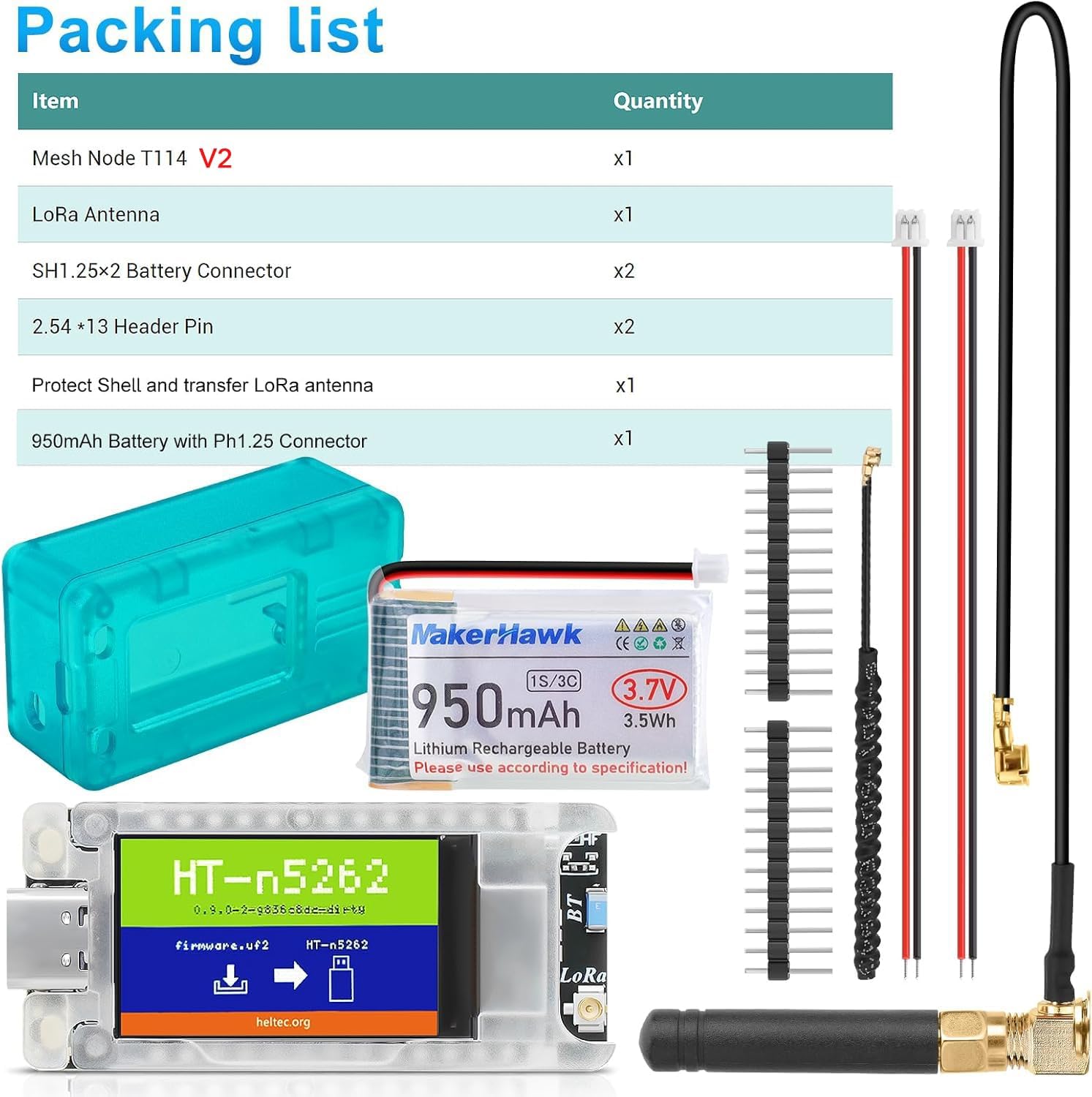
Image: Components included in the Mesh Node T114 V2 package.
- Mesh Node T114 V2 Board x1
- LoRa Antenna x1
- SH1.25×2 Battery Connector x2
- 2.54 × 13 Header Pin x2
- Protective Shell and LoRa Antenna Transfer Cable x1
- 950mAh Battery with PH1.25 Connector x1
3. Product Overview and Features
The Mesh Node T114 Board V2 is engineered for robust performance and expandability. Key features include:
- Integrated TFT Display: A 1.14-inch TFT LCD with 135(H) x 240(V) pixels, supporting up to 262k colors, for enhanced interactivity and data visualization.
- Flexible Power Solutions: Multiple power inputs including 5V USB, lithium battery, and solar panel connectors, ensuring continuous operation. A 950mAh battery is included.
- Extensive Expandability: Connectors for LiPo battery (1.25 * 2P), solar panel (1.25 * 2P), and GNSS module (1.25 * 8P) allow for tailored project integration.
- Reliable and Safe Design: Operates in temperatures from -20℃ to 70℃ with 90% humidity (non-condensing). Features complete voltage regulation, ESD protection, and RF shielding for durability and safety.
- Meshtastic/Arduino Compatibility: Designed to be compatible with popular IoT platforms and development environments.

Image: Overview of the Mesh Node T114 Development Board highlighting its features like low power consumption, Arduino/Meshtastic compatibility, LoRa, Bluetooth, external GPS support, and battery/solar power supply.

Image: Detailed diagram of the Mesh Node T114 board, labeling components such as RGB LEDs, MCU+LoRa Chip, User Button, USB Type-C, Reset Button, TFT-LCD, LoRa ANT Connector, Bluetooth ANT, 2*1.25 Solar Panel Connector, 2*1.25 LiPo Connector, 8*1.25 GNSS Connector, and Pin Headers.
4. Setup Instructions
Follow these steps to assemble and prepare your Mesh Node T114 Board V2 for operation:
- Connect the Battery: Connect the included 950mAh lithium battery to the 2-pin LiPo connector (labeled P2 or similar) on the board. Ensure correct polarity.
- Attach the LoRa Antenna: Connect the LoRa antenna to the U.FL connector on the board. If using the protective shell, route the antenna cable through the designated opening and connect the external antenna.
- Assemble the Protective Case: Carefully place the Mesh Node T114 board into the bottom half of the protective shell. Ensure the USB-C port, buttons, and display align with the case openings. Then, secure the top half of the shell.
- Optional: Connect GPS Module: If using an external GNSS module (not included), connect it to the 8-pin GNSS module connector (labeled P3). Refer to the GNSS Module Link Instruction image for proper connection.
- Initial Power-Up: Connect the board to a 5V USB power source using a USB-C cable. The TFT display should light up, indicating power.

Image: Exploded view illustrating the assembly of the Mesh Node T114 board, 950mAh battery, and protective case with antenna connection.

Image: Diagram showing how to connect an external GNSS module to the Mesh Node T114 board via the 8*1.25mm connector (P3).
5. Operating Instructions
Once assembled and powered, the Mesh Node T114 Board V2 is ready for operation. The specific functionality will depend on the firmware loaded onto the nRF52840 microcontroller.
- Power On/Off: The board powers on automatically when connected to a USB power source or when the battery is connected. There is no dedicated power switch. To power off, disconnect the power source.
- TFT Display: The integrated 1.14-inch TFT display will show information as programmed by the firmware. This can include network status, sensor data, GPS coordinates, or other relevant metrics.
- Buttons: The board includes a 'USER' button and a 'RST' (Reset) button. The 'USER' button's function is typically defined by the loaded firmware, while the 'RST' button restarts the board.
- Firmware Upload: To load or update firmware (e.g., Meshtastic, Arduino sketches), connect the board to your computer via the USB-C port. Follow the specific instructions provided by your chosen development environment or firmware project.
6. Connectivity
The Mesh Node T114 Board V2 supports multiple communication protocols:
- LoRa: Utilizes the SX1262 chip for long-range, low-power wireless communication. This is ideal for Meshtastic networks and LoRaWAN applications. Ensure the LoRa antenna is properly connected for optimal performance.
- Bluetooth 5.0: The nRF52840 microcontroller provides Bluetooth 5.0 capabilities, including Bluetooth Low Energy (BLE) and Bluetooth mesh. This allows for short-range communication with other Bluetooth-enabled devices.
- GPS: The board includes a dedicated 8-pin connector for an external GNSS (GPS) module. When connected, this enables location tracking and time synchronization for your projects.
7. Power Solutions
The Mesh Node T114 Board V2 offers versatile power input options:
- USB-C (5V): The primary power input for development and continuous operation when connected to a computer or USB power adapter.
- Lithium Battery (3-4.2V): The included 950mAh battery provides portable power. The board features integrated charging circuitry for the connected battery when powered via USB or solar.
- Solar Panel: A dedicated 1.25 * 2P connector allows for direct connection of a solar panel, enabling autonomous operation and battery charging in remote locations.

Image: Close-up view of the Mesh Node T114 interfaces, including the TFT-LCD, Type C interface, Battery/Solar Panel Interface, and GNSS Interface.
8. Specifications

Image: Part 1 of the technical specifications table for the Mesh Node T114.

Image: Part 2 of the technical specifications table for the Mesh Node T114.
| Parameter | Description |
|---|---|
| Brand | MakerHawk |
| Model Number | T114 |
| MCU | nRF52840 |
| LoRa Node Chip | SX1262 |
| Frequency | 470~510MHz; 863~870MHz; 902~928MHz |
| Max. TX Power | 21±1dBm |
| Max. Receiving Sensitivity | -135dBm@SF12 BW=125KHz |
| Bluetooth | Bluetooth LE; Bluetooth 5, Bluetooth mesh |
| Hardware Resource | USB 2.0, 4 × SPI, 2 × TWI, 2 × UART, 4 × PWM, QPSI, I2S, PDM, ODEC Etc. |
| Memory | 1M ROM, 256KB SRAM |
| Interface | Type-C USB, 2×1.25 lithium battery connector, 2×1.25 solar panel connector, LoRa ANT, 8×1.25 GPS module connector, 2×13×2.54 Header Pin |
| Battery | 3-4.2V battery power supply and charge (950mAh included) |
| Operating Temperature | -20 ℃ to 70 ℃ |
| Dimensions | 50.80 × 22.86mm (Board only) |
| Item Weight | 3.2 ounces (with components) |
| Display | Onboard 1.14 inch TFT-LCD display |
| Deep Sleep Current | ~11uA |
| Tracker Mode Sleep Current | ~22uA |
| GPS OFF, TFT OFF Current | ~9mA |
| GPS OFF, TFT ON Current | ~20mA |
| GPS ON, TFT ON Current | ~51mA |
9. Maintenance
To ensure the longevity and optimal performance of your Mesh Node T114 Board V2, observe the following maintenance guidelines:
- Operating Environment: Operate the board within the specified temperature range of -20℃ to 70℃ and humidity of 90% (non-condensing). Avoid extreme temperatures, direct sunlight, and high humidity.
- Physical Protection: Always use the provided protective shell to shield the board from dust, accidental impacts, and static discharge.
- Cleaning: If necessary, gently clean the board and case with a soft, dry cloth. Avoid using liquids or abrasive cleaners.
- Battery Care: When not in use for extended periods, store the lithium battery at approximately 50% charge in a cool, dry place. Avoid fully discharging or overcharging the battery.
- Firmware Updates: Regularly check for firmware updates from the Meshtastic or Arduino communities, or from MakerHawk, to benefit from new features, improvements, and bug fixes.
10. Troubleshooting
If you encounter issues with your Mesh Node T114 Board V2, consider the following common troubleshooting steps:
- No Power/Display: Ensure the USB-C cable is securely connected and providing 5V power, or that the battery is properly connected and charged.
- Firmware Issues: If the board is not behaving as expected, try reflashing the firmware. Verify that you are using the correct firmware version for your board.
- Connectivity Problems (LoRa/Bluetooth): Check antenna connections. Ensure that other devices are within range and configured correctly for communication. For LoRa, verify frequency settings match your region.
- GPS Not Working: Confirm the external GNSS module is correctly connected to the P3 connector. Ensure the module has a clear view of the sky for satellite acquisition.
- Software/Driver Issues: If connecting to a computer for programming, ensure you have the necessary drivers and development environment (e.g., Arduino IDE, PlatformIO) properly installed and configured.
For more detailed troubleshooting guides and community support, refer to the official documentation and resources:

Image: Screenshot of the Heltec Automation 'Docs & Resource' page, which provides user manuals, frameworks, schematics, datasheets, and related resources for the T114 board.
11. Warranty and Support
MakerHawk provides comprehensive customer support for the Mesh Node T114 Board V2. For technical assistance, warranty claims, or further inquiries, please contact MakerHawk customer service through their official channels or visit the MakerHawk Store on Amazon.
Please retain your proof of purchase for warranty purposes.


