Introduction
The Filterelated 4-Stage Portable Aquarium Reverse Osmosis Deionized (RO/DI) Water Filtration System is designed to provide ultra-pure water for your aquarium or residential needs. This system effectively removes impurities, ensuring water quality suitable for sensitive aquatic environments or general home use. It features a compact design, making it versatile for various installation locations.
The system includes all necessary accessories for operation and comes with detailed instructions to guide you through each step. Its advanced filtration process ensures a high level of purity, with Total Dissolved Solids (TDS) levels approaching 0 ppm.
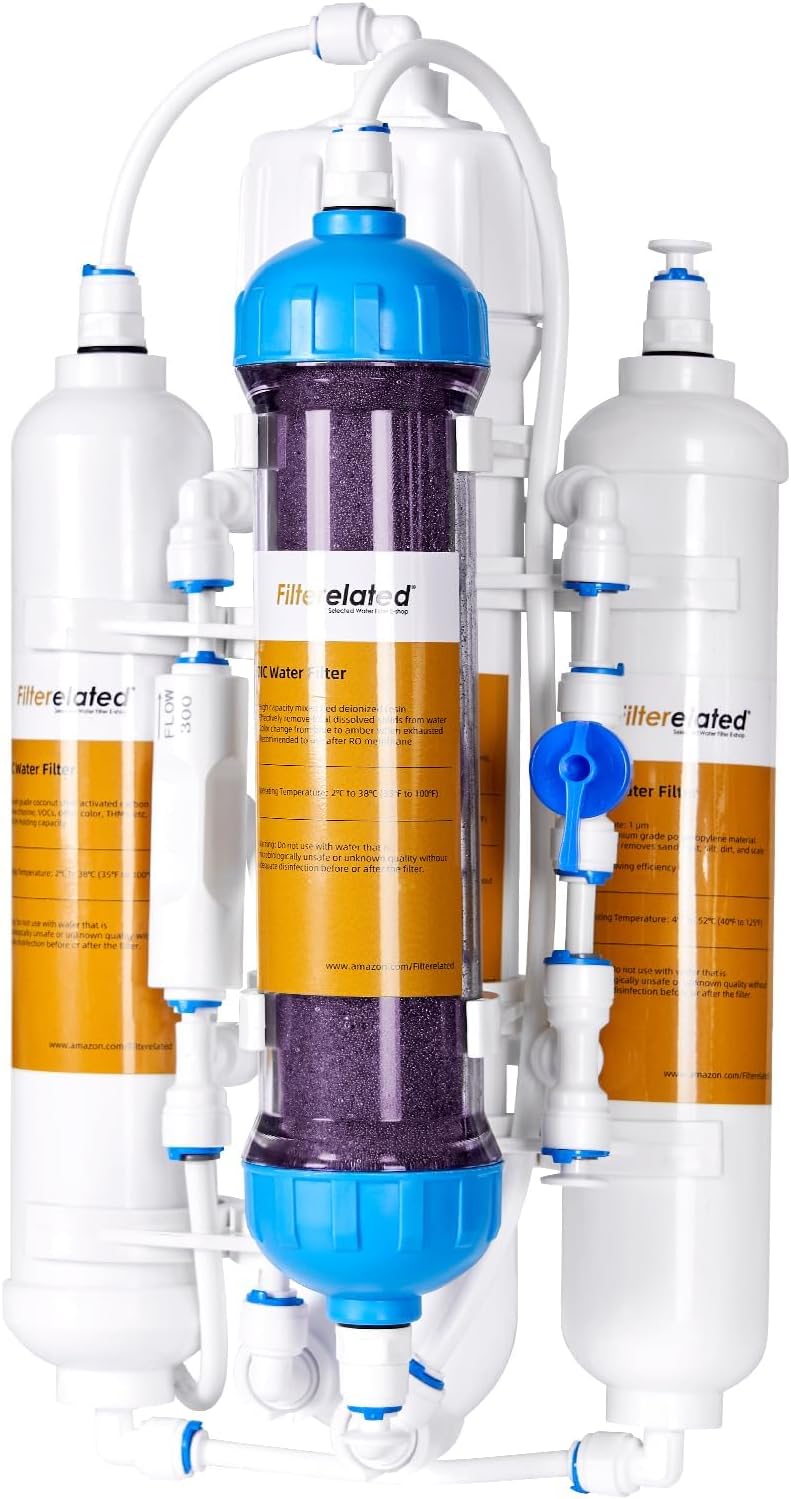
Image: The Filterelated 4-Stage Portable Aquarium RO/DI Water Filtration System, showcasing its compact design and multiple filter cartridges.
Product Components and Filtration Stages
This system utilizes a comprehensive 4-stage filtration process to achieve optimal water purity:
- Stage 1: PP Cotton Filter (Sediment Filter)
Filters out large particles such as sediment, rust, and other suspended solids, reducing water turbidity. - Stage 2: Activated Carbon Cartridge (GAC Filter)
Removes chlorine, volatile organic compounds (VOCs), and odors, improving water taste and clarity. - Stage 3: RO Reverse Osmosis Membrane (100 GPD)
Filters down to 0.0001 micron, effectively reducing arsenic, lead, fluoride, mercury, cadmium, and other dissolved impurities. This NSF-certified membrane ensures healthy and pure water. - Stage 4: DI Resin Filter (Deionization Filter)
A mixing bed DI filter that further removes any remaining TDS (Total Dissolved Solids) from the membrane-filtered water, guaranteeing TDS levels approaching 0 ppm. This DI resin is color-changing, indicating when replacement is needed.

Image: A visual representation of the 4-stage filtration process, showing the sequence of the PP cotton, GAC, RO membrane, and DI resin filters.

Image: Close-up view of the individual filter cartridges, including the PP cotton, activated carbon, RO membrane, and DI resin filters, highlighting their distinct appearances.
Setup and Installation
The system is designed for easy setup. All necessary accessories are included, such as clips and expansion screws for wall mounting, and a 13-foot hose that can be cut to your desired length.
- Unpacking: Carefully remove all components from the packaging. Inspect for any damage.
- Placement: Choose a suitable location. The compact design allows placement under cabinets or in confined spaces. Ensure the system is level.
- Mounting (Optional): If desired, use the provided clips and expansion screws to securely mount the unit to a wall.
- Connecting Water Supply: Connect the system to a cold water supply. Important: Only cold water should enter the reverse osmosis system.
- Hose Connections: Utilize the quick connections to attach the hoses. Ensure all tubing is fully inserted into the quick-connect fittings to prevent leaks. Push firmly until the tubing is seated.
- Initial Flushing: Before first use, rinse the RO diaphragm filter for five minutes. Set the flushing valve to the ON position to initiate flushing. After flushing, set the valve to the OFF position for pure water production.

Image: A diagram illustrating the numbered connection points and the operation of the flushing valve, showing 'OPEN' for flushing and 'CLOSE' for pure water production.
Operation
Once installed and flushed, the system is ready for operation. The system produces 100 gallons per day (GPD) at 60 psi, with a pure water to waste water ratio of approximately 1:1.
- Pure Water Production: Ensure the flushing valve is in the OFF (closed) position for the system to produce pure, deionized water.
- Waste Water: The water that does not pass through the RO membrane is waste water. This water has a higher concentration of dissolved solids and is safe for uses such as watering plants.
- TDS Monitoring: The DI resin filter is designed to reduce TDS to near 0 ppm. You can use a TDS meter (not included, but commonly available) to verify the water purity.

Image: An illustration demonstrating the use of a TDS meter to confirm 0 ppm water purity, alongside a visual representation of the DI resin changing color from purple/blue (new) to brown (depleted).

Image: A conceptual image showing the distinction between filtered pure water, suitable for aquariums, and concentrated waste water, which can be used for other purposes like plant watering.
Maintenance
Regular maintenance ensures the longevity and optimal performance of your RO/DI system. Filter replacement is crucial for maintaining water quality.
- DI Resin Filter Replacement: The DI resin is color-changing. It will change color from purple/blue to brown when it is exhausted and needs to be replaced. This is a clear visual indicator for maintenance.
- Other Filter Replacements: The PP cotton and activated carbon cartridges should be replaced periodically based on water usage and incoming water quality, typically every 6-12 months. The RO membrane generally lasts longer, often 2-3 years, but replacement frequency depends on water quality and usage.
- Filter Replacement Procedure: Quick connections make it easy to remove and replace filter cartridges. Refer to the specific instructions provided with replacement filters for detailed steps. Always turn off the water supply before replacing filters.
Troubleshooting
If you encounter issues with your RO/DI system, refer to the common problems and solutions below:
| Problem | Possible Cause | Solution |
|---|---|---|
| Water Leaks from Connections | Tubing not fully inserted into quick-connect fittings; loose fittings; damaged O-rings. | Ensure all tubing is pushed firmly and completely into quick-connect fittings. Check that fittings are tightened properly. Inspect O-rings for damage and replace if necessary. |
| High TDS in Pure Water | Exhausted DI resin filter; exhausted RO membrane; incorrect filter order. | Replace the DI resin filter (if color has changed to brown). Consider replacing the RO membrane if it's old or if DI resin is depleting too quickly. Verify filters are installed in the correct sequence. |
| Low Pure Water Production / Excessive Waste Water | Low incoming water pressure; clogged filters (especially RO membrane); flushing valve in wrong position. | Ensure incoming water pressure is adequate (60 psi recommended). Replace clogged pre-filters (sediment, carbon). Check if the flushing valve is in the OFF position for pure water production. |
| Flushing Valve Not Working | Valve installed incorrectly; internal blockage. | Verify the flushing valve is installed correctly according to the diagram (OPEN for flushing, CLOSE for pure water). Check for any blockages in the valve or associated tubing. |
Specifications
| Feature | Detail |
|---|---|
| Model Name | ZRO-A100P |
| Item Model Number | 100GPD four stage filtration |
| Filtration Stages | 4-stage (PP Cotton, Activated Carbon, RO Membrane, DI Resin) |
| RO Membrane Capacity | 100 Gallons Per Day (GPD) |
| TDS Reduction | Guaranteed TDS approaching 0 ppm |
| DI Resin Indicator | Color-changing (purple/blue to brown) |
| Item Weight | 4.8 Pounds (2.18 kg) |
| Product Dimensions (LxWxH) | 9.79 x 5.9 x 15.7 inches (24.87 x 14.99 x 39.88 cm) |
| Manufacturer | Filterelated |
| Specific Uses | Aquarium Filters, Residential Use |
Warranty and Support
Warranty information for this product is not detailed in this manual. For specific warranty terms and conditions, please contact Filterelated customer support directly.
For technical assistance, troubleshooting beyond this guide, or to inquire about replacement parts, please contact Filterelated customer service. Refer to the product packaging or the official Filterelated website for the most current contact information.
Manufacturer: Filterelated
Official Product Videos
No official product videos from the seller are available for embedding at this time. Please refer to the written instructions and diagrams provided in this manual for guidance.


