
1. Introduction
This manual provides essential information for the safe and efficient operation of your DATOUBOSS 12V 300Ah LiFePO4 Deep Cycle Lithium Battery. Please read this manual thoroughly before installation and use.
The DATOUBOSS 12V 300Ah LiFePO4 battery features a built-in 200A Battery Management System (BMS) for comprehensive protection against overcharge, over-discharge, over-current, and short circuits. It also includes high and low-temperature protection. Designed as a lightweight and compact alternative to traditional lead-acid batteries, it is suitable for various applications including RVs, boats, home energy storage, and off-grid solar systems.
Utilizing Grade A LiFePO4 cells, this battery offers high energy density, stable performance, and an extended cycle life of over 8000 cycles at 100% Depth of Discharge (DOD). It supports flexible configurations, allowing up to 4 batteries in parallel and 4 batteries in series (4P4S) to achieve higher capacities and voltages, up to a 51.2V 1200Ah system with 61440Wh of energy.
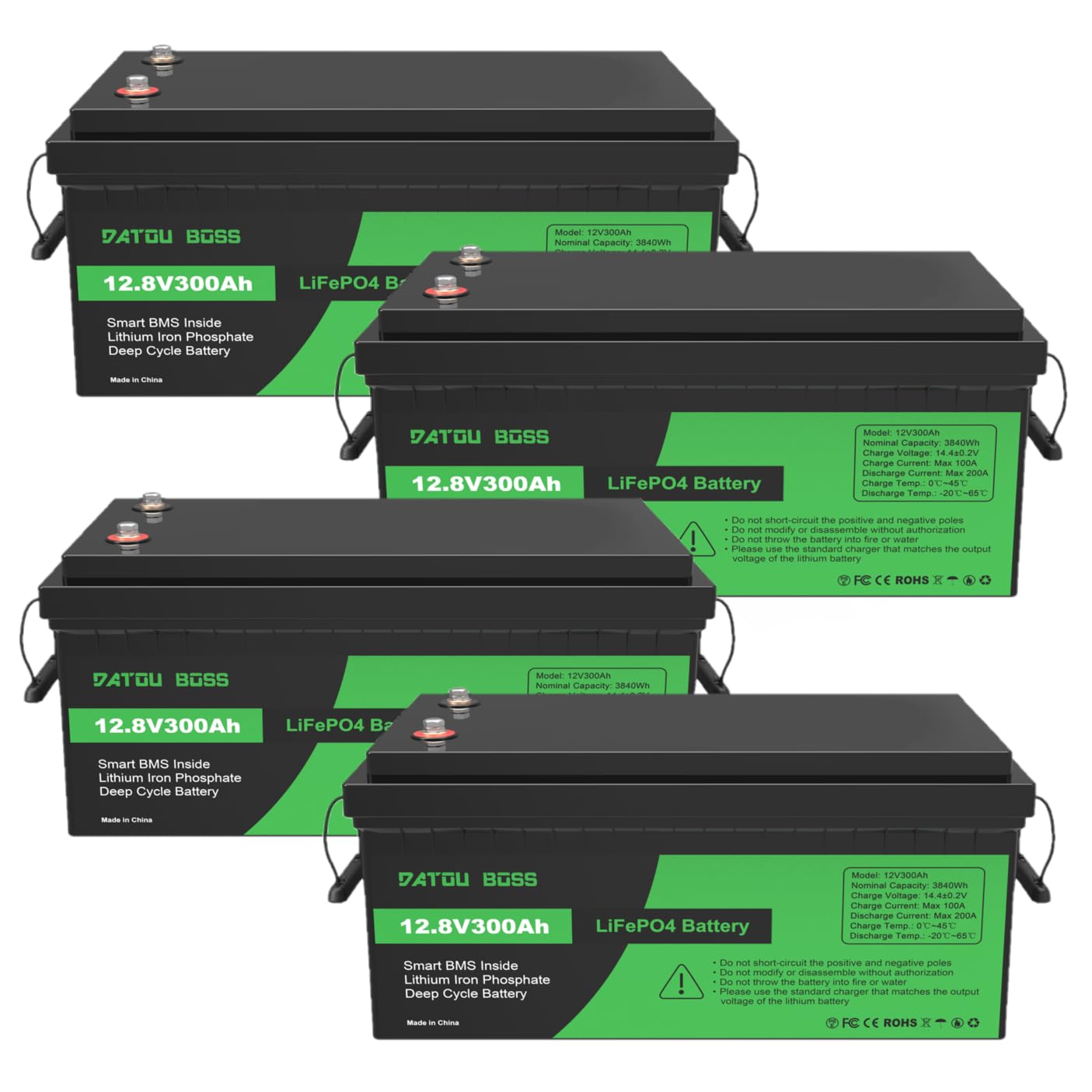
Figure 1: DATOUBOSS 12V 300Ah LiFePO4 Battery highlighting its intelligent BMS and Class A battery cells. Key features include 3840Wh capacity, 200A rated discharge current, Max 100A charging current, and Max 240A discharge current, along with protections for overcharge, overcurrent, high temperature, overdischarge, and short circuit.
2. Safety Information
Always adhere to the following safety guidelines to prevent injury, damage to the battery, or other property.
- Do not short-circuit the positive and negative terminals of the battery. This can cause severe damage to the battery and pose a fire hazard.
- Do not modify or disassemble the battery without authorization. Unauthorized modifications can compromise safety and void the warranty.
- Do not expose the battery to fire or water. LiFePO4 batteries are generally safe, but extreme conditions can lead to dangerous situations.
- Use a dedicated charger that matches the output voltage and current requirements of the lithium battery. Using an incompatible charger can damage the battery.
- Ensure proper ventilation during charging and discharging to prevent heat buildup.
- Keep the battery away from children and pets.
- Wear appropriate personal protective equipment (PPE), such as gloves and eye protection, when handling batteries.
- In case of fire, use a Class D fire extinguisher. Water or standard ABC extinguishers may not be effective on lithium battery fires.
3. Setup and Installation
3.1 Unpacking and Inspection
- Carefully remove the battery from its packaging.
- Inspect the battery for any visible damage. If damage is found, contact customer support immediately.
- Verify that all components listed in the packing list are present.
3.2 Connection Guidelines
The DATOUBOSS 12V 300Ah LiFePO4 battery supports both series and parallel connections to meet various power requirements.
- Parallel Connection (Max 4P): Connect batteries in parallel to increase total capacity while maintaining the nominal voltage (12V). Ensure all batteries are at a similar state of charge before connecting in parallel.
- Series Connection (Max 4S): Connect batteries in series to increase the total voltage (e.g., 25.6V, 38.4V, 51.2V). Ensure all batteries have the same capacity and are fully charged before connecting in series.
- Combined Series-Parallel (Max 4P4S): For advanced systems, up to 16 batteries can be connected in a 4P4S configuration to achieve a 51.2V 1200Ah system.
- Always use appropriate cables and connectors rated for the expected current.
- Ensure all connections are tight and secure to prevent resistance and overheating.

Figure 2: Example of building a power supply system using DATOUBOSS LiFePO4 batteries for mobile applications, demonstrating their smaller size and lighter weight.

Figure 3: Illustration of DATOUBOSS LiFePO4 batteries configured for a home energy storage system, supporting up to 4P4S for 61440Wh expandable power.
4. Operating Instructions
4.1 Charging
- Use a LiFePO4 compatible charger with a maximum charging current of 100A.
- Ensure the charger's voltage matches the battery system's voltage (e.g., 14.4V-14.6V for a single 12V battery).
- The built-in BMS protects against overcharging. However, it is recommended to disconnect the charger once the battery is fully charged.
- Charging temperature range: 0°C to 45°C (32°F to 113°F).
4.2 Discharging
- The maximum continuous discharge current is 200A. The maximum peak discharge current is 240A.
- The BMS will automatically cut off power if the discharge current exceeds the limit or if the battery voltage drops too low (over-discharge protection).
- Discharging temperature range: -20°C to 60°C (-4°F to 140°F).
- Avoid deep discharges below 10% state of charge for optimal battery life, although the battery supports 100% DOD.
5. Maintenance
- Regular Inspection: Periodically check the battery terminals for corrosion or loose connections. Clean terminals with a wire brush if necessary.
- Cleaning: Keep the battery clean and dry. Wipe down the battery case with a damp cloth. Do not use solvents or harsh chemicals.
- Storage: If storing the battery for an extended period, charge it to approximately 50-70% of its capacity. Store in a cool, dry place away from direct sunlight and extreme temperatures. Recharge every 3-6 months to prevent self-discharge.
- Temperature: Operate and store the battery within the recommended temperature ranges to maximize lifespan.
6. Troubleshooting
The built-in BMS provides extensive protection. If the battery stops functioning, it may be due to a BMS protection trigger.
- Battery not charging:
- Check charger connection and ensure it is a LiFePO4 compatible charger.
- Verify the charger's output voltage matches the battery's nominal voltage.
- The BMS may have triggered over-discharge protection. Try connecting a compatible charger; the BMS should reset automatically.
- Ensure charging temperature is within 0°C to 45°C.
- Battery not discharging (no power output):
- Check all connections for looseness or corrosion.
- The BMS may have triggered over-current, over-discharge, or high/low-temperature protection.
- Disconnect the load for a few minutes, then reconnect. The BMS should reset if the fault condition is no longer present.
- Ensure discharging temperature is within -20°C to 60°C.
- Reduced capacity or runtime:
- Ensure the battery is being fully charged.
- Check for excessive loads that might be drawing more current than expected.
- Verify ambient operating temperatures are within optimal range.
If troubleshooting steps do not resolve the issue, please contact DATOUBOSS customer support.
7. Specifications
| Feature | Specification |
|---|---|
| Model Number | 300AH |
| Nominal Voltage | 12.8V |
| Nominal Capacity | 300Ah |
| Energy | 3840Wh |
| Built-in BMS | 200A |
| Max Continuous Charge Current | 100A |
| Max Continuous Discharge Current | 200A |
| Peak Discharge Current | 240A (for 3-5 seconds) |
| Cycle Life | 8000+ cycles (at 100% DOD) |
| Charging Temperature | 0°C to 45°C (32°F to 113°F) |
| Discharging Temperature | -20°C to 60°C (-4°F to 140°F) |
| Dimensions (L x W x H) | 20.45 x 9.33 x 8.55 inches |
| Weight | 30 kg (66 lbs) |
| Terminal Type | M8 |

Figure 4: Visual comparison highlighting the advantages of DATOUBOSS LiFePO4 batteries over traditional 12V 300Ah lead-acid batteries in terms of weight, depth of discharge, cycle life, and lifespan.

Figure 5: Detailed view of the DATOUBOSS LiFePO4 battery's internal structure, emphasizing the professional and safer BMS, battery stability, 10-year lifetime, higher energy density, and 3840W charging power.
8. Warranty and Support
8.1 Warranty Information
Please refer to the product packaging or the official DATOUBOSS website for the most up-to-date warranty terms and conditions. Generally, DATOUBOSS products are covered by a limited warranty against defects in materials and workmanship.
8.2 Customer Support
For technical assistance, troubleshooting, or warranty claims, please contact DATOUBOSS customer support. We offer 24-hour technical support to assist you with any inquiries.
Contact Information:
Please visit the official DATOUBOSS website or refer to your purchase documentation for specific contact details.


