
1. Safety Information
Read and understand all instructions before using the Greteefor Double Block and Tackle Pulley System. Failure to follow these instructions may result in serious injury or property damage.
- Load Capacity: Never exceed the rated load capacity of 7200 LB (32KN) for the pulleys and 7700 LB (35KN) for the rope. Always use the lower of the two ratings as your maximum safe working load.
- Inspection: Before each use, thoroughly inspect all components (pulleys, rope, anchor points) for signs of wear, damage, or degradation. Do not use if any component is compromised.
- Anchor Points: Ensure all anchor points are structurally sound and capable of safely supporting the intended load plus a significant safety margin.
- Rope Compatibility: The pulleys are designed for ropes up to 15mm (3/5'') in diameter. Using ropes outside this specification may lead to malfunction or failure.
- Personal Protective Equipment: Always wear appropriate safety gear, including gloves and eye protection, when operating the pulley system.
- Clearance: Maintain a clear path for the rope and the lifted object. Keep hands, feet, and other body parts away from moving parts.
- Supervision: Do not leave a suspended load unattended.
2. Product Overview
The Greteefor Double Block and Tackle Pulley System is engineered for efficient heavy lifting, offering a 4:1 mechanical advantage. This system reduces the effort required to lift objects, making it suitable for various applications without the need for electricity.
Key Features:
- 4:1 Effort Reduction: Lift heavy objects with approximately one-quarter of the force.
- Dual CE-Certified Pulleys: Constructed from forged aluminum for rust and wear resistance, supporting loads up to 32KN (7200 LB). The 2-inch twin pulleys accommodate ropes up to 15mm (3/5'') for smooth operation.
- High-Strength Rope: Includes a 150-ft (46m) long, 1/2'' (12mm) polyester braided rope with a breaking strength of 35KN (7700 lbs).
- Versatile Applications: Ideal for garage and attic hoisting, logging, hunting, vehicle or boat recovery, rock climbing, and other high-altitude tasks.

Image: The pulley system in various use cases, demonstrating its wide application for lifting, lowering, pulling, and tensioning loads.
3. Package Contents
Verify that all items are present and undamaged upon opening the package:
- 2 x Double Pulley Blocks (Forged Aluminum)
- 1 x 150-ft (46m) x 1/2'' (12mm) Polyester Braided Rope
4. Specifications
| Feature | Detail |
|---|---|
| Manufacturer | Greteefor |
| Part Number | HLSS-150 |
| Model Number | 1/2'' x 150ft |
| Item Weight | 4.5 kg |
| Product Dimensions | 18 x 18 x 30 cm |
| Pulley Material | Forged Aluminum, Ball Bearings |
| Pulley Breaking Strength | 32KN / 7200 lbs |
| Max. Rope Diameter (Pulleys) | 15mm (0.59 inches) |
| Rope Length | 150 ft (46m) |
| Rope Diameter | 1/2 inch (12mm) |
| Rope Material | Polyester Braided |
| Rope Breaking Strength | 35KN / 7700 lbs |
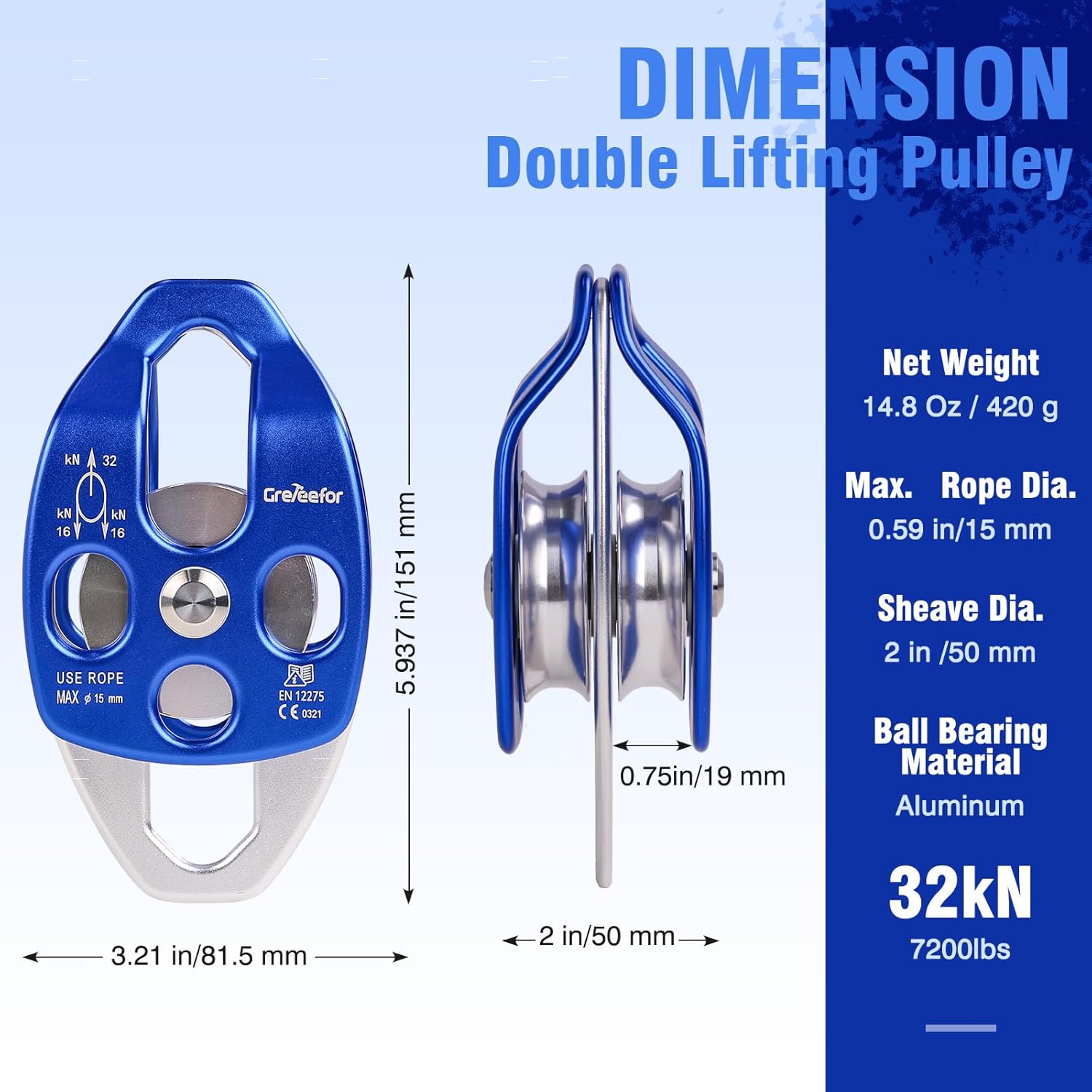
Image: Detailed dimensions of the double lifting pulley, showing net weight, max rope diameter, sheave diameter, and breaking strength.
5. Setup and Assembly
The pulley system is designed for quick and easy setup. Follow these steps to assemble your block and tackle system:
- Secure the Rope: Firmly attach one end of the rope to the attachment point of one pulley block. Ensure the knot is secure and appropriate for the load.
- Guide the Rope (First Pass): Swing the movable pulley block to allow the rope to pass around its back sheave.
- Complete the Loop (Second Pass): Guide the rope back towards the fixed pulley block, passing it around its front sheave. This creates the 4:1 mechanical advantage.
- Ready to Lift: Your pulley system is now reeved and ready for use. Attach the object you wish to lift to the free-moving pulley block, ensuring it is securely fastened.

Image: Visual representation of the four assembly steps: securing the rope, guiding it through the movable pulley, completing the loop through the fixed pulley, and preparing for lift.
6. Operating Instructions
Once assembled, operate the pulley system with care and attention to safety.
- Anchor Securely: Always ensure both the fixed pulley and the object being lifted are attached to stable and strong anchor points.
- Maintain Rope Alignment: Keep the rope free from twists and ensure it runs smoothly through the pulley sheaves. Avoid sudden jerks or movements.
- Smooth Lifting: Apply steady, even force to the free end of the rope to lift the load. The 4:1 mechanical advantage will significantly reduce the required effort.
- Controlled Lowering: To lower the load, slowly release tension on the rope, maintaining control at all times. Do not allow the rope to slip freely.
- Avoid Obstructions: Ensure the load and rope do not snag on any obstacles during lifting or lowering.
7. Maintenance
Regular maintenance will prolong the life and ensure the safe operation of your pulley system.
- Routine Inspection: Before and after each use, inspect the pulleys for any signs of damage, cracks, or excessive wear on the sheaves. Check the rope for fraying, cuts, or weak spots.
- Cleaning: Clean the pulleys and rope as needed. Use a damp cloth to wipe down metal parts. For the rope, follow manufacturer guidelines for cleaning if it becomes excessively dirty. Ensure all components are dry before storage.
- Lubrication: The pulley bearings are designed for smooth operation. If any stiffness is noted, a light application of a suitable lubricant may be applied to the axle points, avoiding contact with the rope path.
- Storage: Store the pulley system in a clean, dry place, away from direct sunlight, extreme temperatures, and corrosive chemicals. Coil the rope neatly to prevent tangles.
- Replacement: Replace any damaged or excessively worn components immediately. Do not attempt to repair damaged pulleys or ropes.
8. Troubleshooting
If you encounter issues during operation, refer to the following common problems and solutions:
| Problem | Possible Cause | Solution |
|---|---|---|
| Rope jams or snags | Improper reeving; twisted rope; obstruction in path | Check reeving according to assembly steps; untwist rope; clear any obstructions. |
| Difficulty lifting load | Load exceeds capacity; excessive friction; incorrect reeving | Verify load is within safe limits; inspect pulleys for debris or damage; re-reeve the system correctly. |
| Pulleys making unusual noises | Debris in bearings; damaged sheaves; lack of lubrication | Clean pulleys thoroughly; inspect for damage and replace if necessary; apply light lubricant if needed. |
| Rope shows signs of wear quickly | Rough edges on pulleys; improper use; abrasive environment | Inspect pulleys for sharp edges; ensure smooth operation; avoid dragging rope over rough surfaces. |
9. Warranty and Support
For product support or inquiries, please contact the manufacturer:
- Manufacturer: Greteefor
- Email Support: Support@greteefor.com
Please note that specific warranty details are not provided in this manual. For warranty information, please contact Greteefor directly via the provided support email.