
Litime L-HYBINV-48V3KW-S
LiTime 3500W Pure Sine Wave Solar Inverter Charger User Manual
Model: L-HYBINV-48V3KW-S | Brand: LiTime
1. Introduction
This manual provides detailed instructions for the installation, operation, and maintenance of your LiTime 3500W Pure Sine Wave Solar Inverter Charger. This all-in-one unit integrates an MPPT controller, inverter, and charger, designed for efficient off-grid power, home energy storage, and cabin use. It features a peak surge of up to 6000W and delivers pure sine wave output. Please read this manual thoroughly before installation and use to ensure proper function and safety.
2. Package Contents
Upon unboxing, verify that all components listed below are present and undamaged. The inverter is securely packaged with foam padding to prevent damage during transit.
Video 2.1: LiTime 3500W Pure Sine Wave Solar Inverter Charger Unboxing and Overview. This video demonstrates the unboxing process and provides an initial look at the inverter unit and its included accessories.
- LiTime 3500W Pure Sine Wave Solar Inverter Charger Unit
- Quick Start Guide
- User Manual
- Accessory Bag containing:
- Copper Wire Connectors (8 pcs)
- M6*25/64"[10mm] Battery Post Bolts (2 pcs)
- M6 Battery Wire Lugs (2 pcs)
- Terminal Panel Spare Screws (4 pcs)
- MC4 Connectors (2 pairs)
- Plastic Anchors
- Self-tapping Screws (for Panel Mount) (2 pcs)
- Slotted Screwdriver (1 pc)
- Heat Shrink Tubing (for PV&AC) (8 pcs)
- Heat Shrink Tubing (for Battery) (2 pcs)

Figure 2.1: Additional Components. This image displays the various connectors, screws, and tools included in the accessory bag for installation.
3. Product Features
- All-in-One Space Saving Design: Integrates an MPPT controller, inverter, and charger into a single unit, optimizing installation space. Offers a peak surge of up to 6000W for efficient auto solar tracking and pure sine wave output.
- Smart Energy Manager: Supports four charging modes (Solar Only, Utility Priority, Solar Priority, Hybrid) and multiple output modes (Inverter Priority, PV Priority, Utility Priority) for flexible energy use and cost savings.
- UPS Function: Built-in Uninterruptible Power Supply (UPS) function ensures continuous power by automatically switching to battery backup during outages. Compatible with 48V lead-acid, lithium, and user-defined battery types.
- Reliable and Protective Design: Features intelligent cooling fans and comprehensive protection against short-circuit, over-temperature, and overload for stable and long-lasting performance.
- Advanced Communication & Integration: Supports RS485 for monitoring battery status (undervoltage/overvoltage/overcurrent) and includes a built-in LCD display for real-time monitoring of battery, solar, and AC status.

Figure 3.1: Inverter Components. This image highlights key components such as the LCD Screen, LED Indicators, Operation Buttons, Air Inlet Vent, AC Input Breaker, and Terminal Panel.
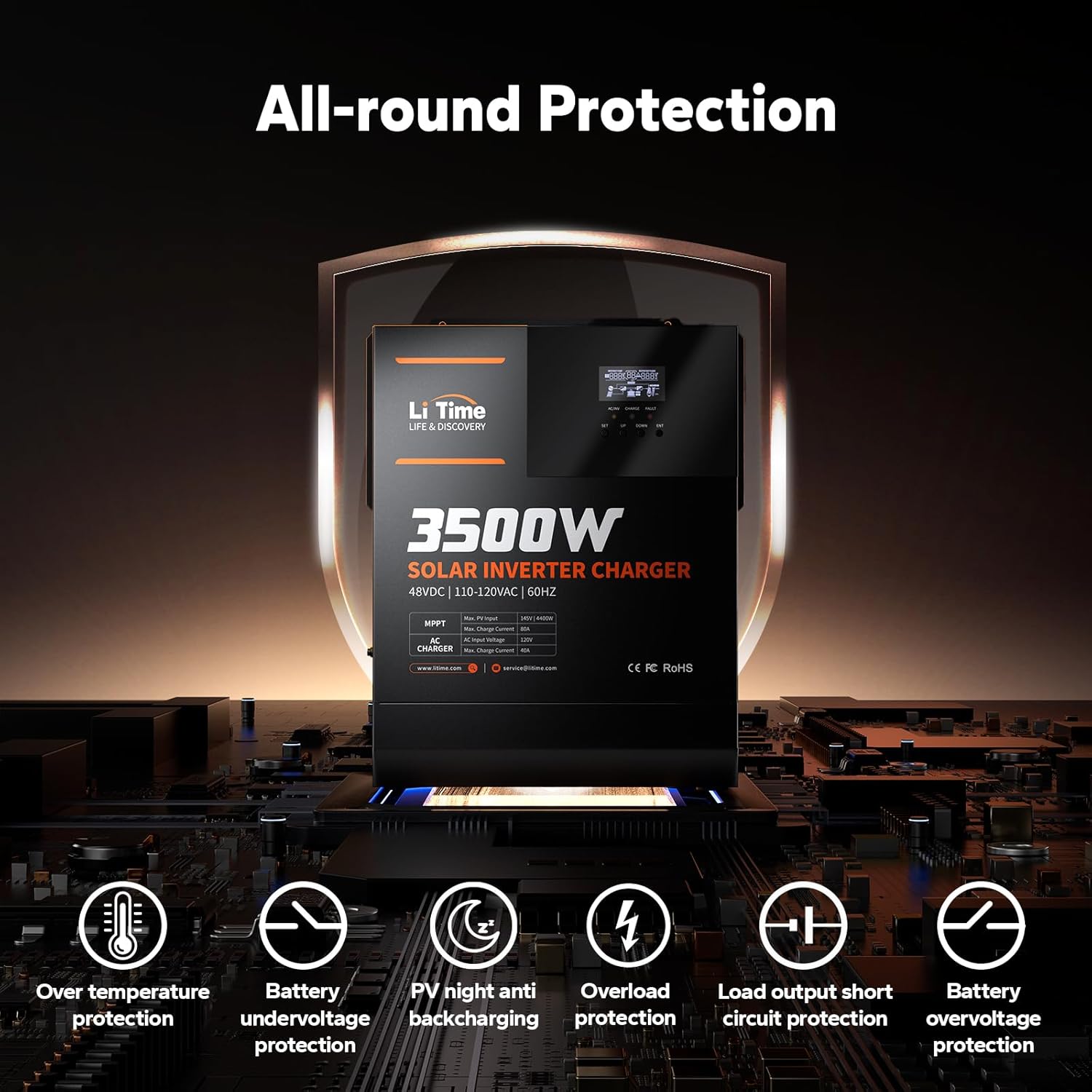
Figure 3.2: All-round Protection. Illustrates the inverter's protection mechanisms including over-temperature, battery undervoltage, PV night anti-backcharging, overload, load output short circuit, and battery overvoltage protection.
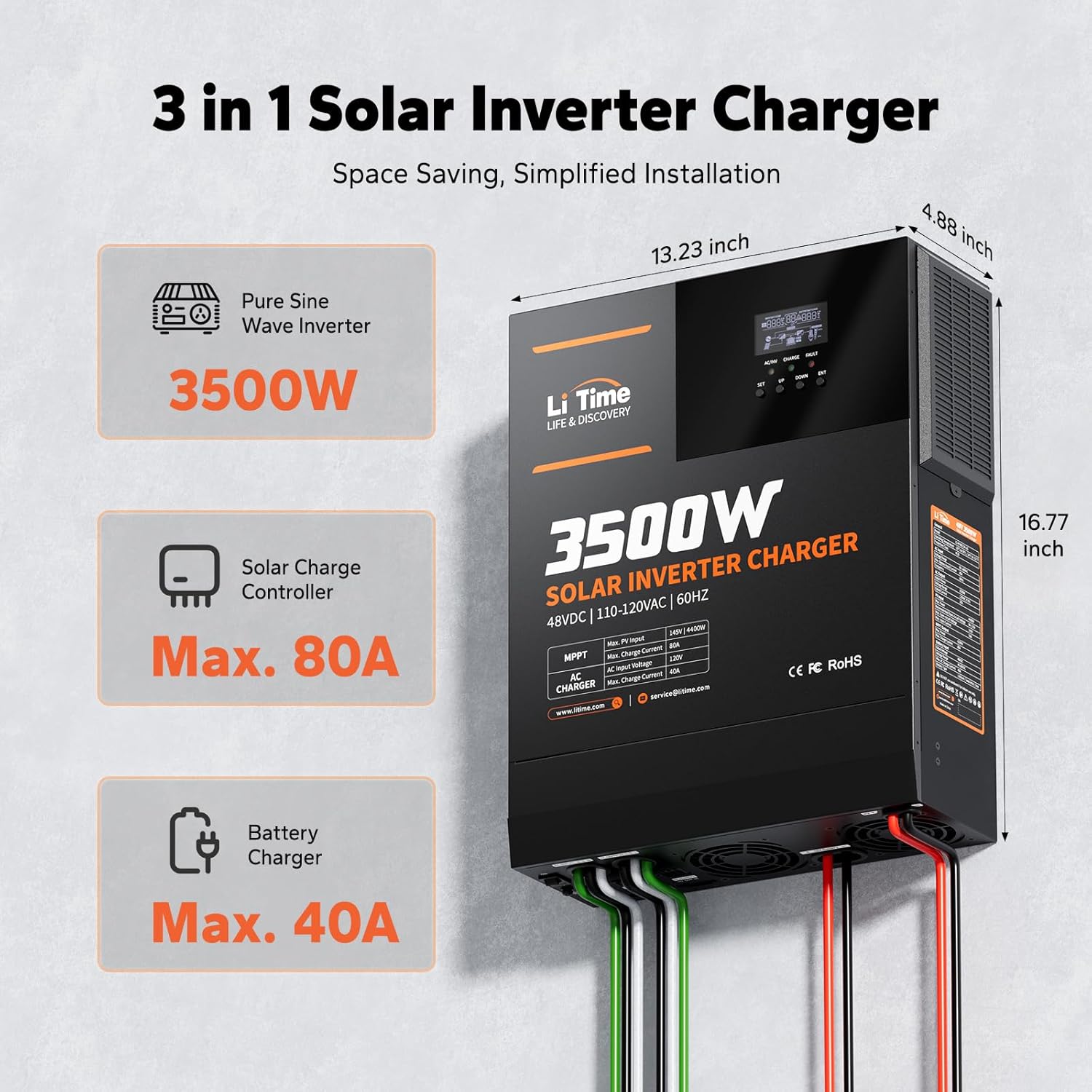
Figure 3.3: 3-in-1 Solar Inverter Charger. This diagram shows the integrated Pure Sine Wave Inverter (3500W), Solar Charge Controller (Max. 80A), and Battery Charger (Max. 40A), along with the unit's dimensions.
4. Setup and Installation
Proper installation is crucial for the safe and efficient operation of your inverter. Ensure all connections are secure and follow local electrical codes.
4.1 Mounting the Inverter
Mount the inverter on a non-flammable surface in a well-ventilated area. Use the provided mounting bracket and screws. Ensure sufficient clearance around the unit for airflow.

Figure 4.1: Rear Panel Connections. This image labels the On/Off Switch, Ground Terminal, AC Input/Output Terminal Blocks, USB-B Port, RS485 Port, Dry Contact Ports, Cooling Fans, Battery Positive and Negative Terminals, and PV Input Terminals.
4.2 Wiring Connections
Before making any connections, ensure the inverter is turned OFF and all power sources (solar, battery, AC grid) are disconnected. Connect the battery, solar panels, and AC input/output according to the diagram below. Use appropriate cable sizes and circuit breakers as recommended in the specifications.

Figure 4.2: Typical System Wiring Diagram. This diagram illustrates how the inverter connects to solar panels, a battery system, AC grid, a generator, and household loads. Note that utility power and generator AC cannot be used simultaneously.
- Battery Connection: Connect the 48V battery bank to the designated battery terminals. Ensure correct polarity.
- PV Input: Connect your solar panel array to the PV input terminals. Verify that the open-circuit voltage and maximum power of your solar array are within the inverter's specified limits.
- AC Input: Connect the AC grid or a generator to the AC input terminal block.
- AC Output: Connect your household loads or distribution panel to the AC output terminal block.
- Grounding: Ensure the inverter is properly grounded to prevent electrical hazards.
Warning: Avoid mismatched voltages to prevent system damage. The utility power and generator AC cannot be connected to AC input simultaneously.
5. Operating Modes
The LiTime inverter offers flexible charging and output modes to optimize energy management.
5.1 Charging Modes
- Solar Only: Prioritizes solar power for charging.
- Utility Priority: Prioritizes AC utility power for charging.
- Solar Priority: Uses solar power first, then supplements with utility power if needed.
- Hybrid: Combines solar and utility power for optimal charging.
5.2 Output Modes
- Inverter Priority: Prioritizes battery power through the inverter.
- PV Priority: Prioritizes solar power for loads.
- Utility Priority: Prioritizes AC utility power for loads.

Figure 5.1: Comprehensive Energy Management Solution. This diagram visually explains the four charging modes and three output modes available for flexible energy use.
6. Specifications
| Feature | Value |
|---|---|
| Model Name | 3500W 48V All-in-One Solar Inverter Charger |
| Wattage | 3500 watts |
| Power Source | Grid/Solar/Battery Powered |
| Recommended Uses | Home, Off-grid Cabin |
| Product Dimensions | 16.77 x 13.22 x 4.88 inches |
| Item Weight | 23.1 pounds |
| Item Model Number | L-HYBINV-48V3KW-S |
| Operating Temperature | -10°C to 55°C / 14°F to 131°F |
| Protection Class | IP20 |
| AC Input Voltage Range | 90-140VAC |
| Max. Bypass Input Current | 40A |
| AC Output Rated Power | 3500W |
| AC Output Voltage | 120VAC ±5% |
| Max. PV Input Power | 4400W |
| Recommended Open-circuit Voltage | 60-115V |
| Max. Open-circuit Voltage | 145V |
| Max. Input Current | 50A |
| MPPT Output Max. Power | 4200W |
| Max. Charge Current | 80A |
| Battery Input Rated Voltage | 48VDC |
| Battery Input Voltage Range | 40-60VDC |
| Max. AC Charge Current | 40A |
| Battery Type | Lithium / Lead Acid / User |
7. Maintenance
Regular maintenance ensures the longevity and optimal performance of your LiTime inverter.
- Ventilation: Ensure the air inlet vents are clear of dust and debris to maintain proper cooling.
- Environment: Keep the inverter in a dry, well-ventilated area, away from direct sunlight and moisture.
- Connections: Periodically check all wiring connections for tightness and signs of corrosion.
- Cleaning: Clean the exterior of the inverter with a dry, soft cloth. Do not use liquid cleaners.
- Inspection: Regularly inspect the unit for any visible damage or unusual operation.
Warning: Do not disassemble the inverter. Refer to qualified personnel for any internal repairs.
8. Troubleshooting
If you encounter issues with your inverter, refer to the following basic troubleshooting steps. For complex problems, contact customer support.
- No Power/Display: Check battery connections, main power switch, and any external circuit breakers.
- Error Codes: The LCD display will show error codes for specific issues. Consult the full user manual for a complete list of codes and their remedies. For example, Error Code 58 typically indicates a low battery condition or an overvoltage alarm if battery settings are incorrect.
- No AC Output: Verify that the inverter is turned on, battery voltage is sufficient, and no overload or short-circuit conditions are present. Check AC output connections.
- No Charging: Ensure solar panels are connected and receiving sunlight, or AC input is active. Check charging mode settings.
- Overload Protection: If the inverter shuts down due to overload, reduce the connected load and restart the unit.
9. Warranty and Support
LiTime is committed to providing reliable products and excellent customer service.
- Warranty: The product comes with a comprehensive warranty. Please refer to the warranty card included in your package or visit the official LiTime website for details on coverage and duration (up to 5-Year Service is available).
- Customer Support: For technical assistance, troubleshooting, or warranty claims, please contact LiTime customer support.
- Website: www.litime.com
- Email: service@litime.com
- Support is available with a 24-hour prompt response.
10. Applications
The LiTime 3500W Solar Inverter Charger is versatile and suitable for various applications requiring reliable off-grid power.
- Home Energy Storage Systems
- Off-grid Cabins and Remote Residences
- RV and Marine Applications
- Backup Power Solutions
- Solar Power Systems
- Garages and Workshops

Figure 10.1: Wide Application. This image demonstrates the diverse environments where the LiTime inverter can be effectively utilized, including residential homes, farms, dedicated solar systems, and garages.
Related documentsL-HYBINV-48V3KW-S


Ask a question about this manual
Ask about setup, troubleshooting, compatibility, parts, safety, or missing instructions. Manuals+ will review the question and use this page’s manual context to help answer it.