
Introduction
This manual provides essential instructions for the safe operation, setup, and maintenance of your Actualia FLYWING Bell-206-V2 RC Helicopter. Please read this manual thoroughly before operating the helicopter to ensure proper function and to prevent damage or injury.
Important Safety Guidelines
- Operate the helicopter in open areas, away from people, animals, and obstacles.
- Always maintain a safe distance from the rotating blades.
- Do not operate in strong winds or adverse weather conditions.
- Ensure all parts are securely fastened before each flight.
- Keep hands and face clear of the helicopter during operation.
- Adult supervision is recommended for users under 14 years of age.
- Do not attempt to modify the helicopter or its components.
- Use only approved charging equipment and batteries.
Package Contents
Upon opening the package, verify that all items are present and in good condition:
- Assembled Fuselage (1)
- Handcrafted Painted Integrated Shell (1)
- Handcrafted Painted Head Cover (1)
- Battery (1)
- Digital Display Charger (1)
- Remote Control Transmitter (1)
- Spare Main Rotor Blades (1 pair)
- Spare Tail Rotor Blades (1 pair)
- Screwdriver and small parts (for maintenance)
- User Manual (this document)

Image: The Bell-206-V2 helicopter, remote control, battery, and charger as included in the RTF package.
Component Identification
Helicopter Overview

Image: Front-side view of the Bell-206-V2 RC Helicopter.
The Bell-206-V2 RC Helicopter features a realistic scale design. Key components include:
- Main Rotor Blades: Provide lift and control.
- Tail Rotor: Controls yaw (left/right rotation) and counteracts main rotor torque.
- Fuselage: The main body, housing electronics and battery.
- Landing Skids: Support the helicopter during takeoff and landing.
- Battery Compartment: Located on the underside of the fuselage.
- H1 Flight Controller: Integrated system for stable flight and advanced features.
- Brushless Motors: Provide efficient and powerful propulsion for main and tail rotors.
Remote Control Transmitter

Image: The remote control transmitter with various sticks and buttons.
The remote control features:
- Left Stick (Throttle/Yaw): Controls altitude and left/right rotation.
- Right Stick (Pitch/Roll): Controls forward/backward and left/right movement.
- Power Switch: Turns the remote on/off.
- Trim Buttons: For fine-tuning flight stability.
- One-Key Takeoff/Landing Button: Initiates or concludes flight automatically.
- Flight Mode Switch: Selects between different flight modes (e.g., GPS Stabilized, 3D Manual).
- Return-to-Home Button: Activates the automatic return function.
Setup Instructions
1. Charging the Helicopter Battery
- Connect the provided digital display charger to a power source.
- Connect the helicopter battery to the charger.
- Monitor the digital display for charging status. The battery is fully charged when the indicator shows completion.
- Disconnect the battery once fully charged. Do not overcharge.
2. Installing Batteries in the Remote Control
- Open the battery compartment on the back of the remote control.
- Insert the required batteries (typically AA, not included) according to the polarity markings.
- Close the battery compartment securely.
3. Installing the Helicopter Battery
- Locate the battery compartment on the underside of the helicopter.
- Carefully insert the charged battery into the compartment, ensuring a snug fit.
- Connect the battery cable to the helicopter's power port.
- Secure the battery compartment cover if applicable.
4. Propeller Check
Before the first flight, and periodically thereafter, ensure the main and tail rotor blades are securely attached and free from damage. If any blades are damaged, replace them with the provided spares using the screwdriver.
Operating Instructions
1. Power On and Binding
- Place the helicopter on a flat, level surface.
- Turn on the helicopter's power switch. The indicator lights will flash.
- Turn on the remote control. The remote will automatically bind with the helicopter. A solid light on both devices indicates successful binding.
2. Basic Flight Controls
- One-Key Takeoff: Press the dedicated "Takeoff" button on the remote. The helicopter will automatically ascend to a stable hovering altitude.
- Throttle (Left Stick Up/Down): Increases or decreases altitude.
- Yaw (Left Stick Left/Right): Rotates the helicopter left or right on its vertical axis.
- Pitch (Right Stick Up/Down): Moves the helicopter forward or backward.
- Roll (Right Stick Left/Right): Moves the helicopter sideways (strafe) left or right.
- One-Key Landing: Press the dedicated "Landing" button. The helicopter will automatically descend and land.
3. Advanced Flight Modes and Features
- GPS Stabilized Mode: Provides automatic and precise hovering, ideal for beginners.
- 3D Manual Mode: Offers high-speed responsiveness for aerobatic maneuvers like flips, rolls, and inverted flight.
- One-Key Return: Activates automatic return to the takeoff point.
- Low Battery Return: Helicopter automatically returns to the takeoff point when battery is low.
- Loss of Control Return: Helicopter automatically returns if signal is lost.
- One-Key Inverted Flight: Allows for quick inversion for advanced maneuvers.
- Semi-Autonomous Assisted Flight: Supports pre-determined flight paths such as circular motion and figure-8 routes.
4. Flight Tips
- Start with GPS Stabilized Mode for learning.
- Practice hovering and gentle movements before attempting advanced maneuvers.
- Always keep the helicopter within visual range.
- Monitor battery levels to ensure safe return.
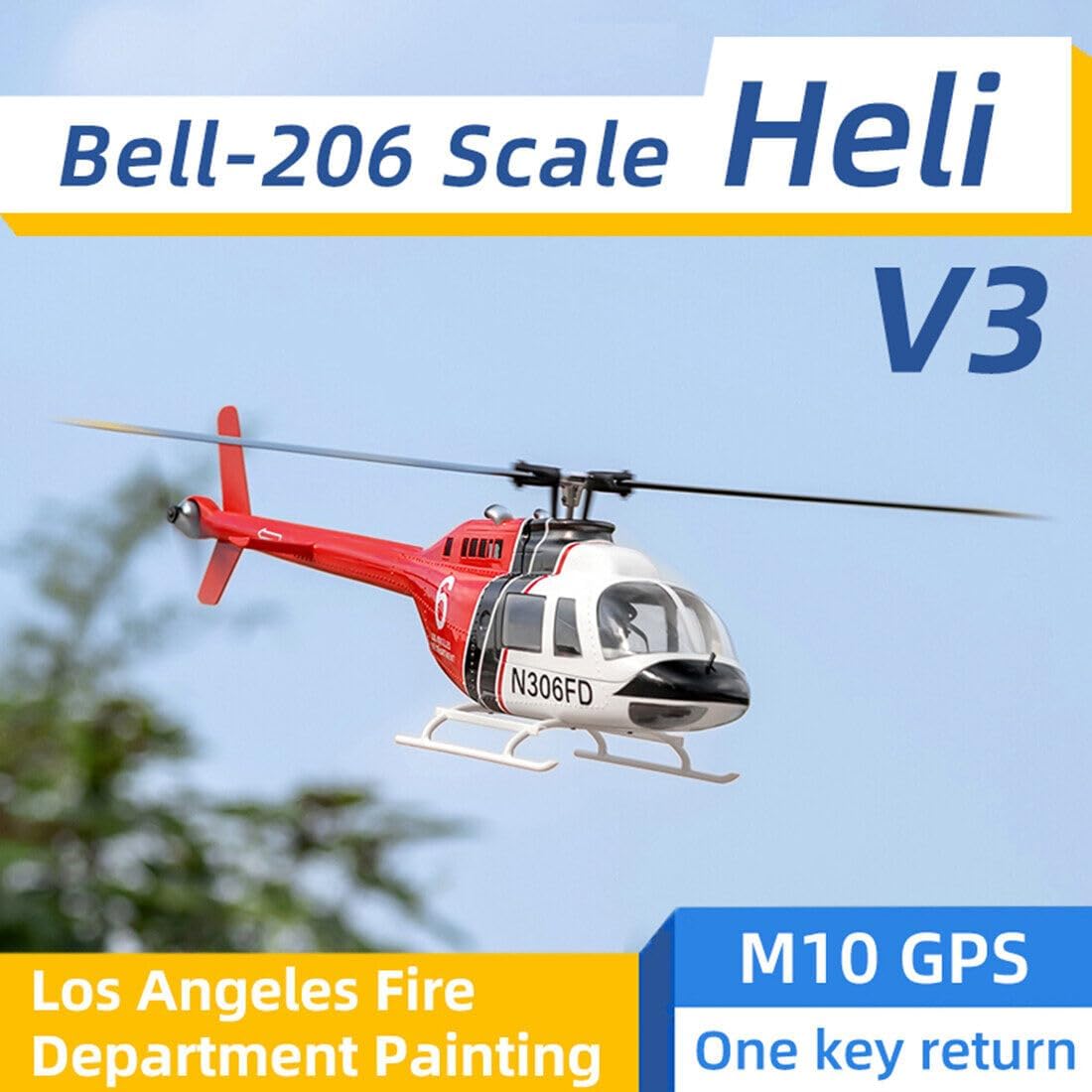
Image: The Bell-206-V2 RC Helicopter flying outdoors.
Maintenance
- Cleaning: Use a soft, dry cloth to clean the helicopter after each flight. Avoid water or harsh chemicals.
- Blade Inspection: Regularly check main and tail rotor blades for cracks, bends, or damage. Replace damaged blades immediately.
- Screw Tightness: Periodically inspect all screws, especially those on the main rotor clamp axle and tail rotor, and tighten if necessary.
- Storage: Store the helicopter and remote control in a cool, dry place, away from direct sunlight and extreme temperatures. Remove batteries from the remote for long-term storage.
Troubleshooting
| Problem | Possible Cause | Solution |
|---|---|---|
| Helicopter does not respond to remote. | Not bound, low remote battery, helicopter battery low. | Ensure proper binding. Replace remote batteries. Charge helicopter battery. |
| Helicopter drifts during hover. | Improper trim settings, strong wind. | Adjust trim buttons on the remote. Fly in calmer conditions. |
| Helicopter does not take off. | Low helicopter battery, damaged blades. | Charge helicopter battery. Inspect and replace damaged blades. |
| Unusual noise or vibration. | Damaged blades, loose screws. | Inspect and replace damaged blades. Check and tighten all screws. |
Specifications
| Feature | Detail |
|---|---|
| Fuselage Length (without paddles) | 700mm |
| Fuselage Height | 195mm |
| Fuselage Width | 120mm |
| Weight (without battery) | 790g |
| Main Rotor Diameter (Wingspan) | 805mm |
| Main Rotor Length (Single) | 360mm |
| Tail Rotor Diameter (Wingspan) | 164mm |
| Gear Spec | Motor Gear: 13T, Transmission Main Gear: 8T |
| Tail Drive Motor | 2008 Brushless Motor |
| Motor | 2816 Brushless Motor |
| ESC | 60A Dual Brushless ESC |
| Flight Modes | GPS Stabilized Mode, 3D Manual Mode, One-Key Return, Low Battery Return, Loss of Control Return, One-Key Inverted Flight, Semi-Autonomous Assisted Flight (Circular Motion, Figure-8 Route) |
| Satellite Positioning Module | GPS/GLONASS with Omni-Directional Positioning |
| Hovering Accuracy | Horizontal: ±1.5m, Vertical: ±0.5m (under normal GPS positioning mode) |
| Product Weight | 2000g (4.41 lbs) |
| Product Dimensions | 70 x 12 x 19.5cm (27.56 x 4.72 x 7.68 inches) |
| Recommended Age | 14+ years |
Warranty and Support
For warranty information, technical support, or replacement parts, please refer to the manufacturer's official website or contact their customer service department. Keep your purchase receipt as proof of purchase.