
PowMr PowMr 10kW 48V Hybrid Solar Inverter
Contents
PowMr 10000W Solar Inverter User Manual
Model: PowMr 10kW 48V Hybrid Solar Inverter
Brand: PowMr
Introduction
This manual provides detailed instructions for the installation, operation, and maintenance of your PowMr 10000W Solar Inverter. This off-grid hybrid inverter is designed to provide reliable power for various residential and commercial applications, featuring a built-in 120A MPPT charge controller and compatibility with 48V lead-acid and lithium batteries.

This image displays the overall design and front panel of the PowMr 10000W Solar Inverter, highlighting its robust construction and user interface.
Important Safety Information
Please read all instructions and warnings carefully before installation and operation. Failure to follow these instructions may result in electric shock, fire, or serious injury.
- Installation must be performed by qualified personnel in accordance with all local and national electrical codes.
- Ensure proper grounding of the inverter before connecting any power sources.
- Do not disassemble, repair, or modify the inverter. Refer all servicing to authorized service personnel.
- Disconnect all power sources (PV, AC input, and battery) before performing any maintenance or servicing.
- Protect the inverter from direct sunlight, rain, snow, and excessive moisture. Install in a dry, well-ventilated area.
- Ensure adequate ventilation around the inverter to prevent overheating. Maintain proper clearances as specified in the installation guide.
- This device contains high voltage. Exercise extreme caution during installation and operation.
The inverter includes multiple built-in protections: short circuit, overload, reverse polarity, overvoltage, and undervoltage, ensuring the safety of your circuits and connected appliances.
Product Overview
The PowMr 10000W Solar Inverter is a high-performance off-grid hybrid inverter with a robust design, including a large toroidal transformer for enhanced load-bearing capacity and stability.
Key Features:
- New 10KW Solar Hybrid Inverter: Compared to typical models, this inverter features a larger toroidal transformer, enhancing its load-bearing capacity with a peak power reaching 30000W. Suitable for various residential and commercial settings, it ensures higher stability and reliability in power output.
- Technical Parameters: Maximum PV input power: 6400W, MPPT input voltage range: 60-150VDC, Maximum AC input current: 60A, Maximum PV input current: 120A, Rated output power: 10000W (Peak power: 30000W), Output frequency: 50Hz/60Hz, Output voltage: 110Vac ±10%. (First start-up voltage > 60V).
- Strong Load Capacity: Through careful optimization and upgrading of traditional built-in transformers, this inverter can stably handle various high-load electrical equipment, including refrigerators, high-powered industrial machinery, and other electrical devices, ensuring stable operation.
- Circuit Safety Guard: Our hybrid inverter is equipped with multiple protections, including short circuit, overload, reverse, overvoltage, and undervoltage protections. Adopting advanced pure sine wave technology, it provides high-quality and stable AC power, effectively protecting electronic products and appliances, and prolonging their service life.
- Suitable for a variety of scenarios: This 48V solar inverter is compatible with various 48V battery types (such as LiCoMnNiO2, LiFePO4, AGM, Gel, etc.), featuring an intelligent battery charger design to optimize battery performance. Compatible with utility or generator power, it can be connected to all kinds of home and office loads. Provides three output modes (PV priority/utility priority/solar-only charging) and three charging modes (solar-only/utility priority/solar priority) to meet different needs.

This graphic summarizes the main technical capabilities of the PowMr 10000W Solar Inverter, emphasizing its power output, charging capacities, and starting voltage.

This image highlights the oversized toroidal transformers, which are central to the inverter's ability to handle high peak power loads of up to 30000W, significantly enhancing its stability and reliability.
Product Components:

This diagram illustrates the various external components of the PowMr solar inverter, including the toggle switch, AC input and output terminals, PV input terminal, communication port, battery circuit fuse, LCD screen, LED indicators, and LCD buttons.

This image demonstrates the inverter's compatibility with multiple battery types, including AGM, GEL, FLD, LI, and SLD, making it versatile for various energy storage setups in home and office environments.
Technical Specifications
| Parameter | Value |
|---|---|
| Product Dimensions | 20.08 x 15.16 x 25.98 inches |
| Item Weight | 120 pounds |
| Item Model Number | PowMr 10kW 48V Hybrid Solar Inverter |
| Frequency | 60 Hz |
| Color | 10000W 48Vdc to 110Vac(Peak Power: 30000W) |
| Manufacturer | PowMr |
| Recommended Uses | Office, Workshop, Home |
| Power Source | Solar and Battery Powered |
| Wattage | 10 KW |
| Max PV Input Power | 6400W |
| MPPT Input Voltage Range | 60-150VDC |
| Max AC Input Current | 60A |
| Max PV Input Current | 120A |
| Rated Output Power | 10000W (Peak power: 30000W) |
| Output Voltage | 110Vac ±10% |
| First Start-up Voltage | > 60V |
Setup and Installation
Proper installation is critical for the safe and efficient operation of your solar inverter. Please follow these guidelines carefully.
Site Selection:
- Install the inverter in a well-ventilated area, free from flammable materials and corrosive gases.
- Ensure the mounting surface can safely support the inverter's weight (120 pounds).
- Avoid direct sunlight and moisture. The operating environment should be dry and within specified temperature ranges.
Wiring Diagram:
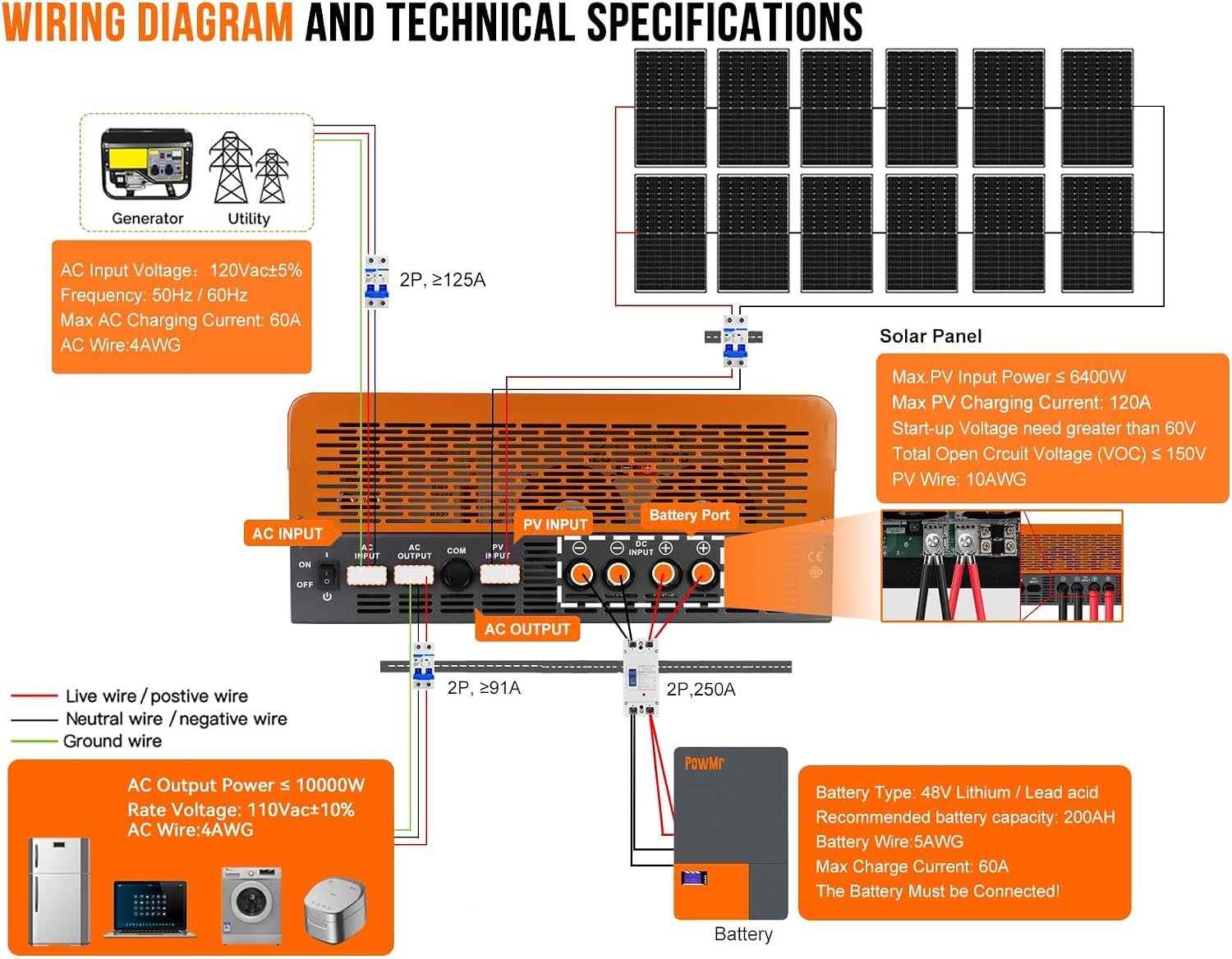
This diagram illustrates the recommended connections for the PowMr solar inverter, including solar panels, battery bank, utility grid, generator, and AC loads. It specifies wire gauges and current ratings for each connection point to ensure safe and efficient operation.
Connection Steps:
- Battery Connection: Connect the 48V battery bank to the inverter's battery terminals. Ensure correct polarity (positive to positive, negative to negative). Recommended battery capacity: 200AH.
- PV Input Connection: Connect your solar panels to the PV input terminals. Ensure the total PV input power does not exceed 6400W and the voltage is within the 60-150VDC MPPT range.
- AC Input Connection (Utility/Generator): Connect the utility grid or a compatible generator to the AC input terminals. The maximum AC input current is 60A.
- AC Output Connection (Loads): Connect your AC loads (appliances, etc.) to the AC output terminals. The rated output power is 10000W (peak 30000W) at 110Vac.
- Grounding: Ensure the inverter chassis is properly grounded to a reliable earth ground point.
- Initial Startup: The inverter requires a starting voltage greater than 60V. Note: Based on user feedback, the inverter may require solar or 240VAC input to initiate startup, it may not turn on with battery power only.
Operating Instructions
The inverter features an LED display for real-time charging information and LCD buttons for configuration and monitoring.
Operating Modes:

This image details the four safe charging modes and three output modes available on the PowMr solar inverter, allowing users to customize power management based on their needs.
Output Modes:
- PV Priority: Solar power is primarily used to power loads and charge batteries. Utility/generator power is used as a backup when solar power is insufficient.
- Utility Priority: Utility power is primarily used to power loads and charge batteries. Solar power is used when utility is unavailable or for supplementary charging.
- Inverter Priority (Solar-Only Charging): The inverter prioritizes drawing power from the battery/solar for loads, minimizing reliance on the utility grid.
Charging Modes:
- Solar-Only Charging: Batteries are charged exclusively by solar power.
- Utility Priority Charging: Utility power is prioritized for charging the batteries, with solar power acting as a supplement.
- Solar Priority Charging: Solar power is prioritized for charging the batteries, with utility power acting as a supplement when solar is insufficient.
LCD Display and Buttons:
Use the LCD buttons (ESC, UP, DOWN, ENTER) located on the front panel to navigate through the menus and configure settings displayed on the LCD screen. The display provides real-time information on system status, input/output parameters, and error codes. Refer to the on-screen prompts for specific parameter adjustments and monitoring.
Maintenance
Regular maintenance ensures the longevity and optimal performance of your inverter. Always disconnect all power sources before performing any maintenance.
- Cleaning: Periodically clean the inverter's exterior and ventilation openings to prevent dust buildup. Use a dry, soft cloth. Do not use liquid cleaners.
- Connections: Regularly check all electrical connections for tightness and signs of corrosion. Loose connections can cause overheating and damage.
- Ventilation: Ensure the area around the inverter remains clear and unobstructed for proper airflow. Blocked vents can lead to overheating.
- Battery Health: Monitor battery voltage and health according to the battery manufacturer's guidelines. Ensure batteries are properly maintained for optimal system performance.
- Environmental Conditions: Ensure the inverter continues to operate within its specified temperature and humidity ranges to prevent damage.
Troubleshooting
This section addresses common issues you might encounter during the operation of your PowMr solar inverter.
Common Issues and Solutions:
- Inverter does not turn on:
Cause: Insufficient input voltage from PV or battery, or specific startup requirements not met.
Solution: Ensure PV input voltage is above 60V for initial startup. Verify battery voltage is within the operational range. Some units may require solar or AC input to initiate startup, not just battery power. - No AC output:
Cause: Overload, short circuit, or internal fault.
Solution: Check for overloaded appliances. Disconnect loads and restart the inverter. Check for short circuits in wiring. If the issue persists, an internal fault may be present. - Battery not charging:
Cause: PV input issue, battery connection issue, or incorrect charging mode setting.
Solution: Verify PV panel connections and output. Check battery connections for tightness and corrosion. Ensure the correct charging mode is selected (e.g., Solar-Only Charging, Utility Priority Charging). - Error Codes on LCD:
Cause: Various system faults or warnings.
Solution: Note the specific error code displayed on the LCD screen. Consult the full product manual (if available) or contact customer support for detailed explanations and solutions pertaining to that specific code.
If issues persist after attempting these troubleshooting steps, please contact PowMr customer support for further assistance.
Warranty and Support
PowMr products are designed for reliability and performance. For detailed warranty information, technical support, or service inquiries, please refer to the official PowMr website or contact their customer service directly.
You can also visit the PowMr Store on Amazon for product information and support resources:
Ask a question about this manual
Ask about setup, troubleshooting, compatibility, parts, safety, or missing instructions. Manuals+ will review the question and use this page’s manual context to help answer it.