
Hobbywing Platinum HV 180A SBEC V5
Contents
HOBBYWING Platinum 180A HV SBEC V5 User Manual
Model: Platinum HV 180A SBEC V5 | Brand: Hobbywing
Introduction
This manual provides detailed instructions for the proper installation, operation, and maintenance of your HOBBYWING Platinum 180A HV SBEC V5 Electric Speed Controller (ESC). Please read this manual thoroughly before using the product to ensure safe and optimal performance.
Safety Information
It is crucial to adhere to all safety guidelines to prevent damage to the ESC, other components, and to ensure personal safety.
- Before using this product, read the instruction manual carefully. Ensure that all components are used correctly to avoid any damage to the ESC and other components of the system.
- It is important to ensure that all wires soldered are properly secured to avoid short circuits. A good soldering station is recommended to do such a job, to avoid overheating the circuit board as well as to ensure connections are properly soldered.
- Even though the product has relevant protective measures, always use it in a safe manner in accordance with the operating environment noted in the manual (e.g., voltage, current, temperature, and etc.).
- Always remember to disconnect the battery each time after using it. Failure to do so will cause the battery to be completely discharged, resulting in an unpredictable danger.
Product Features
The HOBBYWING Platinum 180A HV SBEC V5 ESC incorporates advanced technology for superior performance:
- Constant Speed Performance Upgrade: Features a 32-bit processor and RPM accuracy algorithm for powerful and consistent performance, with adjustable constant speed sensitivity.
- Compact Size with Strong Heat Dissipation: Redesigned with a double-sided hollow heat dissipation structure and side "window" design for efficient airflow and improved cooling.
- Built-in 12V Switch BEC: High current programmable switch BEC with a maximum output voltage of 12V (5-12V adjustable) and peak current up to 35A, including an anti-reverse circuit for parallel battery use.
- Support Multiple Backhaul Protocols: Compatible with Mikado VBar System, Futaba S.BUS2, and other data return protocols, allowing parameter adjustment and status checks via remote control.
- Built-in Anti-Spark Circuitry: Effectively eliminates electric sparks during battery connection, extending connector lifespan.
- Multiple Protections: Includes start-up protection, current protection, temperature protection, capacitor temperature protection, overload protection, throttle signal loss protection, and input voltage abnormality protection.
What's in the Box
Upon opening the package, verify that all items are present and in good condition:
- (1) Platinum 180A HV ESC
- (1) Manual
Setup and Installation
Proper installation is critical for the performance and longevity of your ESC. Follow these general guidelines:
- Mounting: Securely mount the ESC in a location that allows for adequate airflow and minimizes vibration. Ensure it is away from sources of extreme heat or electromagnetic interference.
- Motor Connection: Connect the three motor wires from the ESC to the motor. Ensure correct phasing for proper motor rotation. If the motor spins in the wrong direction, swap any two of the three motor wires.
- Battery Connection: Connect the main power wires (red and black) from the ESC to your battery pack. Ensure correct polarity. The built-in anti-spark circuitry will help mitigate sparks during connection.
- Receiver Connection: Connect the BEC output cable from the ESC to the throttle channel of your receiver. Ensure the BEC voltage is set appropriately for your receiver and servos (5-12V adjustable).
- Calibration: Perform throttle range calibration according to your radio system's instructions and the ESC's specific calibration procedure (refer to detailed Hobbywing documentation if available). This ensures the ESC recognizes the full throttle and brake/reverse range of your transmitter.
- Telemetry (Optional): If using telemetry, connect the appropriate telemetry cable to your compatible system (e.g., Mikado VBar, Futaba S.BUS2) as per the system's instructions.

Image: Top view of the HOBBYWING Platinum 180A HV SBEC V5 ESC, showing the cooling fan and main power leads.
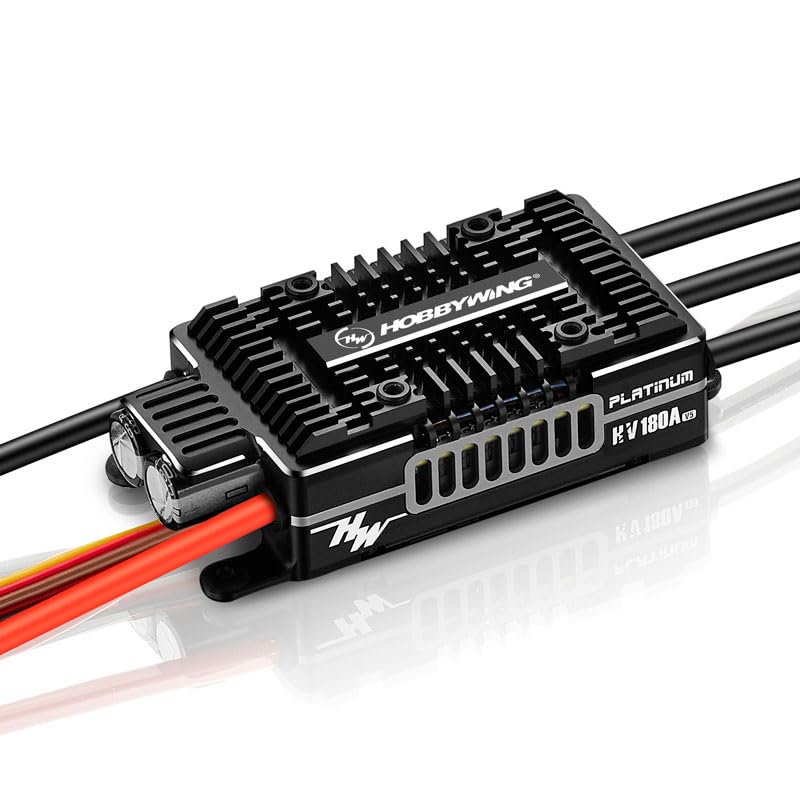
Image: Angled view of the HOBBYWING Platinum 180A HV SBEC V5 ESC, highlighting the heat sink design without the fan.
Operating Instructions
Once installed and calibrated, the ESC is ready for operation. Always ensure your battery is fully charged and securely connected.
- Power On: Connect the battery to the ESC. The ESC will emit a series of beeps indicating cell count and readiness.
- Throttle Control: Use your transmitter's throttle stick to control motor speed. Smooth throttle inputs are recommended for optimal performance and longevity.
- Monitoring: If using telemetry, monitor key parameters such as voltage, current, and temperature during operation to ensure the ESC operates within safe limits.
- Power Off: Always disconnect the battery from the ESC immediately after use. Never leave the battery connected when the model is not in use.
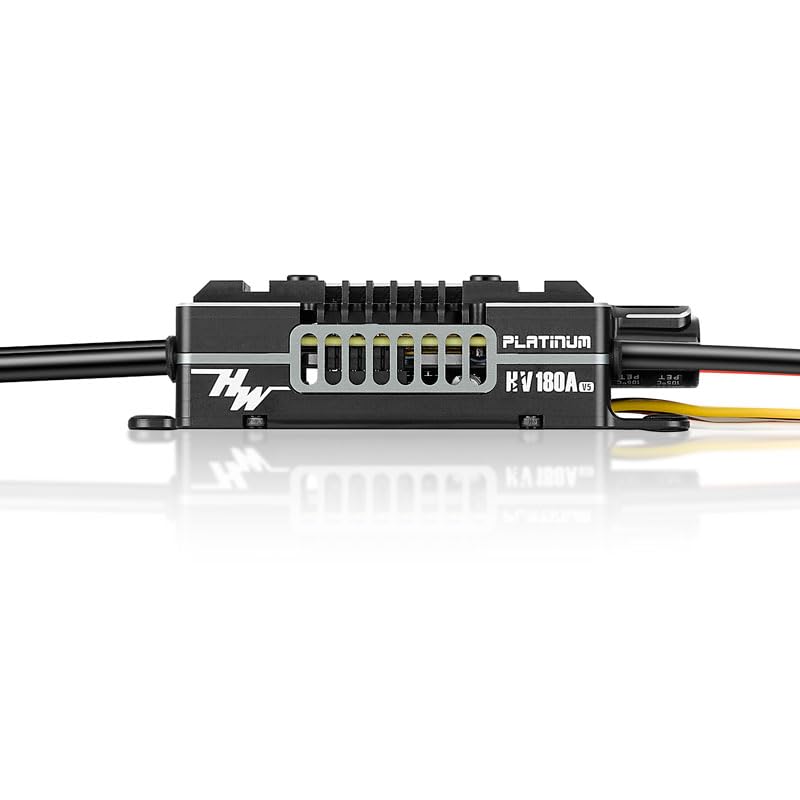
Image: Side profile of the HOBBYWING Platinum 180A HV SBEC V5 ESC, showing its compact design.
Maintenance
Regular maintenance helps ensure the long-term reliability and performance of your HOBBYWING ESC.
- Cleaning: Periodically clean the ESC to remove dust, dirt, and debris, especially from the cooling fins and fan (if applicable). Use a soft brush or compressed air.
- Inspections: Regularly inspect all wires, connectors, and solder joints for signs of wear, damage, or corrosion. Repair or replace as necessary.
- Firmware Updates: Check the Hobbywing official website for any available firmware updates for your ESC. Updating firmware can improve performance and add new features.
- Storage: When not in use, store the ESC in a dry, cool place, away from direct sunlight and extreme temperatures.

Image: Bottom view of the HOBBYWING Platinum 180A HV SBEC V5 ESC, displaying key specifications printed on the casing.
Troubleshooting
If you encounter issues with your ESC, refer to the following common problems and solutions:
| Problem | Possible Cause | Solution |
|---|---|---|
| ESC does not power on. | Battery not connected, low battery voltage, faulty wiring. | Check battery connection and charge level. Inspect all wires and solder joints. |
| Motor stutters or runs erratically. | Incorrect motor wiring, sensor wire issue (if sensored), incorrect ESC settings. | Verify motor wire connections. Check sensor wire. Re-calibrate throttle range. |
| ESC overheats. | Overgearing, insufficient cooling, excessive load. | Reduce gearing. Ensure adequate airflow to the ESC. Reduce load on the motor. |
| No throttle response. | Throttle channel not connected, transmitter not bound, throttle trim incorrect. | Check receiver connection. Re-bind transmitter. Adjust throttle trim to neutral. |

Image: Top-down view of the HOBBYWING Platinum 180A HV SBEC V5 ESC, showing the overall layout and connection points.
Specifications
Detailed technical specifications for the HOBBYWING Platinum 180A HV SBEC V5:
- Model: Platinum HV 180A SBEC V5
- Continuous / Instantaneous Current: 180A / 260A
- Input Voltage: 6-14S LiPo
- BEC Output: SwitchMode: 5-12V & Cont.10A, Peak 30A
- Input / Output Wire: Red-10AWG-255mm*1 / Black-10AWG-255mm*1, Black-10AWG-150mm*3
- Input Connectors: No (User supplied)
- Program Port: Separate Program Port
- Firmware Upgrade: Supported
- Telemetry Function: Supported (Mikado VBar; Futaba S.Bus2; etc.)
- Dimensions (without fan): 100.6 x 45.5 x 26.1mm (3.96"L x 1.79"W x 1.03"H)
- Weight (without fan): 250.6g (8 ounces)
- Application Scope: 550-700 class electric helicopter (main rotor length 550-700mm), or fixed-wing aircraft.
- Manufacturer: Hobbywing Technology
- Material: Aluminum
- Cooling Method: Air
- UPC: 088718523257

Image: Exploded view illustrating the internal components and layered structure of the HOBBYWING Platinum 180A HV SBEC V5 ESC.
Warranty and Support
For warranty information and technical support, please refer to the official Hobbywing website or contact your local distributor. Keep your purchase receipt as proof of purchase.
For further assistance, visit the Hobbywing Brand Store on Amazon.
Ask a question about this manual
Ask about setup, troubleshooting, compatibility, parts, safety, or missing instructions. Manuals+ will review the question and use this page’s manual context to help answer it.