
Introduction
Thank you for choosing the Scheppach 20V IXES C-OBS125-X Cordless Random Orbital Sander. This manual provides essential information for the safe and efficient operation, maintenance, and troubleshooting of your tool. Please read these instructions carefully before use and keep them for future reference.
The C-OBS125-X is a versatile cordless random orbital sander designed for precise sanding of various surfaces. It features a 125mm sanding pad, 2mm oscillation orbit, variable speed control, and a dust extraction system for a clean working environment. This tool is part of the Scheppach IXES 20V battery platform, offering compatibility with other IXES 20V batteries and chargers (sold separately).
Safety Instructions
Always follow basic safety precautions when using electric tools to reduce the risk of fire, electric shock, and personal injury.
- Work Area Safety: Keep your work area clean and well-lit. Cluttered or dark areas invite accidents. Do not operate power tools in explosive atmospheres, such as in the presence of flammable liquids, gases, or dust.
- Electrical Safety: Avoid body contact with earthed or grounded surfaces. Do not expose power tools to rain or wet conditions.
- Personal Safety: Always wear eye protection, dust mask, non-skid safety shoes, hard hat, or hearing protection as appropriate for the conditions. Stay alert, watch what you are doing, and use common sense when operating a power tool.
- Tool Use and Care: Do not force the power tool. Use the correct power tool for your application. Disconnect the battery pack from the power tool before making any adjustments, changing accessories, or storing power tools.
- Battery Tool Use and Care: Recharge only with the charger specified by the manufacturer. Use power tools only with specifically designated battery packs.
Package Contents
Upon unpacking, ensure all items listed below are present and undamaged. If any parts are missing or damaged, contact your retailer.
- Scheppach 20V IXES C-OBS125-X Cordless Random Orbital Sander
- 4 x Sanding Sheets (Grit: K60, K80, K120, K240)
- Dust Extraction Adapter
- Dust Bag
- User Manual
Note: Battery and charger are not included and must be purchased separately.

This image displays the Scheppach C-OBS125-X random orbital sander, equipped with its dust collection bag and a set of sanding discs, ready for use.
Setup
1. Attaching Sanding Sheets
- Ensure the sander is switched off and the battery is removed.
- Align the holes on the sanding sheet with the holes on the sanding pad.
- Press the sanding sheet firmly onto the Velcro fastening system on the sanding pad.

Changing sanding sheets is quick and easy thanks to the Velcro fastening system. Simply peel off the old sheet and press on a new 125mm diameter sanding sheet, ensuring proper alignment of the dust extraction holes.
2. Installing/Removing Battery
- Installation: Slide a charged Scheppach IXES 20V battery pack into the battery slot until it clicks into place.
- Removal: Press the battery release button and slide the battery pack out of the tool.
Important: Only use Scheppach IXES 20V batteries and chargers with this tool.

This image shows the approximate runtime of the sander with different Scheppach IXES 20V batteries: up to 25 minutes with a 2.0Ah battery and up to 50 minutes with a 4.0Ah battery. Actual runtimes may vary based on application and battery condition.
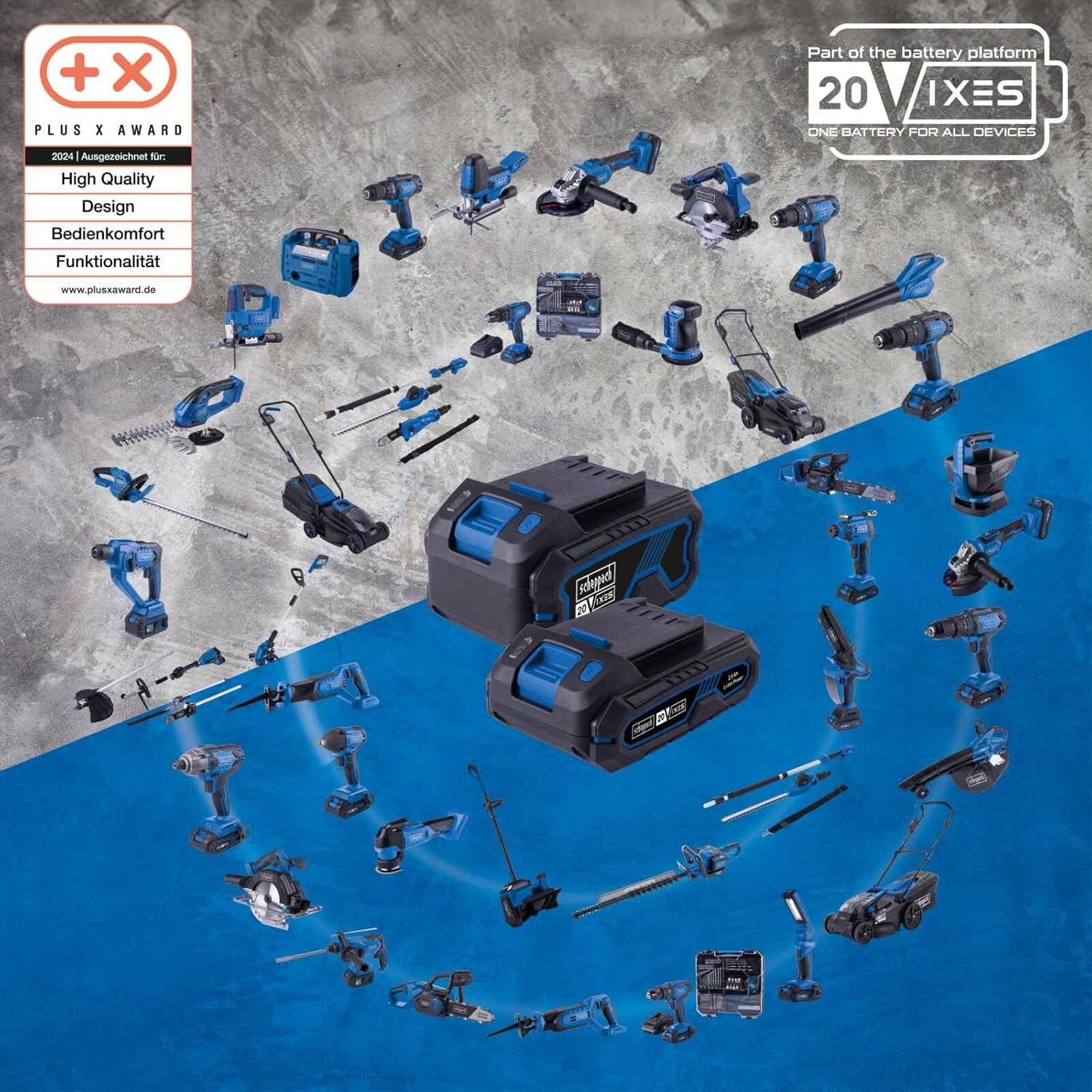
The Scheppach C-OBS125-X is part of the IXES 20V battery platform. This means that any 20V IXES battery and charger are compatible with this sander, offering flexibility and cost savings if you own other IXES tools.
3. Connecting Dust Bag/Extraction System
- Attach the included dust bag to the dust extraction port at the rear of the sander.
- Alternatively, connect a suitable dust extraction adapter and hose to an external vacuum system for enhanced dust collection.

For a cleaner working environment and improved visibility, connect a dust extraction system or the included dust bag to the sander's dust port. This image demonstrates connecting an external dust extraction hose.
Operating Instructions
1. Powering On/Off
- To turn on the sander, press the dust-proof power switch.
- To turn off the sander, press the power switch again.

The sander features a dust-proof power switch, designed to prevent dust ingress and extend the tool's operational lifespan. Ensure the switch is clean and free of debris for reliable performance.
2. Adjusting Speed
- The sander features a variable oscillation speed adjustment dial.
- Rotate the dial to select a speed between 6,000 and 24,000 oscillations per minute (OPM).
- Use lower speeds for delicate work or polishing, and higher speeds for aggressive material removal.

The sander features a variable oscillation speed adjustment dial, allowing you to select speeds from 6,000 to 24,000 oscillations per minute (OPM). Adjust the speed according to the material and desired finish.
3. Sanding Techniques
- Soft Start: The sander incorporates a soft start feature, ensuring a smooth, jolt-free startup.
- Place the sander flat on the workpiece before switching it on.
- Apply light, even pressure and move the sander in overlapping circular or linear patterns.
- The low height design allows for particularly precise and edge-close sanding.
- Avoid excessive pressure, as this can reduce sanding efficiency and damage the workpiece or sander.

This diagram highlights the sander's key features, including the convenient Velcro fastening system for quick abrasive changes, a 2mm oscillation orbit for efficient material removal, a soft start mechanism for smooth operation, and a 125mm sanding pad diameter suitable for various tasks.
4. Application Examples
The Scheppach C-OBS125-X is suitable for a wide range of sanding tasks:
- Workshop: Fine finishing of furniture, preparing surfaces for painting or varnishing.
- Construction Site: Smoothing drywall, preparing wood for installation.
- Home: DIY projects, restoring old furniture, general surface preparation.

The Scheppach C-OBS125-X sander is versatile and suitable for a range of applications, including detailed work in a workshop, tasks on a construction site, and various DIY projects around the home.
Maintenance
1. Cleaning
- Always remove the battery before cleaning.
- Regularly empty the dust bag or clean the dust extraction system to maintain optimal performance.
- Wipe the tool's exterior with a soft, damp cloth. Do not use harsh chemicals or abrasive cleaners.
- Ensure the ventilation openings are clear of dust and debris to prevent overheating.
2. Sanding Pad Replacement
If the Velcro fastening on the sanding pad wears out or the pad becomes damaged, it should be replaced to ensure effective sanding and proper adhesion of sanding sheets. Replacement pads are available from authorized Scheppach dealers.
3. General Care
Store the sander in a dry, secure place out of reach of children. Protect it from extreme temperatures and direct sunlight. Regularly inspect the tool for any signs of wear or damage, especially the power cord (if applicable) and the sanding pad.
Troubleshooting
If you encounter issues with your sander, refer to the following common problems and solutions:
| Problem | Possible Cause | Solution |
|---|---|---|
| Sander does not start | Battery not charged or improperly installed; Power switch faulty | Ensure battery is fully charged and correctly inserted. Check power switch for debris. |
| Poor sanding performance | Worn sanding sheet; Incorrect grit for task; Excessive pressure; Damaged sanding pad | Replace sanding sheet. Use appropriate grit. Apply light, even pressure. Inspect and replace sanding pad if damaged. |
| Excessive dust | Dust bag full or improperly attached; Dust extraction port blocked; Holes on sanding sheet not aligned | Empty and reattach dust bag. Clear any blockages. Ensure sanding sheet holes align with pad holes. |
| Tool overheats | Ventilation openings blocked; Continuous heavy use | Clean ventilation openings. Allow tool to cool down during prolonged use. |
If the problem persists after attempting these solutions, please contact Scheppach customer service or an authorized service center.
Specifications
| Feature | Specification |
|---|---|
| Model Number | 5909240900 |
| Brand | Scheppach |
| Power Source | Battery Powered (20V IXES system) |
| Voltage | 20 Volts |
| Disc Diameter | 125 mm |
| Oscillation Speed | 6,000 - 24,000 OPM (oscillations per minute) |
| Oscillation Orbit | 2 mm |
| Item Weight | 1 Kilogram |
| Product Dimensions (L x W x H) | 12.5 x 18.5 x 17 cm |
| Included Components | 4 Sanding Sheets (K60, K80, K120, K240), Dust Extraction Adapter, Dust Bag |
Warranty and Support
Scheppach products are manufactured to high-quality standards. In the unlikely event of a defect or malfunction, please refer to your purchase documentation for warranty details provided by your retailer. For technical support, spare parts, or service inquiries, please contact Scheppach customer service or visit the official Scheppach website for contact information.