
1. Product Overview
The waveshare 8-inch HDMI Display Monitor is a versatile IPS panel touchscreen designed for various applications, including Raspberry Pi, Windows, and Jetson Nano systems. It features a 768x1024 resolution, 10-point capacitive touch, and a wide 178-degree viewing angle. This manual provides instructions for its setup, operation, and maintenance.
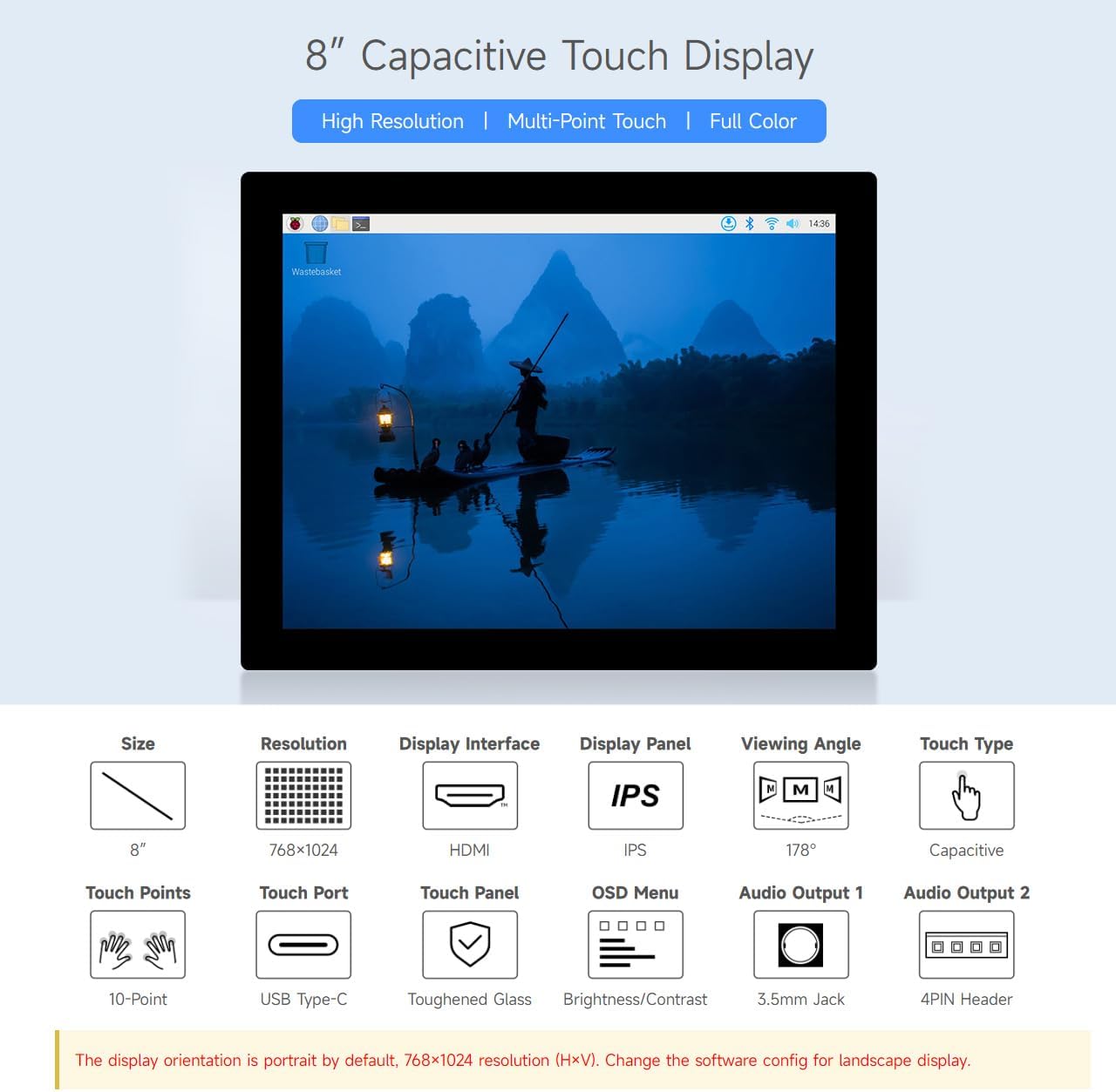
Figure 1.1: Overview of the 8-inch Capacitive Touch Display highlighting its high resolution, multi-point touch, and full-color IPS panel.
2. Package Content
Verify that all items listed below are included in your package. If any items are missing or damaged, please contact customer support.

Figure 2.1: All components included in the product package.
- 8-inch 768x1024 LCD (x1)
- HDMI flat cable ~1m (x1)
- USB-A to Type-C cable ~1m (x1)
- HDMI adapter (x1)
- USB to Type-C adapter (B) (x1)
- HDMI to Micro HDMI adapter (x1)
- USB to Type-C adapter (C) (x1)
- Screws pack (x1)
3. Setup Instructions
3.1. Interface Introduction
Familiarize yourself with the display's interfaces before connecting.

Figure 3.1: Labeled interfaces including Power ON/OFF & Brightness Adjustment, Touch Rotation Button, Audio Jack, HDMI Port, Power Supply, Touch Port, and Speaker Header.
- Power ON/OFF & Brightness Adjustment: Controls power and display brightness.
- Touch Rotation Button: For adjusting touch orientation.
- Audio Jack: 3.5mm audio output.
- HDMI Port: Video input.
- Power Supply: USB Type-C port for power input.
- Touch Port: USB Type-C port for touch data.
- Speaker Header: 4PIN header for external speakers.
3.2. System Compatibility
The display supports a wide range of devices and operating systems:

Figure 3.2: Device and system support for Raspberry Pi, Jetson series boards, and Windows PCs.
- Raspberry Pi: Supports all versions of Raspberry Pi. Compatible with Raspberry Pi OS (10-point touch, driver-free), Ubuntu / Kali / WIN10 IoT (single-point touch, driver-free), and Retropie (driver-free).
- Jetson Series Board: Supports Ubuntu (single-point touch, driver-free).
- PC: Supports Windows 11 / 10 / 8.1 / 8 / 7 (10-point touch, driver-free).
3.3. Connection Examples
Follow these examples for connecting the display to various host devices.

Figure 3.3: Illustrative connection setups for Raspberry Pi 5, Raspberry Pi 4B, Raspberry Pi 3B+, Raspberry Pi Zero 2 W, Jetson Series Board, and a standard PC. Note that additional mini HDMI adapters and USB cables may be required for some setups, and controller boards/hosts are not included.
- Connect Video: Use the provided HDMI cable to connect the display's HDMI port to your host device's HDMI output. Use appropriate adapters (e.g., HDMI to Micro HDMI) if necessary.
- Connect Touch (USB): Connect the display's Touch Port (USB Type-C) to a USB port on your host device using the provided USB-A to Type-C cable. This enables touch functionality.
- Connect Power: Connect the display's Power Supply port (USB Type-C) to a 5V power source (e.g., a USB power adapter or a powered USB port on your host device) using a USB cable. Ensure the power supply meets the display's requirements (e.g., 5V/5A for Raspberry Pi 5, 5V/3A for Raspberry Pi 4B/3B+, 5V/2.5A for Raspberry Pi Zero 2 W).
Note on Display Orientation: The display orientation is portrait by default (768x1024 resolution, HxV). To achieve a landscape display, you will need to change the software configuration on your host device. Refer to your operating system's documentation for display rotation settings.
4. Operating Instructions
4.1. Touch Functionality
The display features a 10-point capacitive touch panel with a toughened glass surface for durability.

Figure 4.1: The display supports up to 10-point capacitive touch, depending on the operating system, and features a 6H hardness toughened glass panel.
Ensure the USB touch cable is connected to your host device for touch input to function. The touch functionality is driver-free for supported operating systems.
4.2. Backlight Adjustment
The display's backlight can be adjusted via software on your connected host device.

Figure 4.2: Example of adjusting backlight brightness through a software interface on the display.
Access your operating system's display settings or use specific utilities provided by your system to control the backlight intensity.
4.3. Audio Output
The display supports audio output via HDMI. Additionally, it features an onboard 3.5mm headphone jack and a 4PIN speaker header for connecting external audio devices.
- 3.5mm Headphone Jack: Connect standard headphones or external speakers.
- 4PIN Speaker Header: For direct connection of small speakers.
5. Maintenance
To ensure the longevity and optimal performance of your display, follow these maintenance guidelines:
- Cleaning: Use a soft, lint-free cloth to gently wipe the screen. For stubborn smudges, slightly dampen the cloth with water or a screen-safe cleaning solution. Avoid harsh chemicals, abrasive materials, or direct spraying onto the screen.
- Handling: Handle the display by its edges. Avoid applying excessive pressure to the screen surface.
- Environment: Operate and store the display in a clean, dry environment, away from extreme temperatures, direct sunlight, and high humidity.
- Power: Always use the recommended 5V power supply. Disconnect power when the display is not in use for extended periods.
6. Troubleshooting
If you encounter issues with your display, refer to the following common troubleshooting steps:
- No Display/Black Screen:
- Ensure the HDMI cable is securely connected to both the display and the host device.
- Verify that the display is receiving adequate power (5V). Check the power cable and adapter.
- Confirm the host device's video output is enabled and configured correctly. Try connecting the host device to another monitor to rule out host issues.
- Restart both the display and the host device.
- Touch Not Responding:
- Ensure the USB Type-C touch cable is securely connected from the display to the host device.
- For Raspberry Pi, ensure the operating system is configured for touch input.
- For Windows, check Device Manager to see if the touch screen device is recognized and drivers are installed (though it's typically driver-free).
- Try connecting the USB touch cable to a different USB port on your host device.
- Incorrect Display Orientation:
- As the display is portrait by default, adjust the display rotation settings within your operating system.
- Use the Touch Rotation Button on the display's circuit board if applicable for touch orientation.
- No Audio:
- Verify that the audio output is selected correctly on your host device (e.g., HDMI audio).
- Ensure speakers or headphones are properly connected to the 3.5mm jack or 4PIN header.
- Check volume levels on both the host device and any connected audio accessories.
If these steps do not resolve the issue, please refer to the support section for further assistance.
7. Specifications
| Feature | Specification |
|---|---|
| Brand | waveshare |
| Model Number | 8inch 768x1024 LCD |
| Screen Size | 8 Inches |
| Resolution | 768x1024 Pixels (Portrait by default) |
| Display Type | IPS LCD |
| Viewing Angle | 178 Degrees |
| Touch Type | 10-point Capacitive Touch |
| Screen Surface | Glossy, Toughened Glass (6H hardness) |
| Connectivity | HDMI (Video), USB Type-C (Touch & Power) |
| Audio Output | HDMI Audio, 3.5mm Headphone Jack, 4PIN Speaker Header |
| Refresh Rate | 60 Hz |
| Voltage | 5 Volts |
| Item Weight | 0.43 Kilograms |
| Item Dimensions (D x W x H) | 0.43"D x 7.4"W x 5.79"H (approx. 11mm D x 188mm W x 147.3mm H) |
| Compatible Devices | Raspberry Pi (all versions), Windows 11/10/8.1/8/7, Jetson Nano, Desktop, Laptop |
Figure 7.1: Detailed dimensions of the display unit in millimeters.
8. Warranty Information
This waveshare 8-inch HDMI Display Monitor comes with a 1 Year Manufacturer Warranty. Please retain your proof of purchase for warranty claims. The warranty covers defects in materials and workmanship under normal use. It does not cover damage caused by misuse, accidents, unauthorized modifications, or improper installation.
9. Support
For technical support, product inquiries, or warranty claims, please contact waveshare customer service through their official website or the platform where the product was purchased. Have your product model number (8inch 768x1024 LCD) and purchase details ready when contacting support.
You can often find additional resources, drivers, and detailed guides on the waveshare official website: www.waveshare.com


