1. Introduction
This manual provides detailed instructions for the safe and effective operation of your ZHDBD 5012H Digital Oscilloscope. Please read this manual thoroughly before using the device to ensure proper functionality and to prevent damage. Keep this manual for future reference.
2. Product Overview
2.1 Key Features
- Intelligent anti-burn protection.
- Afterglow display technology for clear waveform visualization.
- 2.4-inch color display screen (320*240 resolution).
- 100MHz analog bandwidth with a 500MS/s sampling rate (1X = 5MHz, 10X = 100MHz).
- One-button waveform storage with built-in 64M storage space, capable of storing up to 2000 waveform images.
- Powerful waveform file manager supporting thumbnail browsing, viewing, detail viewing, flipping, and deletion.
- Waveform display pause function.
- One-button AUTO function for quick waveform display without complex adjustments.
- Complete triggering functions: Single, Normal, Automatic.
- Built-in 3000mAh rechargeable lithium battery, providing up to 8 hours of continuous use on a full charge.
- Adjustable screen brightness.
- Memory compression technology for flicker-free waveform refresh.
- Anti-slip and anti-drop silicone sleeve for enhanced durability.
- Compact and portable design.
2.2 Components and Accessories
The ZHDBD 5012H Digital Oscilloscope comes with the following components and accessories:
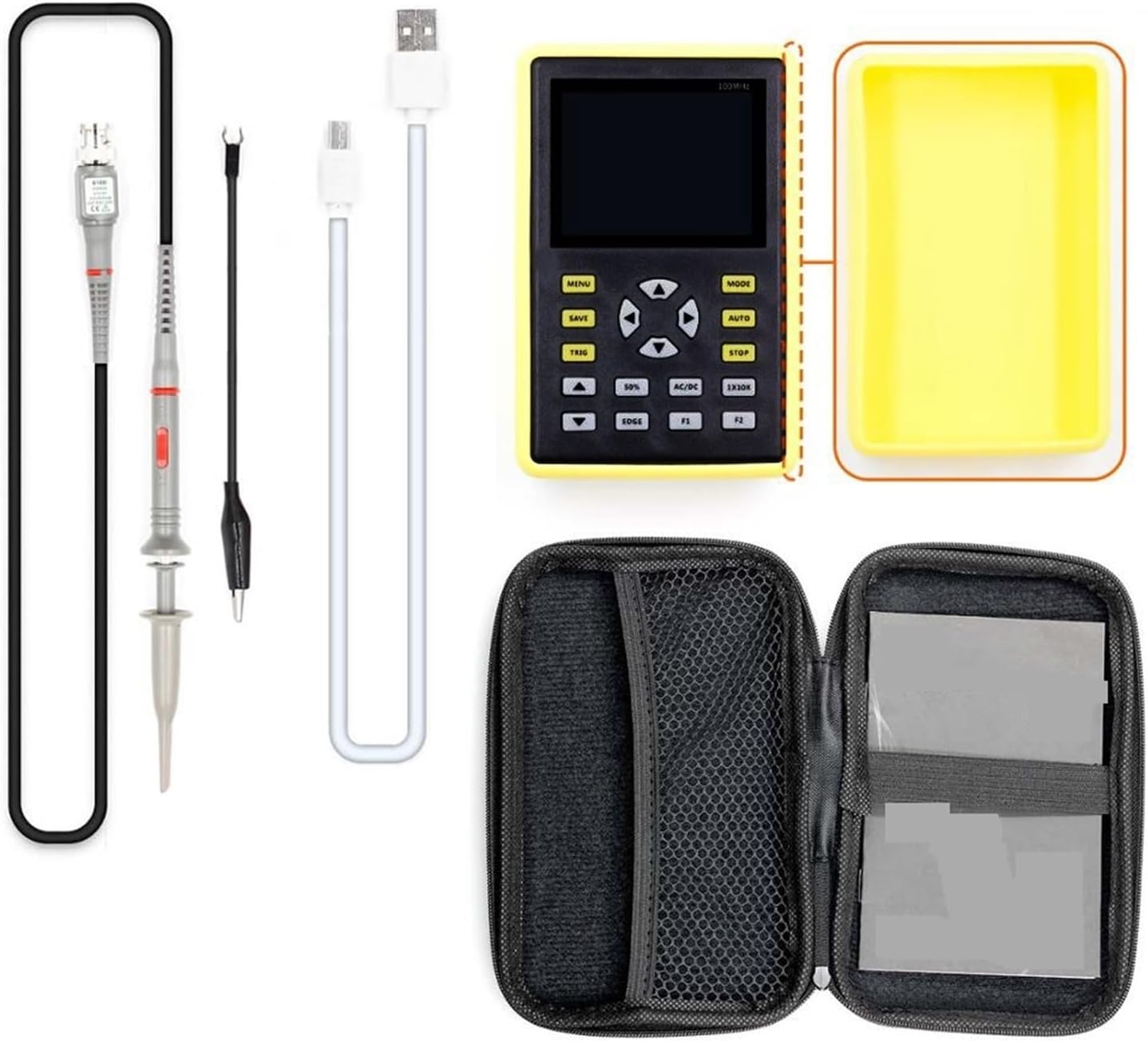
Figure 2.2.1: The ZHDBD 5012H Digital Oscilloscope package includes the main unit, a probe, a USB cable for charging and data transfer, and a protective carrying case.
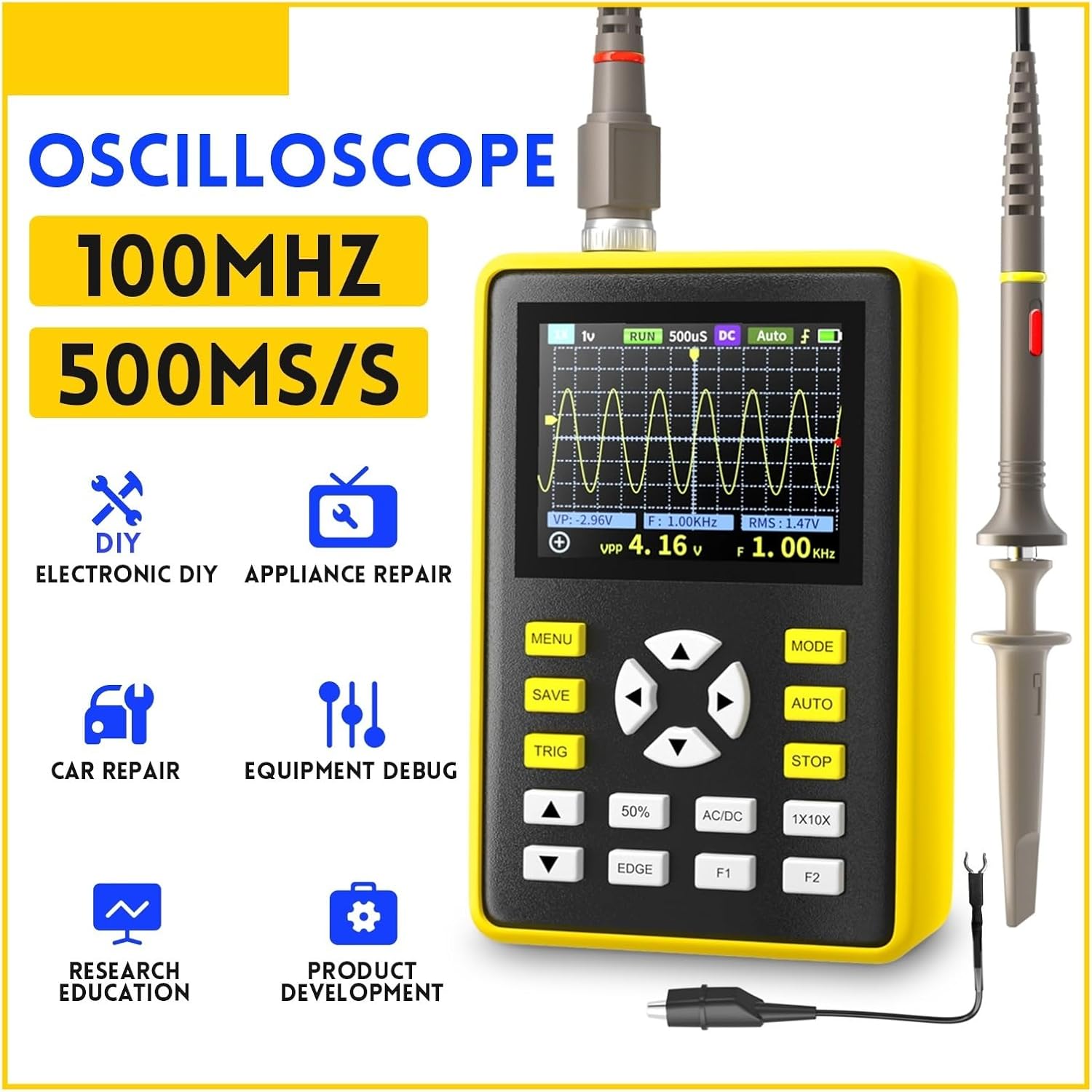
Figure 2.2.2: Front view of the oscilloscope, highlighting the 2.4-inch display, navigation buttons, and function keys (MENU, MODE, SAVE, AUTO, TRIG, STOP, 50%, AC/DC, EDGE, F1, F2).
3. Setup
3.1 Charging the Device
- Connect the provided USB cable to the oscilloscope's charging port.
- Connect the other end of the USB cable to a standard USB power adapter (not included) or a computer's USB port.
- The charging indicator will illuminate. A full charge typically takes several hours and provides up to 8 hours of continuous operation.
3.2 Connecting the Probe
- Ensure the oscilloscope is powered off before connecting the probe.
- Connect the BNC connector of the oscilloscope probe to the input BNC port on the oscilloscope.
- Attach the ground clip of the probe to the ground point of the circuit under test.
- Select the appropriate attenuation setting (1X or 10X) on the probe based on the expected signal voltage. For higher voltages, use 10X.
- Important: When using the 10X attenuation setting on the probe, ensure the oscilloscope's input setting is also configured for 10X to obtain accurate readings. Failure to do so may result in incorrect measurements or potential damage if high voltage is applied with a 1X setting.
4. Operating Instructions
4.1 Power On/Off
- To power on, press and hold the power button until the screen illuminates.
- To power off, press and hold the power button until the screen turns off.
4.2 Automatic Measurement (AUTO)
The one-button AUTO function automatically adjusts the vertical, horizontal, and trigger settings to display a stable waveform. This is useful for quickly viewing an unknown signal.
- Press the AUTO button. The oscilloscope will attempt to automatically detect and display the input waveform.
4.3 Triggering Functions
Triggering stabilizes repetitive waveforms and captures single-shot events. Press the TRIG button to access trigger settings.
- Auto Trigger: The oscilloscope triggers automatically, even without a stable signal. Suitable for most general-purpose measurements.
- Normal Trigger: The oscilloscope triggers only when the signal meets the specified trigger conditions. If no trigger event occurs, the display remains unchanged. Useful for capturing specific events.
- Single Trigger: The oscilloscope waits for a single trigger event, captures one waveform, and then stops. Ideal for capturing non-repetitive or transient events.
- Trigger Edge: Use the EDGE button to select between rising edge or falling edge triggering.
4.4 Waveform Storage and Management
The device allows for easy storage and management of waveform images.
- Save Waveform: Press the SAVE button to instantly store the current waveform displayed on the screen. The device has 64M storage, capable of holding up to 2000 images.
- Waveform Manager: Access the waveform file manager through the MENU button. This allows for thumbnail browsing, viewing, detailed inspection, page turning, and deletion of stored waveforms.
4.5 Adjusting Display and Settings
- Vertical Sensitivity (Volts/Div): Use the up/down arrow buttons to adjust the vertical scale, changing the voltage represented by each vertical division on the grid.
- Horizontal Time Base (Sec/Div): Use the left/right arrow buttons to adjust the horizontal scale, changing the time represented by each horizontal division on the grid.
- AC/DC Coupling: Press the AC/DC button to toggle between AC and DC coupling. AC coupling blocks the DC component of the signal, showing only the AC variations. DC coupling shows the entire signal, including both AC and DC components.
- Screen Brightness: Adjust screen brightness through the MENU settings for optimal viewing in various lighting conditions.
5. Maintenance
5.1 Cleaning
- Power off the device and disconnect all probes and cables before cleaning.
- Use a soft, dry cloth to wipe the exterior of the oscilloscope.
- For stubborn dirt, slightly dampen the cloth with water or a mild, non-abrasive cleaner. Avoid using harsh chemicals or solvents.
- Do not allow any liquids to enter the device.
5.2 Battery Care
- To prolong battery life, avoid fully discharging the battery frequently.
- If storing the device for an extended period, charge the battery to approximately 50% and store it in a cool, dry place. Recharge every few months to prevent deep discharge.
- Use only the provided USB cable for charging.
5.3 Storage
- Store the oscilloscope in its protective carrying case when not in use to prevent physical damage.
- Keep the device away from extreme temperatures, high humidity, and direct sunlight.
6. Troubleshooting
If you encounter issues with your ZHDBD 5012H Digital Oscilloscope, refer to the following common problems and solutions:
| Problem | Possible Cause | Solution |
|---|---|---|
| Device does not power on. | Low battery or power button not pressed correctly. | Charge the device fully. Ensure the power button is pressed and held for a few seconds. |
| No waveform displayed. | Probe not connected, signal too weak/strong, incorrect trigger settings, or incorrect time/voltage scale. | Check probe connection. Use the AUTO button. Adjust vertical (Volts/Div) and horizontal (Sec/Div) scales. Check trigger mode and level. |
| Unstable waveform. | Incorrect trigger settings or trigger level. | Adjust the trigger level. Try different trigger modes (Auto, Normal, Single). Ensure the probe ground clip is securely connected. |
| Incorrect voltage readings. | Probe attenuation mismatch (1X/10X). | Ensure the probe's attenuation setting (e.g., 10X) matches the oscilloscope's input setting. |
If the problem persists after attempting these solutions, please contact customer support.
7. Specifications
| Parameter | Value |
|---|---|
| Analog Bandwidth | 100MHz |
| Maximum Real-time Sampling Rate | 500MS/s |
| Horizontal Time Base Range | 50S/div ~ 6nS/div |
| Storage Depth | 128KB |
| Input Resistance | 1MΩ |
| ADC Precision | 8 bits |
| Coupling Mode | AC/DC |
| Trigger Mode | Single, Normal, Auto |
| Trigger Edge | Ascending/Descending edge |
| Display | 2.4 inch - 320*240 color display |
| Power Supply | 3000 mAh lithium battery |
8. Warranty and Support
The ZHDBD 5012H Digital Oscilloscope is designed for reliability and performance. For specific warranty information, please refer to the documentation provided with your purchase or contact the retailer.
For technical support, troubleshooting assistance beyond what is covered in this manual, or inquiries regarding parts and service, please contact ZHDBD customer service through their official channels.