
1. Introduction
Thank you for choosing the MASTECH MY75 Digital Multimeter. This device is a professional, handheld instrument designed for accurate measurement of AC/DC voltage, AC/DC current, resistance, capacitance, frequency, diode, continuity, and transistor hFE. Please read this manual thoroughly before use to ensure safe and proper operation.
1.1 Safety Information
Always adhere to safety precautions when using any electrical testing equipment. Failure to do so may result in injury or damage to the meter or equipment under test.
- Do not exceed the maximum input values specified for each range.
- Exercise extreme caution when working with voltages above 60V DC or 30V AC RMS.
- Ensure the test leads are in good condition and properly connected.
- Do not operate the meter if it appears damaged or if the case is open.
- Replace batteries when the low battery indicator appears to ensure accurate readings.
- This meter is rated CAT III 600V.
2. Product Overview
The MASTECH MY75 is a compact and versatile digital multimeter suitable for domestic, industrial, and electronics applications.
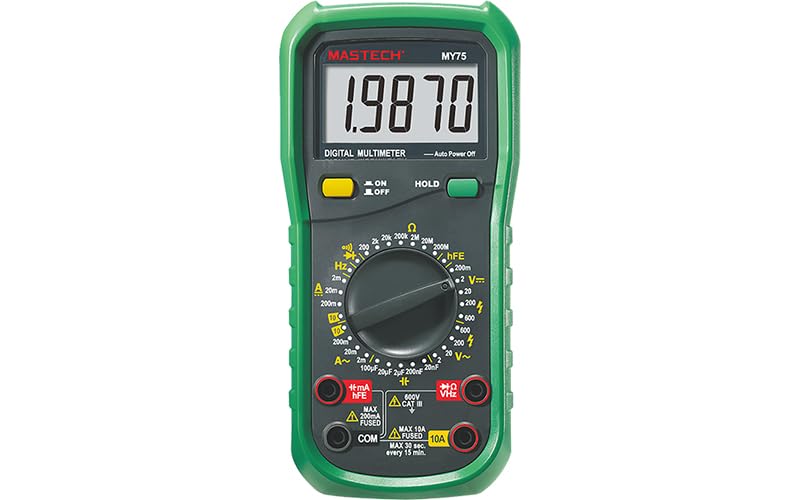
Figure 2.1: Front view of the MASTECH MY75 Digital Multimeter, showing the LCD display, rotary switch, function buttons, and input jacks.
2.1 Main Components
- LCD Display: 20000 counts display for clear readings.
- Rotary Switch: Used to select measurement functions and ranges.
- Function Buttons: Includes ON/OFF, HOLD, and other specific function buttons.
- Input Jacks: Terminals for connecting test leads (COM, VΩHz, 10A, mA/µA/hFE).

Figure 2.2: Overview of MY75 features, main applications (domestic, industrial, electronics), and package contents.
3. Setup
3.1 Package Contents
Before starting, verify that all items are present in the package:
- MASTECH MY75 Digital Multimeter
- Test Leads (Red and Black)
- Multi-function Socket (for hFE testing)
- 2 x LR44 Batteries (pre-installed or included separately)
- Quick-Start Guide
- Calibration Certificate

Figure 3.1: The MASTECH MY75 Multimeter shown with its retail packaging and included accessories.

Figure 3.2: The MASTECH MY75 Multimeter with its essential accessories: test leads, LR44 batteries, and the multi-function hFE socket.
3.2 Battery Installation
The MASTECH MY75 uses 2 LR44 batteries. If the low battery indicator appears on the display, replace the batteries immediately to maintain measurement accuracy.
- Turn off the multimeter and disconnect all test leads.
- Locate the battery compartment cover on the back of the unit.
- Unscrew the retaining screw(s) and remove the cover.
- Remove the old batteries and insert new LR44 batteries, observing correct polarity.
- Replace the battery compartment cover and secure it with the screw(s).
3.3 Connecting Test Leads
Always connect the black test lead to the "COM" (Common) jack. Connect the red test lead to the appropriate input jack based on the measurement function:
- VΩHz: For Voltage, Resistance, Frequency, Capacitance, Diode, and Continuity measurements.
- mA/µA/hFE: For milliampere/microampere current measurements and transistor hFE testing.
- 10A: For high current (up to 10A) measurements.
4. Operating Instructions
To operate the multimeter, turn the rotary switch to the desired function. The meter features auto-ranging for most functions, simplifying operation.
4.1 DC Voltage Measurement (V=)
- Connect the black test lead to the COM jack and the red test lead to the VΩHz jack.
- Turn the rotary switch to the "V=" position.
- Connect the test leads across the DC voltage source to be measured.
- Read the voltage value on the display.
4.2 AC Voltage Measurement (V~)
- Connect the black test lead to the COM jack and the red test lead to the VΩHz jack.
- Turn the rotary switch to the "V~" position.
- Connect the test leads across the AC voltage source to be measured.
- Read the voltage value on the display.
4.3 DC Current Measurement (A= / mA= / µA=)
- Turn off power to the circuit.
- Connect the black test lead to the COM jack.
- For currents up to 200mA, connect the red test lead to the mA/µA/hFE jack. For currents up to 10A, connect the red test lead to the 10A jack.
- Turn the rotary switch to the appropriate "A=", "mA=", or "µA=" position.
- Break the circuit and connect the meter in series with the load.
- Apply power to the circuit and read the current value.
4.4 AC Current Measurement (A~ / mA~ / µA~)
- Follow the same steps as DC Current Measurement, but select the appropriate "A~", "mA~", or "µA~" position on the rotary switch.
4.5 Resistance Measurement (Ω)
- Ensure the circuit is de-energized and all capacitors are discharged.
- Connect the black test lead to the COM jack and the red test lead to the VΩHz jack.
- Turn the rotary switch to the "Ω" position.
- Connect the test leads across the component to be measured.
- Read the resistance value on the display.
4.6 Capacitance Measurement (F)
- Ensure the capacitor is fully discharged before measurement.
- Connect the black test lead to the COM jack and the red test lead to the VΩHz jack.
- Turn the rotary switch to the "F" position.
- Connect the test leads across the capacitor terminals.
- Read the capacitance value on the display.
4.7 Frequency Measurement (Hz)
- Connect the black test lead to the COM jack and the red test lead to the VΩHz jack.
- Turn the rotary switch to the "Hz" position.
- Connect the test leads across the signal source.
- Read the frequency value on the display.
4.8 Diode Test (→|)
- Ensure the circuit is de-energized.
- Connect the black test lead to the COM jack and the red test lead to the VΩHz jack.
- Turn the rotary switch to the Diode symbol position.
- Connect the red lead to the anode and the black lead to the cathode of the diode. A forward voltage drop will be displayed (Diode Open Voltage 3.0V).
- Reverse the leads. The display should show "OL" (Open Loop) for a good diode.
4.9 Continuity Test ())))
- Ensure the circuit is de-energized.
- Connect the black test lead to the COM jack and the red test lead to the VΩHz jack.
- Turn the rotary switch to the Continuity symbol position.
- Connect the test leads across the circuit or component.
- If the resistance is less than approximately 60Ω, the buzzer will sound, indicating continuity.
4.10 Transistor hFE Test
- Connect the multi-function socket to the mA/µA/hFE and COM jacks.
- Turn the rotary switch to the "hFE" position.
- Insert the transistor's emitter, base, and collector leads into the corresponding holes on the multi-function socket (NPN or PNP).
- Read the hFE value (0-1000) on the display.
5. Features
- Display 20000 Counts: Provides high resolution for precise measurements.
- Data Hold: Press the "HOLD" button to freeze the current reading on the display. Press again to release.
- Auto Power Off: The meter automatically turns off after a period of inactivity to conserve battery life.
- Low Battery Display: An icon on the display indicates when the batteries are low and need replacement.
6. Maintenance
6.1 Cleaning
Wipe the case with a damp cloth and mild detergent. Do not use abrasives or solvents. Keep the input terminals free from dirt and moisture.
6.2 Battery Replacement
Refer to Section 3.2 for detailed instructions on replacing the LR44 batteries.
6.3 Storage
If the meter is not used for an extended period, remove the batteries to prevent leakage and damage. Store the meter in a cool, dry place away from direct sunlight.
7. Troubleshooting
| Problem | Possible Cause | Solution |
|---|---|---|
| No display or faint display | Low or dead batteries; Incorrect battery installation | Replace batteries; Check battery polarity |
| "OL" (Overload) displayed | Input value exceeds selected range; Open circuit | Select a higher range; Check circuit connections |
| Incorrect readings | Low batteries; Incorrect function/range selected; Poor test lead connection | Replace batteries; Verify function/range; Ensure secure connections |
| No continuity beep | Resistance too high; Open circuit | Check circuit for breaks; Ensure resistance is below 60Ω |
8. Specifications
The following table details the technical specifications of the MASTECH MY75 Digital Multimeter.

Figure 8.1: Detailed specifications including range, resolution, and accuracy for various measurement functions of the MY75.
| Measurement Type | Range | Resolution | Accuracy |
|---|---|---|---|
| DC Voltage | 200mV / 2V / 20V / 200V / 600V | 0.01mV / 0.1mV / 1mV / 10mV / 0.1V / 1V | ±(0.05%+3) to ±(0.15%+3) |
| AC Voltage | 2V / 20V / 200V / 600V | 0.1mV / 1mV / 10mV / 0.1V | ±(0.5%+3) to ±(1.0%+15) |
| DC Current | 2mA / 20mA / 200mA / 10A | 0.1µA / 1µA / 10µA / 1mA / 10mA | ±(0.5%+50) to ±(2.0%+10) |
| AC Current | 2mA / 20mA / 200mA / 10A | 0.1µA / 1µA / 10µA / 1mA / 10mA | ±(0.8%+50) to ±(2.5%+10) |
| Resistance | 200Ω / 2kΩ / 20kΩ / 200kΩ / 2MΩ / 20MΩ / 200MΩ | 0.01Ω / 0.1Ω / 1Ω / 10Ω / 100Ω / 1kΩ / 10kΩ | ±(0.5%+10) to ±(5.0%+10) |
| Capacitance | 2µF / 20µF / 100µF / 20nF / 200nF | 0.1nF / 1nF / 10nF / 1pF / 10pF | ±(4.0%+20) |
| Frequency | 20kHz | 1Hz | ±(1.5%+5) |
| Diode Open Voltage | 3.0V | N/A | N/A |
| Continuity Buzzer | <60Ω | N/A | N/A |
| Transistor hFE | 0~1000 | N/A | N/A |
| Display | 20000 counts | N/A | N/A |
| Power Source | 2 x LR44 batteries | N/A | N/A |
| Dimensions (L x W x H) | 16 x 9 x 5 cm | N/A | N/A |
| Weight | 500 g | N/A | N/A |
| Safety Rating | CAT III 600V | N/A | N/A |
| Certifications | CE, RoHS | N/A | N/A |
9. Warranty and Support
MASTECH products are designed for reliability and performance. For warranty information or technical support, please refer to the contact details provided with your purchase documentation or visit the official MASTECH website. Keep your purchase receipt as proof of purchase for warranty claims.
EU Spare Part Availability Duration: 1 Year.


