
Kidde 30CUDR-V
Kidde Smoke & Carbon Monoxide Detector 30CUDR-V User Manual
Model: 30CUDR-V
1. Introduction
This manual provides essential information for the installation, operation, and maintenance of your Kidde 30CUDR-V Smoke and Carbon Monoxide (CO) Detector. This device is designed to alert you to the presence of both smoke and carbon monoxide hazards in your home. Please read this manual thoroughly before installation and retain it for future reference.

Image: Two Kidde 30CUDR-V combination smoke and carbon monoxide detectors, shown with their packaging.
2. Important Safety Information
WARNING: This unit is designed to detect smoke and carbon monoxide. It is not designed to detect natural gas (methane), propane, butane, or other combustible fuels. This alarm is not a substitute for property, disability, life, or other insurance. Consult your insurance agent.
DANGER: Carbon Monoxide is an odorless, colorless, poisonous gas. If the alarm sounds, immediately move to fresh air and call emergency services.
IMPORTANT: Regular testing and maintenance are crucial for proper operation. Refer to the "Maintenance" section for details.
3. Package Contents
- Kidde 30CUDR-V Smoke and Carbon Monoxide Detector
- Mounting Hardware (screws and anchors)
- 2 AA Alkaline Batteries (pre-installed or included separately)
- User Guide (this document)
4. Setup and Installation
4.1 Battery Installation
The Kidde 30CUDR-V detector operates on two AA alkaline batteries. These batteries are typically included and may be pre-installed with a pull tab to activate. If not pre-installed, insert the batteries according to the polarity markings inside the battery compartment.

Image: The rear of the detector showing the battery compartment with two AA batteries correctly installed.
4.2 Mounting Location
For optimal performance and safety, follow these guidelines for mounting your detector:
- Install at least one detector on every level of your home, including basements and attics.
- For best smoke detection, install detectors in all sleeping areas and in the hallway outside of each separate sleeping area.
- For best CO detection, install detectors near sleeping areas and on every level of the home.
- Avoid placing detectors within 6 feet of fuel-burning appliances.
- Do not install in kitchens, garages, or furnace rooms where combustion particles are normally present, as this can lead to nuisance alarms.
- Avoid dead air spaces, such as the peak of an A-frame ceiling or in corners where walls and ceilings meet.

Image: A diagram illustrating recommended locations for various safety devices, including smoke and carbon monoxide alarms, within a typical home layout.
4.3 Mounting the Detector
The detector comes with a twist-and-click mounting bracket for easy installation.
- Choose a suitable mounting location on a ceiling or wall.
- Use the mounting bracket as a template to mark the screw holes.
- Drill pilot holes and insert the plastic anchors if mounting into drywall or plaster.
- Secure the mounting bracket to the ceiling or wall using the provided screws.
- Align the detector with the mounting bracket and twist clockwise until it clicks securely into place.

Image: A person on a ladder installing the Kidde detector onto a ceiling, demonstrating the simple twist-and-click mounting process.

Image: A detailed view of the detector and its mounting bracket, highlighting the 5-inch diameter and other dimensions for installation planning.
5. Operating Instructions
5.1 Initial Power-Up
Once batteries are installed and the unit is mounted, the detector will perform a self-test and enter normal operation mode. The green LED will flash periodically.
5.2 Testing the Alarm
Test the alarm weekly to ensure proper operation. Press and hold the Test/Hush button on the front of the detector until the alarm sounds. The alarm will emit a series of beeps and voice announcements. Release the button once the test sequence begins.

Image: A family in a living room, with the detector visible on the ceiling, representing the device's self-testing capability in a home environment.
5.3 Hush Feature
The Hush feature temporarily silences the alarm for approximately 7-10 minutes in case of a nuisance alarm (e.g., from cooking smoke). To activate, press the Test/Hush button during an alarm. The alarm will chirp every 30-40 seconds during the hush period. If smoke or CO levels are still present after the hush period, the alarm will reactivate.

Image: A toaster producing smoke from burnt toast, with the detector on the ceiling, illustrating the detector's ability to reduce nuisance alarms from common cooking activities.
6. LED Indicators and Voice Alerts
The Kidde 30CUDR-V uses both LED lights and voice announcements to communicate its status.
6.1 LED Notifications
- Green LED: Flashes every 60 seconds during normal operation.
- Amber LED: Indicates a fault or error. Refer to the troubleshooting section.
- Red LED: Flashes rapidly during a smoke or CO alarm.
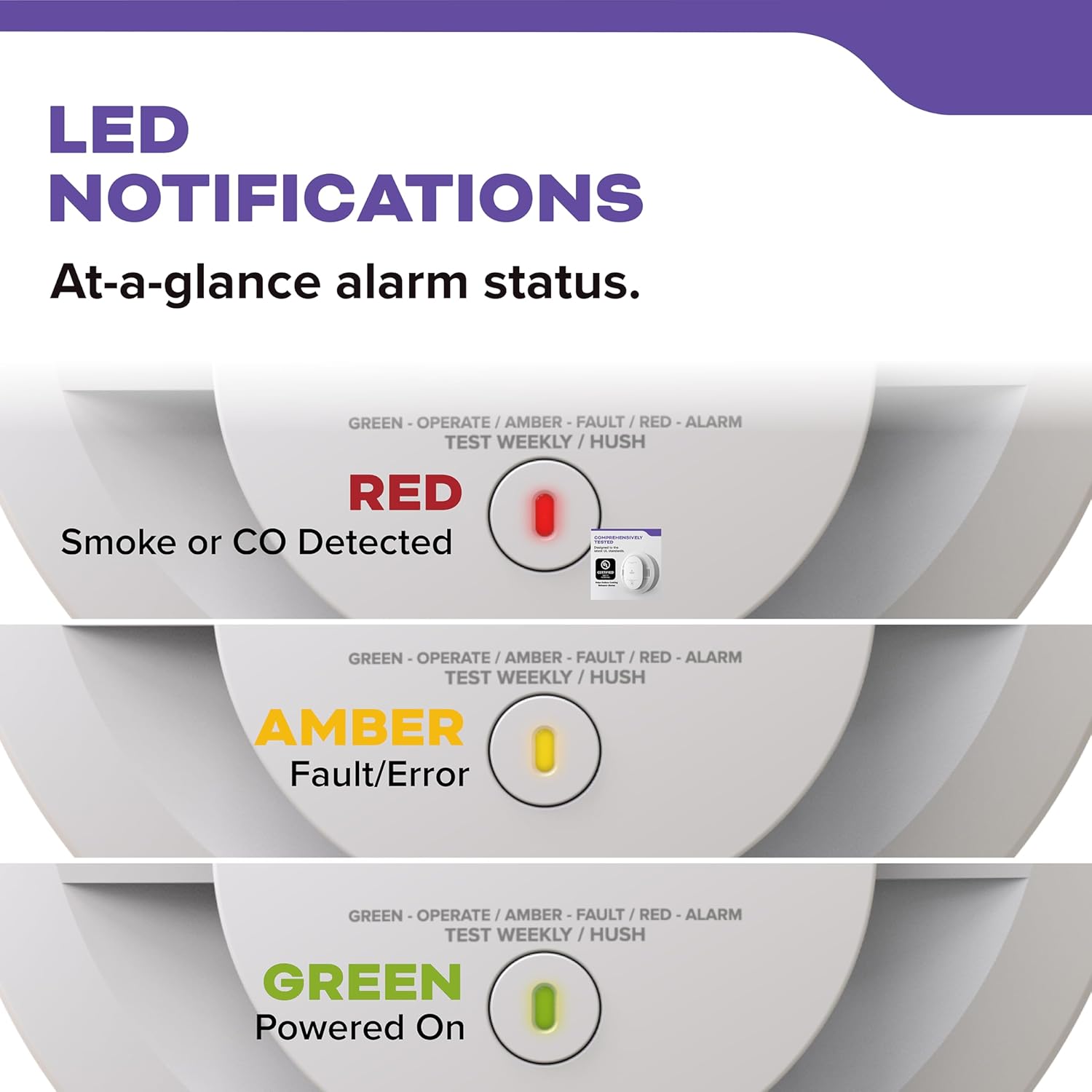
Image: A visual representation of the detector's LED indicators: Red for smoke/CO detection, Amber for fault/error, and Green for normal operation.
6.2 Voice Alerts
The detector provides clear voice announcements to specify the detected hazard:
- If smoke is detected, the alarm will announce: "Fire! Fire!"
- If carbon monoxide is detected, the alarm will announce: "Warning Carbon Monoxide!"
- Other alerts may include: "Replace Alarm" or "Low Battery".

Image: A graphic illustrating the distinct voice alerts provided by the detector for fire, carbon monoxide, and replacement notifications.

Image: The detector shown with visual cues of carbon monoxide detection, emphasizing its dual detection capability.
7. Maintenance
7.1 Battery Replacement
The detector requires two AA alkaline batteries. Replace batteries at least once every 6 months, or immediately when the detector chirps and announces "Low Battery".
7.2 Cleaning Your Detector
Clean your detector at least once a month. Use a soft brush or vacuum cleaner with a soft brush attachment to remove dust and debris from the vents. Do not use cleaning solvents or spray cleaners directly on the unit.
7.3 Self-Testing Feature
The detector includes a self-testing feature that continuously monitors its internal components. While this ensures the alarm is operating as expected, it is not a substitute for a manual push test. Perform a button test once per week to verify alarm operation.
8. Troubleshooting
| Problem | Possible Cause | Solution |
|---|---|---|
| Alarm chirps and announces "Low Battery" | Batteries are low. | Replace both AA alkaline batteries immediately. |
| Amber LED flashes, alarm chirps, or announces "Fault" | Internal fault or sensor error. | Clean the detector. If the issue persists after cleaning and battery replacement, the unit may need to be replaced. |
| Nuisance alarm (e.g., from cooking) | Smoke or steam from cooking, showering, etc. | Press the Test/Hush button to temporarily silence the alarm. Ensure proper ventilation in areas prone to nuisance alarms. |
| Alarm does not sound during test | Dead batteries, unit malfunction. | Replace batteries. If still no sound, the unit may be faulty and needs replacement. |
9. Specifications
- Model: 30CUDR-V
- Power Source: 2 AA Alkaline Batteries (included)
- Sensor Type: Photoelectric (Smoke), Electrochemical (Carbon Monoxide)
- Alarm Loudness: 85 decibels at 10 feet
- Operating Temperature: 40°F (4.4°C) to 100°F (37.8°C)
- Operating Humidity: 10-95% relative humidity, non-condensing
- Dimensions: 5" Diameter x 1.88" Depth (approximate)
- Certifications: Meets UL 217 9th Edition, UL 2034 4th Edition, and FCC standards.

Image: The detector displaying its compliance with UL 217 and UL 2034 safety standards.
10. Warranty and Support
10.1 Limited Warranty
This Kidde detector comes with a 10-Year Limited Warranty. The warranty period begins when the alarm is powered on. If the power-on date is unknown, it is recommended to assume the alarm should be replaced after 10 years from the manufacturing date.

Image: A family in a kitchen setting, with the detector visible on the ceiling, accompanied by a graphic indicating a 10-year limited warranty.
10.2 Customer Support
For technical assistance or warranty claims, please contact Kidde Customer Service. Refer to the contact information provided in the product packaging or visit the official Kidde website.
Manufacturer: Kidde
Part Number: 21032833
UPC: 047871328338
11. Additional Information
11.1 State and Local Requirements
Always check your local building codes and regulations regarding smoke and carbon monoxide alarm installation. Requirements may vary by state and municipality.

Image: A map of the United States indicating various state and city requirements for carbon monoxide and smoke alarms, current as of December 2023.
Related documents30CUDR-V


Ask a question about this manual
Ask about setup, troubleshooting, compatibility, parts, safety, or missing instructions. Manuals+ will review the question and use this page’s manual context to help answer it.