
1. Introduction
This manual provides essential information for the safe and effective operation of your Hantek DSO4204C Digital Oscilloscope and Arbitrary Function Waveform Generator. Please read this manual thoroughly before using the device to ensure proper functionality and to prevent damage.
The Hantek DSO4204C is a versatile instrument combining a 4-channel digital oscilloscope with an integrated arbitrary function waveform generator. It features a 200 MHz bandwidth, 1GSa/s real-time sample rate, and advanced measurement capabilities, making it suitable for a wide range of electronic testing and measurement applications.
2. Safety Information
WARNING: To prevent electric shock or personal injury, and to avoid damage to the instrument or connected equipment, observe the following safety precautions:
- Use the provided power cord and ensure it is properly grounded.
- Do not operate the instrument in wet or damp conditions.
- Do not operate the instrument in explosive atmospheres.
- Ensure proper ventilation to prevent overheating.
- Do not attempt to service the instrument unless you are qualified to do so. Refer all servicing to qualified personnel.
- Before making connections to the input or output terminals, ensure the instrument is powered off.
- Use only probes and accessories specified for this instrument.
3. Package Contents
Verify that all items listed below are included in your package. If any items are missing or damaged, please contact your supplier.
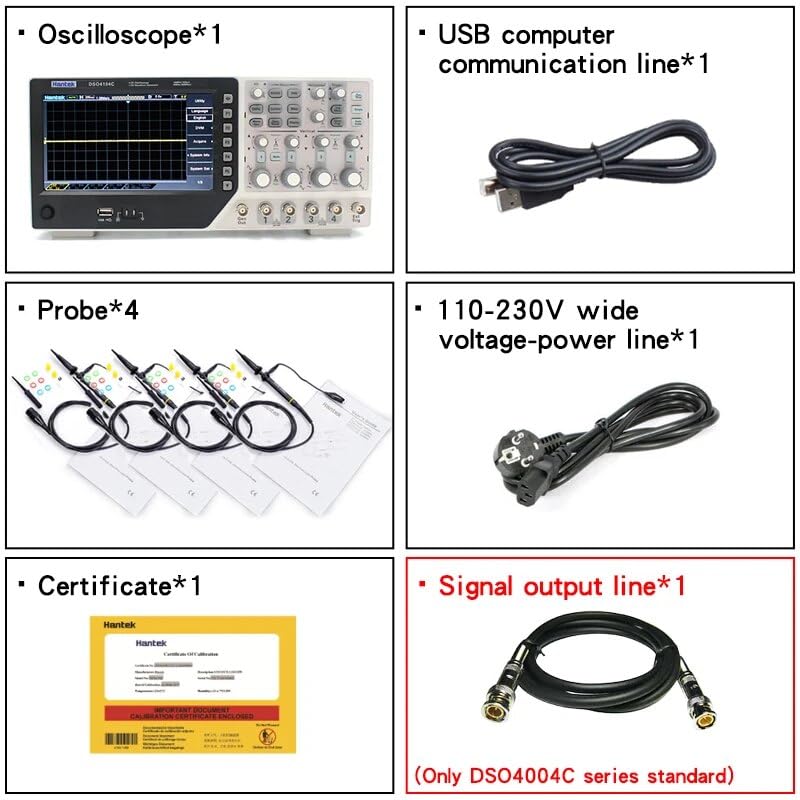
Figure 3.1: Overview of included accessories. This image displays the Hantek oscilloscope unit, four probes, a USB communication cable, a 110-230V power line, a quality certificate, and a signal output line.

Figure 3.2: The Hantek DSO4204C oscilloscope and its various accessories, still sealed in their protective plastic packaging, as they appear upon unboxing.
- Hantek DSO4204C Digital Oscilloscope Unit
- Oscilloscope Probes (x4)
- USB Communication Cable
- Power Cord (110-230V wide voltage)
- Quality Certificate
- Signal Output Line (for Arbitrary Function Generator)
- User Manual (this document)
4. Product Overview
The Hantek DSO4204C integrates multiple functions into a single compact device, designed for efficiency and accuracy in electronic testing.

Figure 4.1: Front view of the Hantek DSO4204C, highlighting the display screen, function buttons, rotary encoders, and BNC input connectors for channels 1-4, signal output, and external trigger.
4.1 Front Panel Controls and Connectors
- Display Screen: High-resolution color display for waveform visualization and menu navigation.
- Function Buttons (F1-F6): Context-sensitive buttons for menu selections.
- Control Knobs: For adjusting vertical scale (Volts/Div), horizontal scale (Sec/Div), trigger level, and menu navigation.
- Channel Inputs (CH1-CH4): BNC connectors for connecting oscilloscope probes.
- Gen Out: Output for the arbitrary function waveform generator.
- Ext Trig: External trigger input.
- USB Host/Device Ports: For data storage (U-stick) and PC communication.
4.2 Side and Rear Panels

Figure 4.2: Left side view of the oscilloscope, showing ventilation openings for heat dissipation.

Figure 4.3: Right side view of the oscilloscope, also featuring ventilation slots to maintain optimal operating temperature.
The side panels primarily feature ventilation slots to ensure adequate cooling during operation. The rear panel typically houses the power input and any optional communication ports (e.g., RS232, LAN).
5. Setup
5.1 Power Connection
- Connect the provided power cord to the power input on the rear panel of the oscilloscope.
- Plug the other end of the power cord into a grounded AC power outlet.
- Press the power button, usually located on the front or side panel, to turn on the instrument.
5.2 Probe Connection and Compensation
- Connect an oscilloscope probe to one of the BNC input channels (CH1-CH4).
- Attach the probe tip to the probe compensation output (usually a square wave test point on the front panel).
- Adjust the compensation trimmer on the probe until a flat-top square wave is displayed on the screen. This ensures accurate measurements.
5.3 Initial Settings
Upon first power-on or after a factory reset, the oscilloscope will typically default to standard settings. It is recommended to perform a self-calibration if available in the utility menu for optimal performance.
6. Operating Instructions
6.1 Basic Oscilloscope Operation
- Vertical Controls: Use the Volts/Div knobs for each channel to adjust the vertical scale of the waveform. Use the position knobs to shift the waveform vertically.
- Horizontal Controls: Use the Sec/Div knob to adjust the horizontal time base. The position knob shifts the waveform horizontally.
- Trigger System: The advanced digital trigger system offers high sensitivity. Use the Trigger Level knob to set the trigger point. Select trigger types (edge, overtime, pulse, pattern, interval, etc.) from the trigger menu.
- Auto Measurement: The device supports over 32 types of auto measurement functions. Access these through the measurement menu to automatically display parameters like Vpp, Vmax, Vmin, Frequency, Period, etc.
- Serial Bus Triggering and Decode: For analyzing serial communication protocols, use the dedicated functions to trigger on and decode bus data. Information can be displayed in a table format.
6.2 Arbitrary Function Waveform Generator (AFG)
The integrated AFG can generate various waveforms up to 25MHz with 12-bit resolution.
- Connect the signal output line from the "Gen Out" port to your circuit or another oscilloscope input.
- Access the AFG menu to select waveform types (ARB, square, sine, triangular, trapezoidal, impulse, DC), frequency, amplitude, and offset.
- The AFG is useful for simulating sensors and testing circuit responses.
6.3 Data Storage and Communication
- USB Host: Insert a U-stick into the USB Host port for saving waveforms, screenshots, or instrument settings.
- USB Device: Connect the oscilloscope to a PC using the USB Device port for remote control and data transfer via Hantek software.
- SCPI Commands: The instrument supports a variety of SCPI remote control commands for automated testing.
- Optional Ports: If equipped, RS232 and LAN ports provide additional communication options.
7. Maintenance
7.1 Cleaning
Regularly clean the exterior of the instrument with a soft, damp cloth. Do not use abrasive cleaners or solvents that could damage the casing or display. Ensure the instrument is powered off and disconnected from the power source before cleaning.
7.2 Firmware Updates
Periodically check the Hantek official website for firmware updates. Updates can improve performance, add features, or fix bugs. Follow the instructions provided with the firmware update package carefully to avoid damaging the device.
7.3 Storage
When not in use, store the oscilloscope in a dry, dust-free environment, away from direct sunlight and extreme temperatures. Use the original packaging or a suitable carrying case for protection during transport.
8. Troubleshooting
| Problem | Possible Cause | Solution |
|---|---|---|
| Instrument does not power on. | Power cord not connected; power outlet faulty; internal fuse blown. | Check power cord connection; test power outlet; contact support for fuse replacement. |
| No waveform displayed. | Probe not connected; channel disabled; vertical/horizontal scale incorrect; trigger not set. | Ensure probe is connected and functional; enable channel; adjust Volts/Div and Sec/Div; set trigger correctly or use Auto Set. |
| Waveform is distorted. | Probe compensation incorrect; probe faulty; input signal too large/small. | Perform probe compensation; try a different probe; adjust vertical scale. |
| USB storage not recognized. | USB drive formatted incorrectly; drive faulty; port faulty. | Ensure USB drive is FAT32 formatted; try a different USB drive; contact support. |
For issues not covered here, please refer to the official Hantek support resources or contact customer service.
9. Specifications
| Feature | Specification |
|---|---|
| Model | DSO4204C |
| Channels | 4 Oscilloscope Channels + 1 Arbitrary Function Generator Channel |
| Bandwidth | 200 MHz (for DSO4204C variant) |
| Sample Rate | 1 GSa/s (Real-time) |
| Vertical Sensitivity | 500 µV/div - 10 V/div |
| Auto Measurement Functions | Over 32 types |
| Trigger Types | Edge, Overtime, Pulse, Pattern, Interval, etc. (Over 14 types) |
| Arbitrary Function Generator Frequency | 25 MHz |
| Arbitrary Function Generator Resolution | 12-bit |
| Connectivity | USB Host/Device, Optional RS232, Optional LAN |
| SCPI Support | Yes |
| Product Dimensions (L x W x H) | 8.27 x 4.33 x 6.3 inches (210 x 110 x 160 mm) |
| Item Weight | 3.31 Pounds (1.5 Kilograms) |
| Manufacturer | Hantek Qingdao |
| Certifications | CE, ISO 9001, RoHS |
10. Warranty and Support
Hantek products are designed for reliability and performance. This instrument is covered by a standard manufacturer's warranty against defects in materials and workmanship. For specific warranty terms and duration, please refer to the warranty card included with your product or visit the official Hantek website.
For technical support, troubleshooting assistance, or service inquiries, please contact Hantek customer service through their official channels. You may need to provide your product model number (DSO4204C) and serial number (if applicable) when seeking support.
Official Hantek Website: www.hantek.com