Introduction
This manual provides detailed instructions for the setup, operation, and maintenance of your seenda CTU-301 Multi-Device Wireless Keyboard and Mouse. This combo offers versatile connectivity options (Bluetooth and 2.4G wireless) and is designed for use across various operating systems and devices, including iPads, MacBooks, Windows computers, and Android tablets/phones.
Please read this manual thoroughly to ensure proper usage and to maximize your product's functionality.
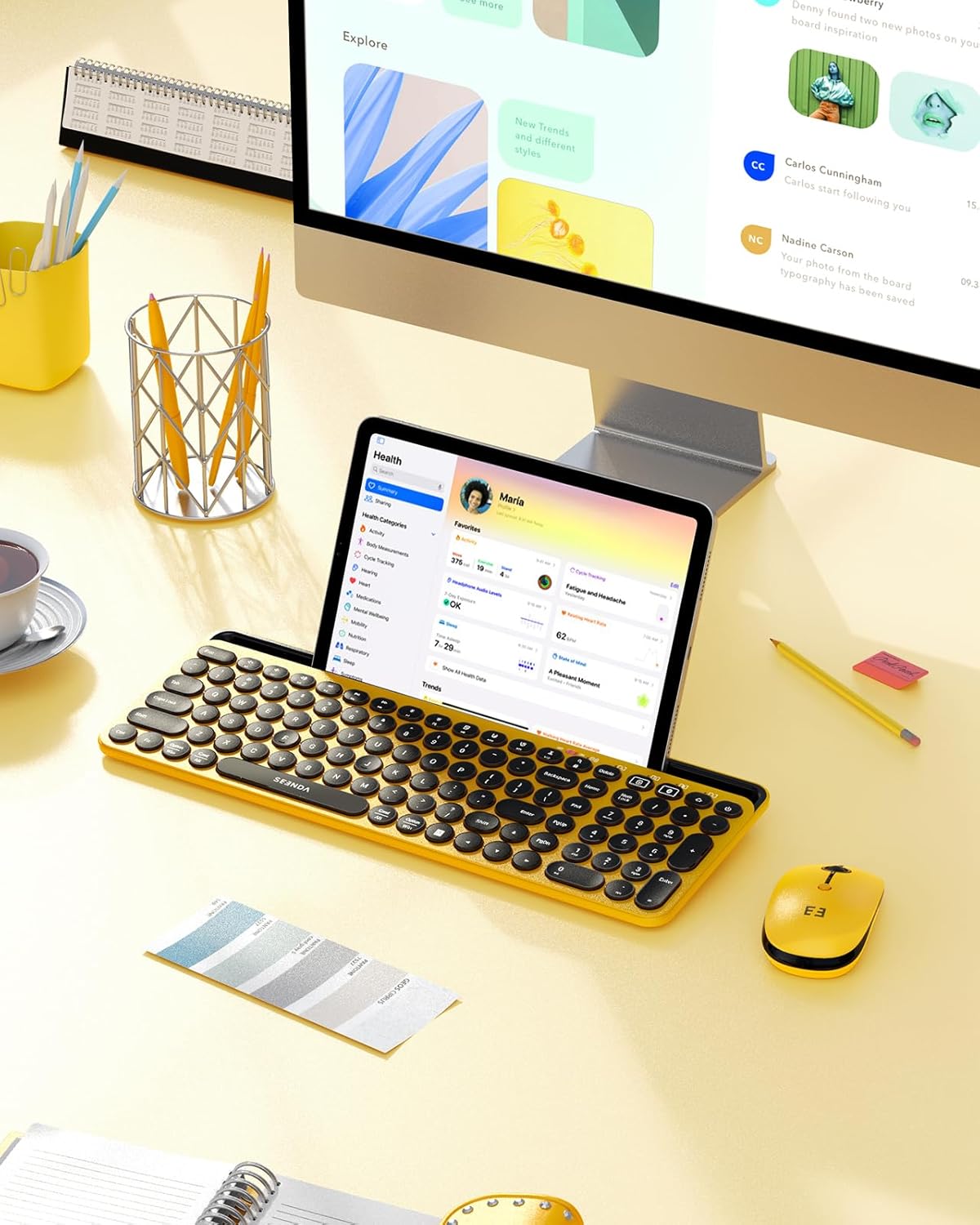
Image: The seenda CTU-301 keyboard and mouse combo integrated into a modern workspace, with a tablet in the holder, demonstrating its practical application.
Product Features
The seenda CTU-301 keyboard and mouse combo offers a range of features designed for versatility and user comfort:
- Multi-Device Compatibility: Seamlessly switch between up to two devices (one 2.4G, one Bluetooth) across iOS, Android, macOS, and Windows operating systems.
- Dual Connection Modes: Connect via Bluetooth 5.0 for wireless convenience or 2.4G USB receiver for stable, plug-and-play connectivity.
- Integrated Tablet Holder: Features a built-in slot to securely hold tablets and smartphones, providing an optimal viewing angle.
- Full-Size Keyboard with Numeric Pad: Includes 15 convenient hotkeys and an FN lock function for enhanced productivity.
- Responsive Round Keys: Low-profile, water-drop concave keys designed for comfortable, quiet, and accurate typing, with an anti-grease finish.
- Silent Symmetrical Mouse: Adjustable DPI (1000/1600/2400) with quiet clicks and an ergonomic, anti-fingerprint design.
- Low Power Consumption: Efficient design for extended battery life.

Image: The seenda CTU-301 wireless keyboard and mouse combo, featuring a yellow and black design, with a tablet and smartphone positioned in the integrated holder, showcasing its multi-device capability.

Image: A close-up view of the keyboard's low-profile, round, water-drop concave keys, emphasizing quiet typing and an anti-grease surface for comfortable and clean use.

Image: An illustration detailing the mouse's features, including quiet click buttons, three levels of adjustable DPI (1000/1600/2400), and a soft-touch, anti-fingerprint design for enhanced user experience.
Package Contents
Please check the package for the following items:
- seenda CTU-301 Wireless Keyboard
- seenda Wireless Mouse
- 2.4G USB Receiver (stored in the mouse battery compartment)
- Silicone Keyboard Cover
- User Manual (this document)
Note: AAA batteries for the keyboard (2x) and AA battery for the mouse (1x) are not included and must be purchased separately.
Setup Instructions
1. Battery Installation
Ensure fresh batteries are installed in both the keyboard and mouse for optimal performance.
- Keyboard: Open the battery compartment on the underside of the keyboard. Insert two (2) AAA batteries, ensuring correct polarity. Close the compartment.
- Mouse: Open the battery compartment on the underside of the mouse. Insert one (1) AA battery, ensuring correct polarity. The 2.4G USB receiver is also stored in this compartment. Remove it for 2.4G connection. Close the compartment.

Image: Underside view of the keyboard and mouse, showing the battery compartments and the location of the 2.4G USB receiver within the mouse.
2. 2.4G Wireless Connection (for Keyboard and Mouse)
This mode uses a single USB receiver for both the keyboard and mouse.
- Locate the 2.4G USB receiver inside the mouse's battery compartment and remove it.
- Plug the USB receiver into an available USB-A port on your computer or device.
- Turn on the keyboard using the ON/OFF switch located on the top right side.
- Turn on the mouse using the ON/OFF switch on its underside.
- Press the 2.4G button on the keyboard (usually indicated by a red light) to select 2.4G mode. The red indicator light will illuminate.
- The keyboard and mouse should automatically connect to your device.
3. Bluetooth Connection (for Keyboard and Mouse)
This mode allows connection to Bluetooth-enabled devices without a USB receiver.
Keyboard Bluetooth Pairing:
- Turn on the keyboard using the ON/OFF switch.
- Press the Bluetooth button on the keyboard (usually indicated by a blue light) to select Bluetooth mode. The blue indicator light will flash, indicating it's in pairing mode.
- On your device (e.g., iPad, smartphone, computer), go to Bluetooth settings.
- Search for available devices and select "seenda Keyboard" (or similar name).
- Follow any on-screen prompts to complete pairing. The blue indicator light will stop flashing once connected.
Mouse Bluetooth Pairing:
- Turn on the mouse using the ON/OFF switch.
- Press the Bluetooth button on the underside of the mouse. The blue indicator light will flash, indicating it's in pairing mode.
- On your device, go to Bluetooth settings.
- Search for available devices and select "seenda Mouse" (or similar name).
- Follow any on-screen prompts to complete pairing. The blue indicator light will stop flashing once connected.

Image: Illustration demonstrating the one-click switching mechanism between 2.4G wireless mode (red indicator) and Bluetooth mode (blue indicator) for the keyboard and mouse.
Operating Instructions
1. Switching Between Devices
The keyboard and mouse support connecting to multiple devices. Use the dedicated buttons to switch between 2.4G and Bluetooth connections.
- To switch to 2.4G Wireless Mode: Press the button labeled "2.4G" on the keyboard or mouse. The red indicator light will confirm the mode.
- To switch to Bluetooth Mode: Press the button labeled "Bluetooth" on the keyboard or mouse. The blue indicator light will confirm the mode.
The system automatically recognizes the connected device's operating system (Windows, macOS, iOS, Android) and maps keys accordingly, eliminating manual switching.

Image: An illustration depicting the dual-mode Bluetooth and 2.4G wireless connectivity, showing the keyboard and mouse connected to a laptop and a desktop computer, compatible with Windows, macOS, iOS, and Android.
2. Using the Integrated Tablet Holder
The keyboard features a built-in slot designed to hold your tablet or smartphone.
- Gently place your tablet or smartphone into the slot at the top of the keyboard.
- The slot is 14.4 inches long and 0.43 inches wide, capable of holding devices up to a 12.9-inch iPad Pro horizontally.
- Note: If your device has a thick protective case, it may need to be removed for the device to fit securely in the holder. The holder includes anti-slip and anti-scratch pads.

Image: Close-up view of the keyboard's integrated holder, demonstrating its ability to securely hold a tablet and a smartphone simultaneously, highlighting the anti-slip and anti-scratch features.
3. Keyboard Hotkeys and FN Lock
The keyboard includes 15 convenient hotkeys and an FN lock function to enhance your workflow.
- Hotkeys: Access functions like media control (play/pause, volume), brightness adjustment, search, and more directly.
- FN Lock Key: This key allows you to toggle the F1-F12 keys between their standard function key behavior and their media/hotkey functions. Press the FN lock key to switch modes.
- Lock Key: A dedicated "Lock key" is available to quickly lock your device's screen.

Image: A detailed view of the keyboard layout, highlighting the 15 hotkeys and the FN lock key, illustrating their functions for Apple and Windows layouts.
4. Adjusting Mouse DPI
The mouse features adjustable DPI settings to customize cursor sensitivity.
- Press the DPI button (usually located near the scroll wheel) to cycle through the available DPI settings: 1000 DPI, 1600 DPI, and 2400 DPI.
- Select the DPI setting that best suits your preference and task.

Image: A close-up of the wireless mouse, indicating the DPI button and the three adjustable DPI levels (1000, 1600, 2400), along with a note about its quiet click functionality.
Maintenance
- Cleaning: Use a soft, dry cloth to clean the keyboard and mouse. For stubborn dirt, slightly dampen the cloth with water or a mild cleaning solution. Avoid harsh chemicals.
- Silicone Keyboard Cover: The included silicone cover can be removed and washed with water to keep your keyboard clean and protected from dust and spills.
- Battery Replacement: Replace batteries when the low battery indicator light illuminates (red light on the keyboard). Always use new, high-quality AAA batteries for the keyboard and AA battery for the mouse.
- Storage: When not in use for extended periods, turn off both the keyboard and mouse to conserve battery life. Store the 2.4G USB receiver in the mouse's battery compartment to prevent loss.

Image: A visual guide to the keyboard's intuitive indicators (low battery, caps lock, mode, number lock) and the included silicone cover, emphasizing its protective benefits.
Troubleshooting
Keyboard/Mouse Not Connecting or Lagging:
- Check Batteries: Ensure batteries are correctly installed and have sufficient charge. Replace if necessary.
- Power On: Verify that both the keyboard and mouse are switched ON.
- Correct Mode: Ensure the correct connection mode (2.4G or Bluetooth) is selected on both the keyboard and mouse. The indicator lights should confirm the selected mode.
- 2.4G Connection: For 2.4G, ensure the USB receiver is securely plugged into a working USB port. Try a different USB port.
- Bluetooth Connection: For Bluetooth, ensure Bluetooth is enabled on your device. If previously paired, try unpairing and re-pairing the device. Ensure the keyboard/mouse is in pairing mode (flashing blue light).
- Distance: Ensure the keyboard/mouse is within the operating range (up to 33 feet or 10 meters) of your device.
- Interference: Move away from other wireless devices that might cause interference (e.g., Wi-Fi routers, other Bluetooth devices).
- Restart Devices: Try restarting your computer/tablet/phone and then reconnecting the keyboard and mouse.
Keys Not Responding or Double Typing:
- Clean Keyboard: Remove the silicone cover and check for any debris under the keys. Clean as per maintenance instructions.
- Battery Level: Low battery can sometimes cause inconsistent key presses. Replace batteries.
- Reconnection: Disconnect and reconnect the keyboard (either via 2.4G or Bluetooth).
Mouse Cursor Jumps or is Inaccurate:
- Surface: Ensure you are using the mouse on a clean, non-reflective, and even surface. A mouse pad is recommended.
- Sensor: Check the mouse's optical sensor for any obstructions or dirt.
- DPI Setting: Adjust the DPI setting to a lower value if the cursor is too sensitive.
- Battery Level: Replace the mouse battery if the cursor movement is erratic.
Specifications
| Model | CTU-301 |
| Connectivity | Bluetooth 5.0, 2.4G Wireless (USB Receiver) |
| Operating Distance | Up to 10 meters (33 feet) |
| Keyboard Layout | Full-size with Numeric Pad, 15 Hotkeys |
| Keyboard Keys | Low-profile, Round, Water-drop Concave |
| Mouse DPI | 1000 / 1600 / 2400 adjustable |
| Compatible OS | iOS, Android, macOS, Windows |
| Keyboard Battery | 2 x AAA batteries (not included) |
| Mouse Battery | 1 x AA battery (not included) |
| Keyboard Dimensions | Approximately 15.5 x 5.7 x 0.3-0.9 inches |
| Mouse Dimensions | Approximately 4.7 x 2.6 x 1.4 inches |
| Item Weight | Approximately 2.33 pounds (keyboard and mouse combined) |

Image: Technical drawing showing the dimensions of the seenda CTU-301 keyboard and mouse, including length, width, and height measurements.
Warranty and Support
seenda products are designed for reliability and performance. For specific warranty information, please refer to the warranty card included with your purchase or visit the official seenda website.
If you encounter any issues or have questions regarding your CTU-301 keyboard and mouse, please contact seenda customer support through their official channels. Contact information can typically be found on the product packaging or the brand's website.


