
1. Introduction
The ORICO R40 External SSD is a high-performance portable storage device designed for rapid data transfer and reliable storage. It features compatibility with Thunderbolt 3, Thunderbolt 4, and USB4.0 interfaces, offering speeds up to 40Gbps. This manual provides instructions for the proper setup, operation, and maintenance of your ORICO R40 SSD.
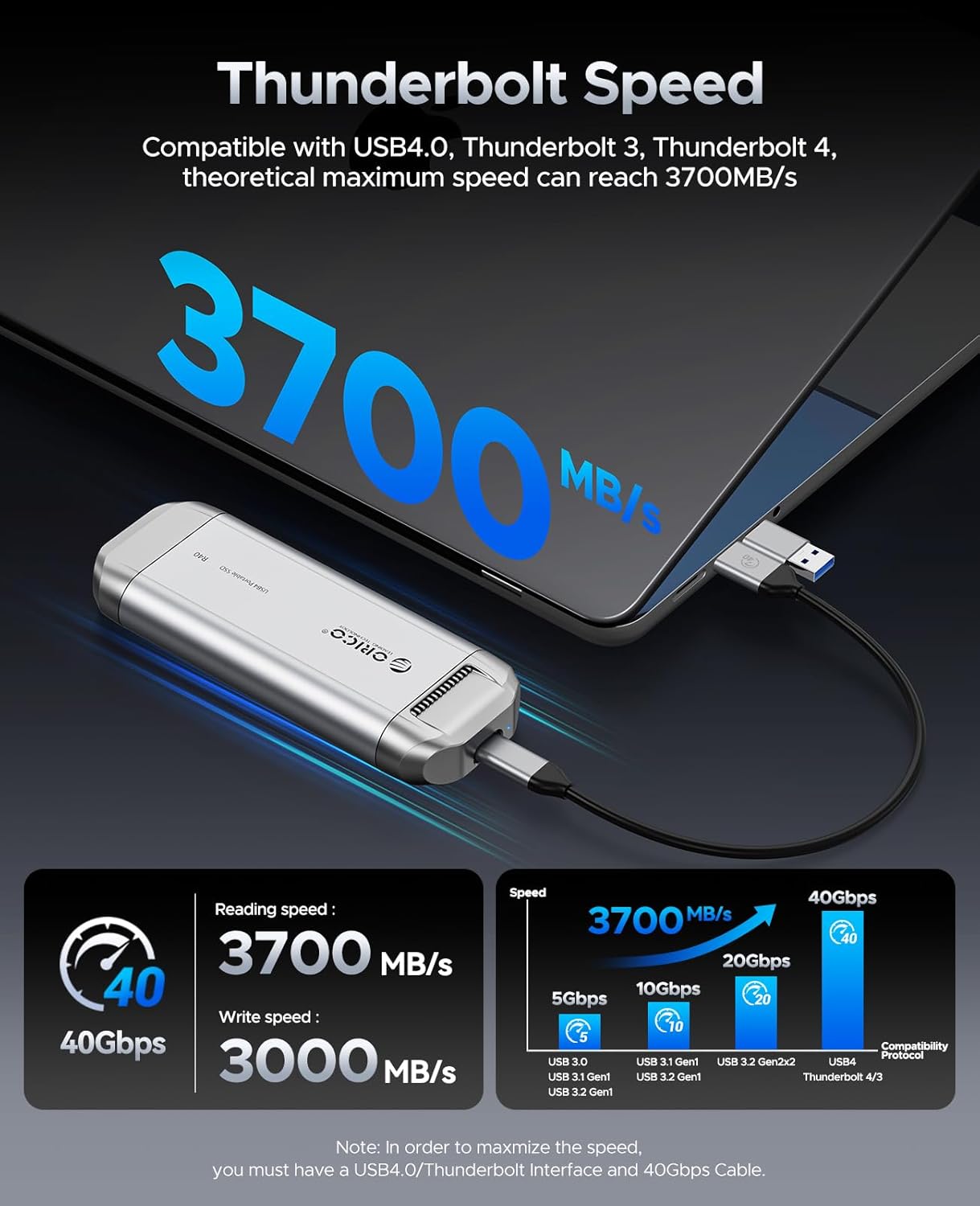
Image: The ORICO R40 External SSD, a compact and durable portable storage device.
2. Package Contents
Please verify that all items are present in the package:
- ORICO R40 External SSD (1TB, 2TB, or 4TB model)
- 2-in-1 USB-A and USB-C Cable
- User Manual (this document)
3. Setup Instructions
3.1 Connecting the SSD
- Locate the 2-in-1 USB-A and USB-C cable provided with your ORICO R40 SSD.
- Connect the USB-C end of the cable to the USB-C port on the ORICO R40 SSD.
- Connect the other end of the cable (USB-C or USB-A, depending on your device) to an available port on your computer, smartphone, tablet, or other compatible device.
- Ensure the connection is secure. The SSD should be recognized by your operating system automatically.

Image: The ORICO R40 SSD connected to a laptop, illustrating its broad compatibility with USB-A and USB-C devices.
3.2 Initializing and Formatting (If Required)
For new SSDs, or if the SSD is not recognized, you may need to initialize and format it. This process varies by operating system:
- Windows: Open Disk Management (Right-click "This PC" > "Manage" > "Disk Management"). Locate the ORICO R40 SSD, initialize it (GPT recommended for larger drives), and then create a new simple volume, formatting it with NTFS or exFAT.
- macOS: Open Disk Utility (Applications > Utilities > Disk Utility). Select the ORICO R40 SSD, click "Erase," choose a name, format (APFS or Mac OS Extended (Journaled)), and scheme (GUID Partition Map).
- Linux: Use disk management tools like GParted or
fdisk/mkfscommands to partition and format the drive.
Note: Formatting an SSD will erase all data on it. Back up any important data before proceeding.
4. Operating Instructions
4.1 Data Transfer
To transfer files, simply drag and drop them to and from the ORICO R40 SSD, similar to any other external drive. For optimal performance, ensure your host device supports Thunderbolt 3/4 or USB4.0 and use the provided cable.

Image: A user editing video on a laptop, demonstrating the ORICO R40 SSD's capability for fast data transfer in professional workflows.
4.2 Speed and Performance
The ORICO R40 SSD is capable of theoretical maximum speeds of up to 3700MB/s (read) and 3000MB/s (write) when connected to a compatible Thunderbolt 3/4 or USB4.0 port with a 40Gbps cable. Actual speeds may vary based on your system configuration, file types, and operating environment.

Image: Illustration of the ORICO R40 SSD's Thunderbolt speed, showing up to 3700MB/s read and 3000MB/s write speeds.
4.3 Safe Removal
Always safely eject the SSD from your operating system before physically disconnecting it to prevent data corruption. This is typically done by right-clicking the drive icon and selecting "Eject" (Windows) or dragging the drive icon to the Trash (macOS).
5. Maintenance
5.1 Cooling System
The ORICO R40 SSD incorporates a built-in cooling fan and an aluminum alloy housing to maintain optimal operating temperatures during intensive use. Ensure that the ventilation openings are not obstructed to allow for proper airflow.

Image: Internal view of the ORICO R40 SSD highlighting the cooling fan and aluminum alloy shell for efficient heat dissipation.
5.2 General Care
- Keep the SSD clean and free from dust. Use a soft, dry cloth for cleaning.
- Avoid exposing the SSD to extreme temperatures, direct sunlight, or high humidity.
- While the device is designed to be durable, avoid dropping it or subjecting it to strong impacts.
6. Troubleshooting
6.1 SSD Not Recognized
- Check Cable Connection: Ensure the 2-in-1 USB-C cable is securely connected to both the SSD and your device. Try a different port on your device.
- Try a Different Cable: If available, test with another compatible USB4.0 or Thunderbolt cable to rule out a faulty cable.
- Check Disk Management (Windows) / Disk Utility (macOS): Verify if the drive appears there. If it does, it might need initialization and formatting (refer to Section 3.2).
- Restart Device: Sometimes a simple restart of your computer or device can resolve recognition issues.
- Compatibility: Ensure your device's port supports the required bandwidth (Thunderbolt 3/4 or USB4.0 for optimal performance). Older USB standards may have limited compatibility or performance.
6.2 Slow Transfer Speeds
- Verify Port Type: For maximum speeds (up to 3700MB/s), your device must have a Thunderbolt 3, Thunderbolt 4, or USB4.0 port. Connecting to a standard USB 3.0/3.1/3.2 port will result in lower speeds.
- Use Provided Cable: Always use the original 2-in-1 USB-C cable or another certified 40Gbps cable. Lower quality or incompatible cables can limit speed.
- System Load: High CPU usage or other background processes on your computer can affect transfer speeds.
- File Type and Size: Transferring many small files is generally slower than transferring a few large files.
- SSD Temperature: While the R40 has a cooling system, prolonged heavy use in a hot environment might lead to thermal throttling, reducing speeds. Ensure proper ventilation.
6.3 Overheating or Fan Noise
- Ventilation: Ensure the SSD is placed on a hard, flat surface and that its ventilation grilles are not blocked.
- Normal Operation: The built-in fan operates to keep the SSD cool during high-performance tasks. Some fan noise is normal. If the noise is excessive or unusual, contact support.
- Disconnect When Not in Use: If the fan noise or warmth is bothersome when the drive is idle, disconnect it from your device.
7. Specifications
| Feature | Detail |
|---|---|
| Model | R40 Series (R40-1TB, R40-2TB, R40-4TB) |
| Digital Storage Capacity | 1TB, 2TB, 4TB (depending on model) |
| Hard Disk Interface | Thunderbolt |
| Connectivity Technology | Thunderbolt, USB |
| Theoretical Max Read Speed | Up to 3700 MB/s |
| Theoretical Max Write Speed | Up to 3000 MB/s |
| Compatibility | Thunderbolt 3, Thunderbolt 4, USB4.0, USB-C, USB-A (with included cable) |
| Material | Aluminum Alloy, ABS |
| Special Features | Portable, Built-in Cooling System |
| Item Weight | Approximately 3.17 ounces (90 grams) |
| Dimensions | Approximately 7.28 x 4.25 x 1.26 inches (18.5 x 10.8 x 3.2 cm) |
8. Warranty and Support
8.1 Warranty Information
ORICO products typically come with a limited manufacturer's warranty. Please refer to the warranty card included in your product packaging or visit the official ORICO website for detailed warranty terms and conditions specific to your region and product model. Keep your proof of purchase for warranty claims.
8.2 Customer Support
For technical assistance, troubleshooting, or product inquiries, please contact ORICO customer support through their official website. You can usually find contact information, FAQs, and driver downloads on the support section of the ORICO website.
Official ORICO Website: www.oricotech.com


