1. Important Safety Information
Read all safety warnings, instructions, illustrations, and specifications provided with this power tool. Failure to follow all instructions listed below may result in electric shock, fire, and/or serious injury.
- Always wear appropriate personal protective equipment, including eye protection, gloves, and a respirator, especially when spraying paints or chemicals.
- Ensure adequate ventilation in the work area to prevent the accumulation of flammable vapors.
- Keep children and bystanders away while operating the paint sprayer.
- Do not spray near open flames, pilot lights, or other ignition sources.
- Always disconnect the power supply before cleaning, adjusting, or performing maintenance on the sprayer.
- Use only paints and materials compatible with HVLP sprayers and follow the paint manufacturer's safety guidelines.
2. Product Overview
The ENEACRO HVLP Paint Sprayer System is designed for efficient and uniform application of paint on various surfaces. It features a powerful motor and a large capacity container for extended use.
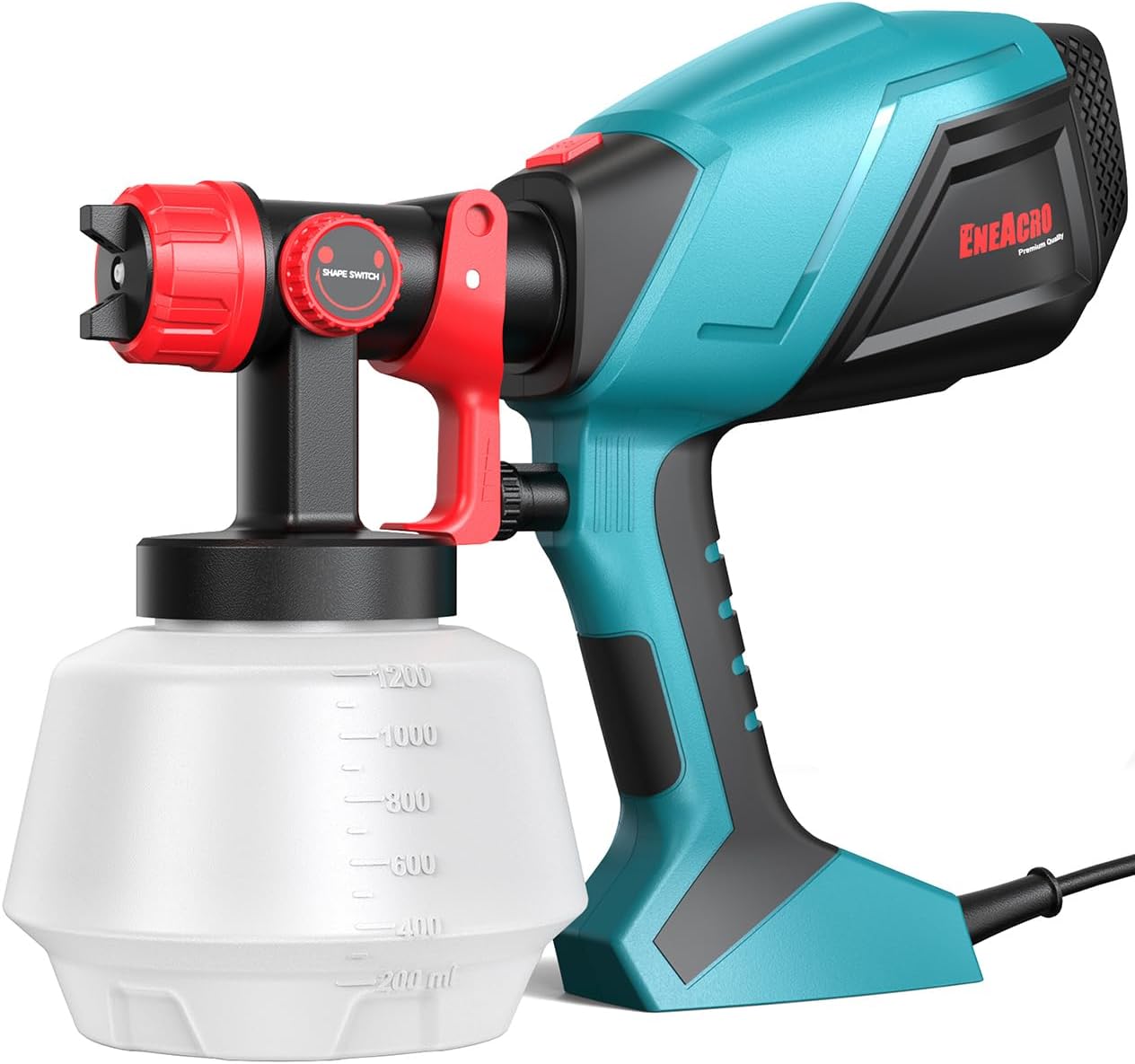
Image: The ENEACRO 650W HVLP Paint Sprayer System, showing the main unit, spray gun, and paint container.
Package Contents:
- 1 x 650W Paint Sprayer Unit
- 1 x 1200ml Paint Container
- 5 x Brass Nozzles (1mm, 1.5mm, 2mm, 2.5mm, 3mm)
- 5 x Paper Funnels
- 1 x Replacement Sponge Filter
- 1 x Viscosity Cup
- 1 x Cleaning Needle
- 1 x Cleaning Brush
- 1 x User Manual
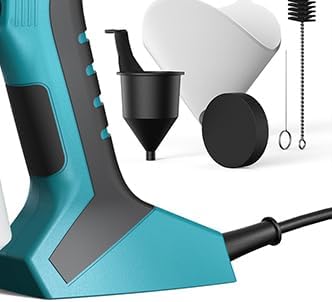
Image: Various accessories including nozzles, cleaning tools, and a viscosity cup.
3. Setup
3.1 Paint Preparation and Viscosity Test
Proper paint viscosity is crucial for optimal spraying. Use the included viscosity cup to test your paint. Thin the paint as necessary according to the paint manufacturer's recommendations until it flows smoothly through the cup within the recommended time (typically 20-40 seconds for most paints, refer to paint instructions for specifics).

Image: The 1200ml paint container with clear volume markings for accurate mixing.
3.2 Nozzle Selection
The sprayer comes with 5 brass nozzles (1mm, 1.5mm, 2mm, 2.5mm, 3mm) for different paint types and desired finishes. Choose the appropriate nozzle based on the paint's viscosity and the project requirements. Thicker paints generally require larger nozzles.

Image: A selection of five brass nozzles, ranging from 1mm to 3mm, for various paint viscosities.
3.3 Assembly
- Attach the spray gun assembly to the motor unit by aligning the components and securing them firmly.
- Ensure the selected nozzle is properly installed and tightened onto the spray gun.
- Fill the paint container with the prepared paint and securely attach it to the spray gun.

Image: Visual guide demonstrating the assembly and disassembly of the paint sprayer unit.
4. Operating Instructions
4.1 Power On and Flow Control
Connect the sprayer to a power outlet. The sprayer features an adjustable flow control knob to regulate the paint output. Turn the knob to increase or decrease the paint flow rate to suit your project and paint type.

Image: Detail of the adjustable flow control mechanism, allowing precise regulation of paint output.
4.2 Adjusting Spray Pattern
The air cap can be rotated 360° to adjust the spray pattern to horizontal, vertical, or circular. Select the pattern that best suits the surface you are painting.
- Horizontal Pattern: Ideal for spraying vertical surfaces.
- Vertical Pattern: Ideal for spraying horizontal surfaces.
- Circular Pattern: Suitable for small areas, corners, or intricate details.
4.3 Spraying Technique
Maintain a consistent distance (approximately 6-10 inches) from the surface. Move the sprayer in smooth, even strokes, overlapping each pass by about 50% to ensure uniform coverage. Avoid tilting the sprayer excessively to prevent paint starvation.

Image: Demonstrating the sprayer in use on a wooden fence, showing a wide, even spray pattern.

Image: The paint sprayer being used to apply paint to a wooden chair, highlighting its versatility for furniture.

Image: Applying paint to a brick wall, demonstrating the sprayer's ability to cover textured surfaces.

Image: The paint sprayer being used on a wooden door, showing a smooth and even application.
5. Maintenance
Thorough cleaning after each use is essential to maintain the sprayer's performance and extend its lifespan. Paint residue can clog nozzles and internal components.
5.1 Cleaning Procedure
- Empty any remaining paint from the container.
- Fill the container with an appropriate cleaning solution (water for water-based paints, mineral spirits for oil-based paints).
- Spray the cleaning solution through the sprayer until it runs clear.
- Disassemble the spray gun, including the nozzle, air cap, and paint container.
- Clean all disassembled parts thoroughly with the cleaning brush and needle. Pay special attention to the nozzle and air cap to remove all paint residue.
- Rinse all parts with clean water and allow them to dry completely before reassembly or storage.

Image: A visual guide illustrating the steps for cleaning the paint sprayer's components, including the container and nozzle.
5.2 Filter Maintenance
Regularly check and clean the air filter located on the motor unit. A clogged filter can reduce performance. Replace the filter with the provided spare sponge filter when necessary.

Image: Close-up view of the air filter compartment, showing the removable sponge filter for cleaning or replacement.
6. Troubleshooting
If you encounter issues with your paint sprayer, refer to the following common problems and solutions:
| Problem | Possible Cause | Solution |
|---|---|---|
| No spray or weak spray | Clogged nozzle, paint too thick, air filter clogged, suction tube blocked. | Clean nozzle, thin paint, clean/replace air filter, clear suction tube. |
| Uneven spray pattern | Incorrect nozzle size, paint too thick/thin, damaged air cap, inconsistent spraying technique. | Select correct nozzle, adjust paint viscosity, check/replace air cap, practice technique. |
| Paint leaking | Loose connections, damaged seals, paint container not sealed properly. | Tighten all connections, inspect and replace seals if damaged, ensure container is sealed. |
| Motor not starting | No power, faulty switch, motor issue. | Check power connection, test power outlet, contact customer support. |
7. Specifications
| Feature | Specification |
|---|---|
| Brand | ENEACRO |
| Model Name | JH-12 |
| Power Type | Corded Electric |
| Motor Power | 650W (Note: Some product descriptions may state 700W, but the primary title indicates 650W) |
| Tank Volume | 1200 Milliliters |
| Material | Polypropylene (PP) |
| Product Dimensions (L x W x H) | 26 x 26 x 36 cm |
| Item Weight | 1.79 kilograms |
| Nozzle Sizes | 1mm, 1.5mm, 2mm, 2.5mm, 3mm (Brass) |
| Color | Blue |
8. Warranty and Support
For any questions or concerns regarding your ENEACRO paint sprayer, please contact our customer service team. You can typically reach support through your order platform, and our team aims to provide a response within 12 hours.
Please retain your proof of purchase for any warranty claims.


