
1. Introduction
The RESIONE K+ ABS-Like Tough 3D Printer Resin is engineered for high-performance 3D printing, offering a unique combination of strength, toughness, and precision. This resin is ideal for creating functional parts, prototypes, and models that require durability and fine detail. Its formulation ensures low water absorption, scratch resistance, and a pure black finish with an injection-molded texture.

An overview of the RESIONE K+ Black Tough Resin, emphasizing its core properties for high-performance 3D printing.
2. Safety Precautions
Always prioritize safety when handling 3D printer resin. Failure to follow these guidelines may result in personal injury or property damage.
- Ventilation: Use resin in a well-ventilated area to minimize exposure to fumes. Consider using an air purifier or working near an open window.
- Personal Protective Equipment (PPE): Always wear chemical-resistant gloves (nitrile or butyl rubber) and safety glasses to prevent skin and eye contact. A respirator with organic vapor cartridges is recommended for prolonged exposure.
- Skin Contact: In case of skin contact, immediately wash the affected area with soap and plenty of water. Do not use alcohol or solvents to clean skin.
- Eye Contact: If resin gets into eyes, flush immediately with plenty of water for at least 15 minutes and seek medical attention.
- Ingestion: Do not ingest resin. If swallowed, do not induce vomiting. Rinse mouth and seek immediate medical attention.
- Storage: Store resin in its original opaque bottle, tightly sealed, in a cool, dry, and dark place away from direct sunlight and heat sources. Keep out of reach of children and pets.
- Disposal: Dispose of uncured liquid resin and contaminated materials (e.g., paper towels, gloves) according to local regulations for hazardous waste. Cured resin is generally safe for regular waste disposal.
- Flammability: Keep resin away from open flames, sparks, and heat.
3. Product Features
The RESIONE K+ ABS-Like Tough 3D Printer Resin offers several key advantages for your printing needs:
3.1 Stiff and Tough, High Strength
Printed parts exhibit excellent tensile, bending, and impact strength, comparable to tough thermoplastic plastics. They can withstand drilling, tapping, and other high-stress modifications, making them suitable for functional parts and fixtures that endure long-term static loads, transient stresses, or strains.

This image illustrates the exceptional flexibility and durability of parts printed with RESIONE K+ resin, capable of withstanding significant bending without fracture.
3.2 High Precision, Sharp Details
The K+ ABS-Like resin's special formulation minimizes overexposure, allowing printed parts to accurately replicate intricate details from 3D data, such as grooves, textures, hairs, holes, and protrusions. These parts achieve precise assembly, making them perfect for precision components, assembly parts, and miniature accessories.

Observe the fine details and sharp edges achievable with RESIONE K+ resin, making it suitable for intricate models and precision parts.
3.3 Low Water Absorption
Unlike materials with high water absorption, K+ printed parts have low water absorption and are less affected by changes in humidity. They remain stable and resistant to softening, deformation, or cracking, making them suitable for high humidity environments and certain underwater operations.

This image highlights the low water absorption characteristic of RESIONE K+ resin, ensuring printed parts maintain stability even in humid or wet conditions.
3.4 Scratch Resistance
The surface of K+ printed parts is hard, with excellent scratch resistance performance. The surface will not be easily scratched by hard objects or become powdery by friction. This tough resin is a good choice for parts requiring repeated assembly or snap-fit applications.

The scratch resistance of RESIONE K+ resin is demonstrated here, showing its ability to maintain surface integrity against abrasive contact, ideal for functional parts.
3.5 Pure Black, Injection-Molded Texture
Our K+ high precision resin is a pure black liquid, and the printed parts it produces do not exhibit a blue-purple hue in sunlight like K resin. The parts have a delicate texture that resembles injection molded parts, giving them a high-end and attractive appearance. This makes it an ideal material for appearance verification prototypes, artworks, interior decorations, and toy accessories.
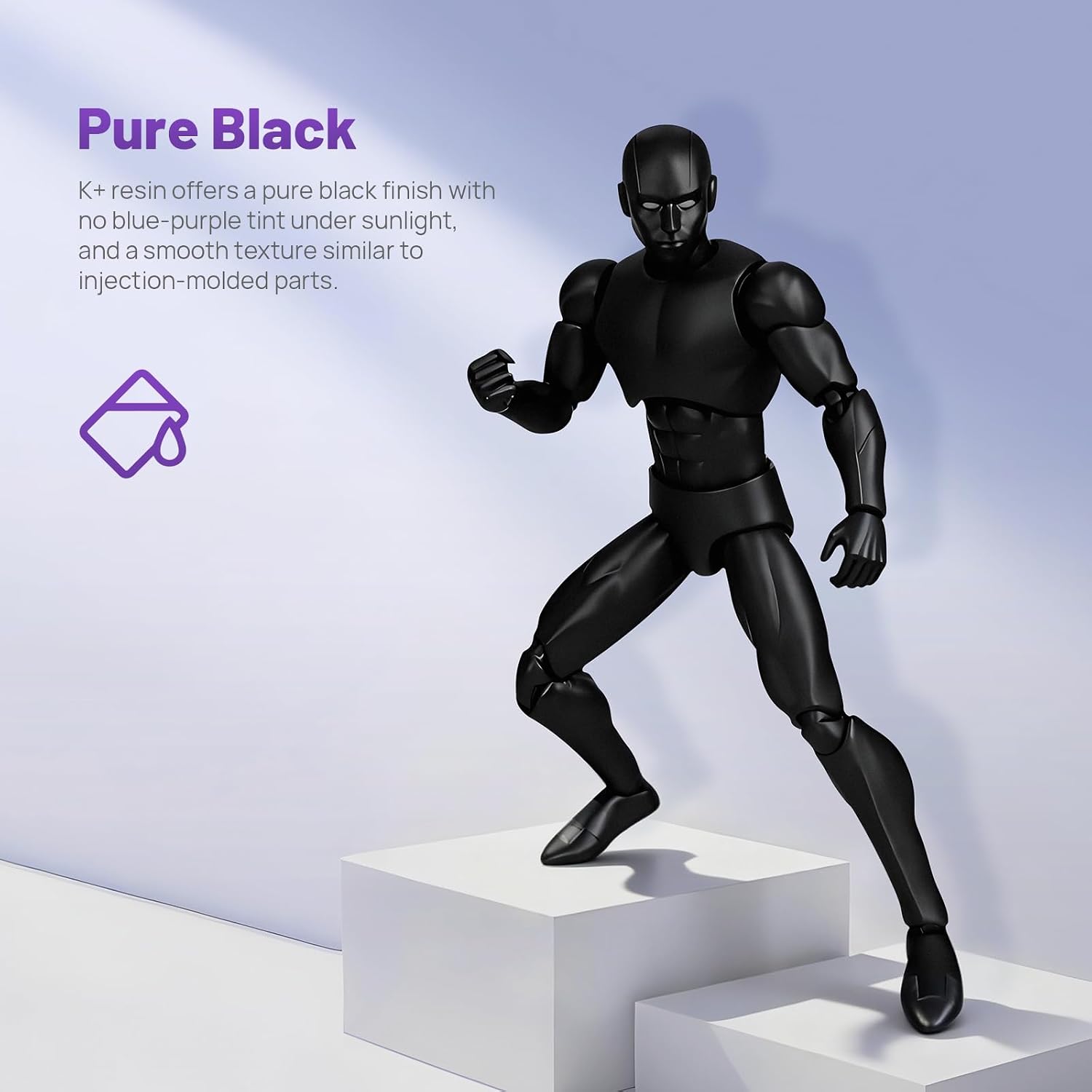
This image displays the pure black finish and smooth, high-quality texture of parts printed with RESIONE K+ resin, resembling injection-molded components.
3.6 Wide Range of Applications
RESIONE K+ 3D printer resin is suitable for printing functional verification components, product enclosures, precision parts, tooling fixtures, miniature accessories, artworks, end-use parts with moderate impact resistance requirements, short-term waterproof parts, and high-strength, impact-resistant parts, snap-fit components, and assemblies for short-term use.

Examples of functional and intricate parts printed with RESIONE K+ resin, highlighting its suitability for precision components, assembly parts, and diverse applications.
4. Setup
Proper setup is crucial for successful 3D printing with RESIONE K+ resin.
- Preparation: Ensure your 3D printer is clean and level. Check the FEP film for any damage or cloudiness.
- Shake Resin Bottle: Before each use, thoroughly shake the resin bottle for at least 1-2 minutes to ensure all components are well mixed. This is especially important if the resin has been sitting for a while.
- Pour Resin: Carefully pour the desired amount of RESIONE K+ resin into the printer's resin vat. Do not overfill.
- Temperature: Optimal printing temperature is typically between 25-30°C (77-86°F). If your printing environment is cooler, consider warming the resin bottle in a warm water bath before use.
- Printer Settings: Refer to your 3D printer's manual and RESIONE's recommended exposure settings for K+ resin. These settings may vary depending on your printer model and desired layer height.
5. Operating Instructions
Follow these steps for optimal printing results with RESIONE K+ resin:
- Slicing Software: Prepare your 3D model using appropriate slicing software (e.g., Chitubox, Lychee Slicer). Ensure supports are correctly placed and print orientation is optimized.
- Exposure Settings: Apply the recommended exposure settings for RESIONE K+ resin. Initial layer exposure times are typically longer to ensure good bed adhesion.
- Start Printing: Initiate the printing process on your 3D printer. Monitor the first few layers to ensure proper adhesion and print formation.
- Post-Processing - Washing: Once printing is complete, carefully remove the build plate. Use a scraper to detach the printed part. Wash the part thoroughly in isopropyl alcohol (IPA) with a concentration of 95% or higher, or a dedicated resin cleaner. Use a soft brush to remove any uncured resin from crevices.
- Post-Processing - Curing: After washing and allowing the part to dry completely, place it in a UV curing station or expose it to direct sunlight for final curing. Curing times vary based on the part's thickness and UV light intensity. Ensure all surfaces are evenly cured.
- Support Removal: Carefully remove any remaining supports. For best results, remove supports before full curing, as they may be easier to detach.
6. Maintenance
Proper maintenance ensures the longevity of your resin and printer components.
- Resin Storage: After printing, if there is unused resin in the vat, filter it back into the original opaque bottle using a resin filter funnel. Seal the bottle tightly and store it in a cool, dark place.
- Vat Cleaning: Clean the resin vat thoroughly after each print session or if changing resin types. Use IPA and soft cloths. Avoid scratching the FEP film.
- Printer Cleaning: Regularly clean your 3D printer, especially the build plate and any resin spills, using IPA.
- FEP Film Inspection: Periodically inspect the FEP film for damage, cloudiness, or excessive wear. Replace it if necessary to prevent print failures.
7. Troubleshooting
Here are solutions to common issues encountered when printing with resin:
- Prints Not Sticking to Build Plate:
- Increase initial layer exposure time.
- Ensure build plate is properly leveled and clean.
- Increase room/resin temperature.
- Failed Prints / Partial Prints:
- Check for adequate support structures.
- Verify exposure settings are correct for the resin and layer height.
- Inspect FEP film for damage or cloudiness.
- Filter resin for cured bits.
- Sticky / Soft Prints:
- Ensure parts are thoroughly washed to remove all uncured resin.
- Increase post-curing time or ensure even UV exposure.
- Check IPA concentration; use 95% or higher.
- Brittle Prints:
- Avoid over-curing, which can make parts brittle.
- Ensure resin is not expired or contaminated.
- Verify print settings are within recommended ranges.
- Poor Detail / Blurry Prints:
- Reduce normal exposure time slightly.
- Ensure FEP film is clean and clear.
- Check for vibrations during printing.
8. Specifications
| Attribute | Value |
|---|---|
| Brand | RI RESIONE |
| Model Number | K-CA-P |
| Item Weight | 1.21 kg |
| Colour | Black / Pure Black |
| Item Package Quantity | 1 |
| Manufacturer | RESIONE |
| Country of Origin | China |
| First Available Date | Nov. 27 2024 |
9. Warranty and Support
RESIONE K+ ABS-Like Tough 3D Printer Resin is subject to a standard return policy of 30 days for refund or replacement, in accordance with retailer terms and conditions.
For technical support, product inquiries, or assistance with printing issues, please contact RESIONE customer service through their official website or the retailer's support channels. Provide your product model number (K-CA-P) and a detailed description of your issue for efficient assistance.