
Redodo 24V200Ah
Redodo 24V 200Ah LiFePO4 Battery User Manual
Model: 24V200Ah
Product Overview
The Redodo 24V 200Ah LiFePO4 Battery is a high-performance, long-lasting lithium iron phosphate battery designed for various applications including off-grid solar systems, RVs, vans, backup power, and home energy storage. It features a robust Battery Management System (BMS) for enhanced safety and reliability.

Figure 1: Redodo 24V 200Ah LiFePO4 Battery, showcasing its compact design and branding.
Key Features
- High Energy Density: Provides 5120Wh capacity with a weight of 82.67lbs, offering powerful backup.
- Long Cycle Life: Built with Grade A LiFePO4 cells, offering 4000+ deep cycles at 100% Depth of Discharge (DOD) and up to 15000 cycles at 60% DOD, ensuring a lifespan of over 10 years.
- Advanced 200A BMS: Integrated Battery Management System protects against overcharging, over-discharging, over-current, short circuits, and high-temperature cut-off, safeguarding both the battery and your system.
- Scalable System: Supports up to 4 parallel and 2 series connections (4P2S) for a maximum 51.2V 800Ah LiFePO4 battery system, reaching up to 40.96kWh energy.
- Low Maintenance: Requires minimal maintenance, reducing long-term costs.
Safety Information and Warnings
Please read all safety instructions carefully before installation or use. Failure to follow these instructions may result in serious injury, property damage, or electric shock.
- ⚠ WARNING: A damaged lithium iron phosphate battery must not be installed or used under any circumstances. Immediately after unpacking, the lithium iron phosphate battery must be inspected for any damage. If the lithium iron phosphate battery is damaged, please contact your reseller.
- ⚠ WARNING: An external charge of the lithium iron phosphate battery must only be carried out with chargers recommended by the battery manufacturer.
- ⚠ WARNING: The lithium iron phosphate battery must never be short-circuited.
- ⚠ WARNING: In case of undervoltage tripping, the lithium iron phosphate battery must be recharged as soon as possible.
- ⚠ WARNING: When using the lithium iron phosphate battery, the parameters mentioned in the technical data sheet for the use of lithium iron phosphate batteries must always be respected.
- ⚠ WARNING: A lithium iron phosphate battery must never be overcharged, as this would permanently damage the battery. Only chargers with an automatic charge stop function should be used.
- ⚠ WARNING: If the lithium iron phosphate battery becomes too hot during charging, the charging process must be interrupted.
- ⚠ WARNING: The charging current must not exceed the maximum charging current indicated on the technical data sheet.
- ⚠ WARNING: The lithium iron phosphate battery must be charged before use. When the charger is no longer used, the lithium iron phosphate battery must be disconnected from the charger.
- ⚠ WARNING: To ensure a long lifespan of the lithium iron phosphate battery and ensure safety, a charger allowing the parameters mentioned in the technical data sheet to be adjusted must be used. Other chargers should only be used if it is certain that the charging voltage does not exceed the charging voltage limits of the lithium iron phosphate battery at any stage of the charge.
- ⚠ WARNING: DO NOT DISASSEMBLE: Never disassemble these cells. Disassembly can lead to an internal short circuit in the cell, which may result in gas production, inflammation, an explosion, or other problems.
- ⚠ WARNING: ELECTROLYTE IS HARMFUL: Normally, there should be no liquid electrolyte from Li-Fe batteries, but if electrolyte comes into contact with skin or eyes, it is necessary to immediately dilute with fresh water and consult a doctor.
- ⚠ WARNING: DO NOT THROW CELLS INTO WATER: Do not immerse the battery in liquids such as water, sea water, non-alcoholic beverages, fruit juices, coffee, or other beverages.
- ⚠ WARNING: DO NOT USE DAMAGED CELLS: If abnormal cell properties are observed, such as damage to the plastic casing or the cell, deformation of the cell pack, an electrolyte odor, electrolyte leakage, and other abnormalities, the cells must no longer be used. Cells that smell of electrolyte or are leaking must be kept away from fire to prevent inflammation or explosion.
- ⚠ WARNING: DO NOT USE IN CERTAIN LOCATIONS: Do not use the battery in places with a strong magnetic field, as this could easily damage the battery's safety protection device and create hidden dangers.

Figure 2: Original safety warnings provided with the product, translated for user convenience.
Specifications
| Attribute | Value |
|---|---|
| Brand | Redodo |
| Size | 24V200Ah |
| Product Dimensions | 10.55"D x 20.47"W x 8.66"H |
| Number Of Cells | 1 |
| Resistance | 40 Microohms |
| Terminal | M8 Terminal |
| Automotive Fit Type | Universal Fit |
| Manufacturer | Redodo |

Figure 3: Detailed dimensions and terminal specifications for the Redodo 24V 200Ah battery.

Figure 4: Comparison table showing specifications for various Redodo 12V100Ah battery models, including dimensions, weight, BMS, and temperature ranges.
Setup and Installation
Before installation, ensure all components are present and undamaged. Always wear appropriate personal protective equipment (PPE) including gloves and eye protection.
Connecting Batteries in Series or Parallel
The Redodo 24V 200Ah battery supports a maximum 4P2S configuration, allowing for a 51.2V 800Ah system. Ensure all batteries are of the same voltage and capacity when connecting in series or parallel. Use appropriate cables and connectors rated for the expected current.

Figure 5: Illustration of a solar system setup demonstrating how Redodo batteries can be connected in a 4P2S (4 parallel, 2 series) configuration to power various loads via an inverter.
Terminal Connections
Use the provided M8 terminal posts and isolation caps for secure and safe connections. Ensure all connections are tight to prevent arcing and overheating.
Operating the Battery
Charging
The battery can be charged using a compatible LiFePO4 charger, solar panels with an MPPT controller, or a DC to DC generator charger. Always use chargers specifically designed for LiFePO4 batteries to ensure optimal performance and safety.

Figure 6: Overview of fast charging options for the Redodo LiFePO4 battery, including generator, solar panels with MPPT, and a dedicated LiFePO4 charger, with estimated charging times.
Discharging and Applications
The 24V 200Ah battery is suitable for powering a wide range of appliances and systems. Its high capacity and stable voltage output make it ideal for extended use.

Figure 7: Examples of appliances powered by the Redodo battery, including TV, fridge, coffee maker, and water heater, with their respective power consumption and estimated run times.

Figure 8: The Redodo battery providing power for an RV, highlighting its versatility for mobile and outdoor applications.

Figure 9: The Redodo battery as part of a home solar system, illustrating its role in reducing electricity bills and providing backup power.
Performance Overview
The Redodo LiFePO4 battery offers superior performance compared to traditional lead-acid batteries, providing higher energy density and better stability.
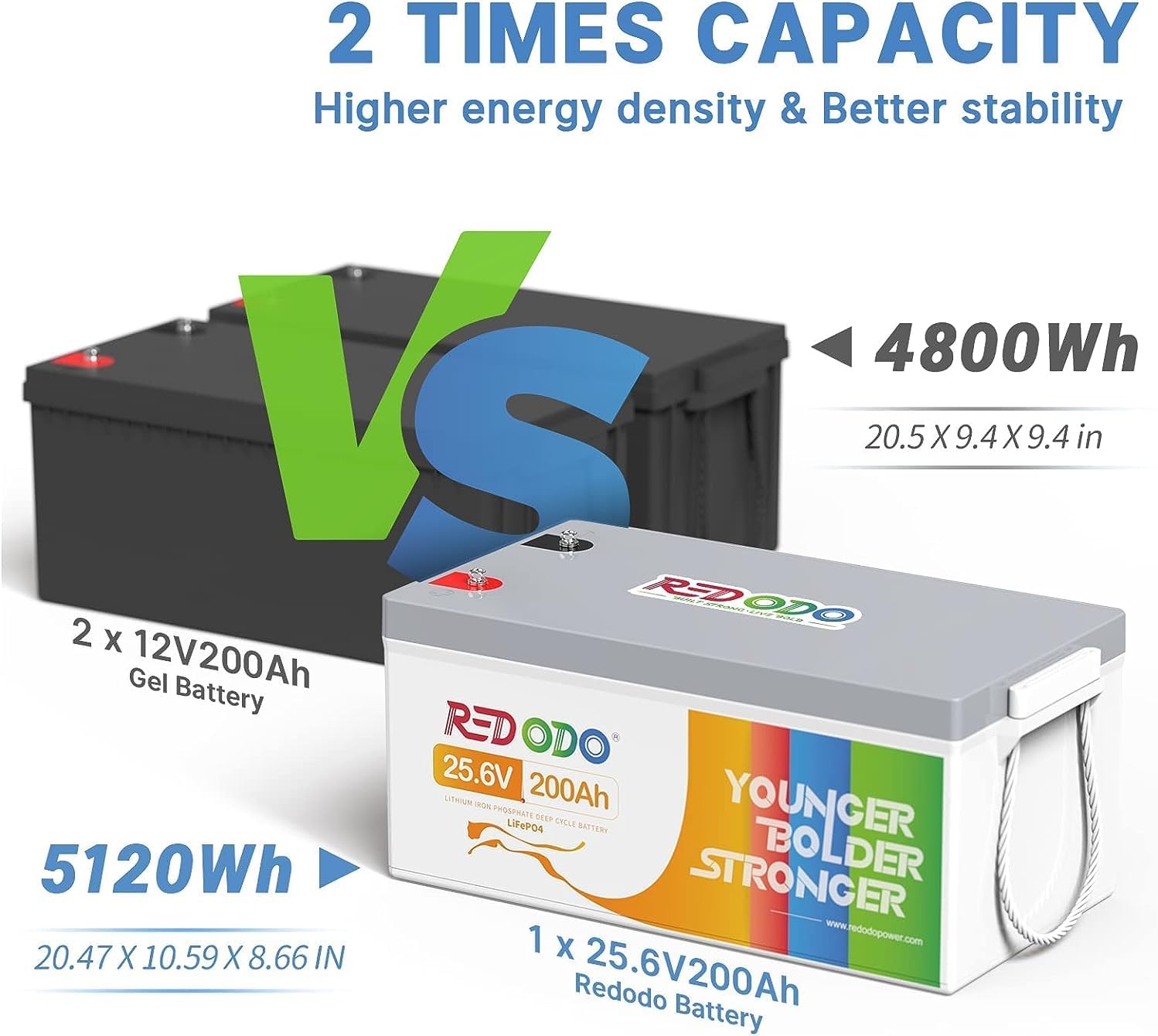
Figure 10: Visual comparison demonstrating the Redodo 25.6V 200Ah LiFePO4 battery's superior energy capacity (5120Wh) compared to two 12V200Ah Gel Batteries (4800Wh).
Official Product Videos
Video 1: "Beyond 101% Capacity for Redodo LiFePO4 Battery". This video demonstrates the battery's actual capacity exceeding its stated rating, showcasing its robust performance in various tests.
Video 2: "Redodo 24V 100ah lifepo4 battery". This video provides an overview of the Redodo 24V 100Ah LiFePO4 battery, highlighting its features and benefits for various applications. While this specific video features a 100Ah model, the general principles and quality apply to the 200Ah model.
Maintenance
Redodo LiFePO4 batteries are designed for low maintenance. However, regular checks can help ensure optimal performance and longevity:
- Keep terminals clean and free of corrosion.
- Ensure all connections are secure.
- Store the battery in a cool, dry place when not in use for extended periods.
- Avoid exposing the battery to extreme temperatures.
- Charge the battery before long-term storage and periodically during storage to maintain charge.
Troubleshooting
If you encounter issues with your Redodo battery, consider the following common troubleshooting steps:
- Battery not charging:
- Verify the charger is specifically designed for LiFePO4 batteries and is functioning correctly.
- Check all cable connections for looseness or corrosion.
- Ensure the battery's BMS has not triggered a protection mode (e.g., due to over-discharge or over-temperature).
- Battery not providing power:
- Check the battery's state of charge. It might be deeply discharged.
- Inspect all connections to the load for proper contact.
- Confirm the load's power requirements do not exceed the battery's continuous discharge current or the BMS's limits.
- Unusual heat or smell:
- Immediately disconnect the battery from all loads and chargers.
- Contact Redodo customer support. Do not attempt to open or repair the battery.
Warranty and Support
Redodo provides one-on-one customer service and lifetime technical support for its products. The package includes a quick start guide, a product manual, 4 terminal posts, and 2 isolation caps. For any questions or assistance, please feel free to contact Redodo customer support.
For more information or to contact support, visit the official Redodo website or refer to the contact details provided in your product packaging.
Related documents24V200Ah


Ask a question about this manual
Ask about setup, troubleshooting, compatibility, parts, safety, or missing instructions. Manuals+ will review the question and use this page’s manual context to help answer it.