
DEWALT DCF403D1
DEWALT 20V MAX XR Cordless Rivet Tool Instruction Manual
Model: DCF403D1
Brand: DEWALT
Introduction
This manual provides essential information for the safe and efficient operation, maintenance, and troubleshooting of your DEWALT 20V MAX* XR Cordless Rivet Tool (DCF403D1). Please read this manual thoroughly before using the tool to ensure proper handling and to prevent injury or damage.
Key Features
- Brushless Motor: Delivers up to 2,100 lbf of pulling force, suitable for various rivet materials including stainless steel.
- High Productivity: Capable of installing up to 800 rivets per charge (with DCB203 battery).
- Tool-Free Nose Piece Change: Allows for quick and easy changes between different rivet sizes.
- On-Board Nose Piece Storage: Conveniently stores nose pieces directly on the tool.
- Mandrel Collector: Designed to collect and store loose mandrels for a cleaner workspace.
- Integrated LED Work Light: Illuminates the work area for enhanced visibility.
- Versatile Compatibility: Works with 3/32", 1/8", 5/32", and 3/16" rivets.
Safety Information
Always follow basic safety precautions when using power tools to reduce the risk of fire, electric shock, and personal injury. Keep work area clean and well lit. Do not operate power tools in explosive atmospheres, such as in the presence of flammable liquids, gases or dust. Always wear appropriate personal protective equipment, including eye protection, hearing protection, and gloves. Disconnect the battery pack from the tool before making any adjustments, changing accessories, or storing the tool.
Package Contents

Image: The complete DEWALT 20V MAX XR Cordless Rivet Tool kit, showing the rivet tool, a 20V MAX* 2 Ah battery, a charger, and a black kit bag.
Your DEWALT 20V MAX* XR Cordless Rivet Tool (DCF403D1) package should include the following items:
- (1) DCF403B 20V MAX* XR 3/16" Rivet Tool
- (1) DCB203 20V MAX* 2 Ah Battery
- (1) DCB1102 Charger
- (1) 3/32" Nose Piece
- (1) 1/8" Nose Piece
- (1) 5/32" Nose Piece
- (1) 3/16" Nose Piece
- (1) Replacement Jaw Set
- (1) Belt Hook
- (1) Kit Bag
Inspect the package contents carefully to ensure all items are present and undamaged. If any items are missing or damaged, contact your retailer or DEWALT customer service.
Setup
1. Battery Installation and Charging
Before first use, fully charge the included DCB203 20V MAX* 2 Ah Battery using the DCB1102 Charger. Refer to the charger's instruction manual for detailed charging procedures.
- To install the battery, align the battery pack with the tool's battery port and slide it in until it clicks into place.
- To remove the battery, press the release button on the battery pack and slide it out.
2. Nose Piece Installation and Change
The rivet tool comes with multiple nose pieces to accommodate different rivet sizes. The tool features a convenient tool-free nose piece change mechanism.

Image: A hand demonstrating the tool-free nose piece change by unscrewing the current nose piece from the tool.
- Ensure the tool is off and the battery is removed.
- To remove the current nose piece, simply unscrew it counter-clockwise by hand.
- Select the appropriate nose piece for your rivet size.
- Screw the new nose piece onto the tool clockwise until it is hand-tight. Do not overtighten.
The tool also has on-board storage for nose pieces, allowing you to keep frequently used sizes readily accessible.

Image: A labeled diagram of the DEWALT rivet tool highlighting key features such as the tool-free nose piece, mandrel collector, LED light, and on-board nose piece storage.
Operating Instructions
1. Rivet Compatibility
The DEWALT DCF403D1 is compatible with various rivet sizes and materials. Refer to the table below for compatible sizes:
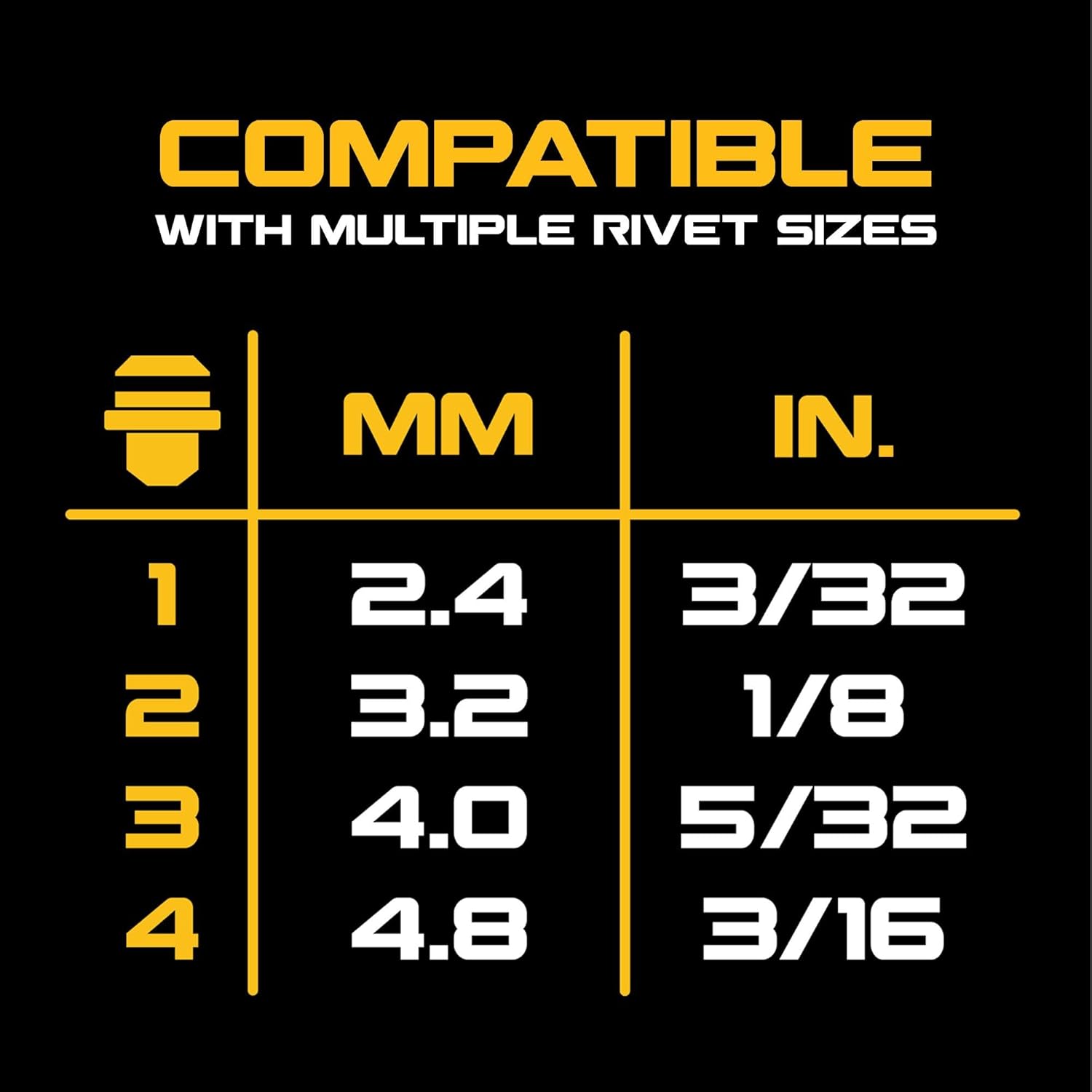
Image: A compatibility chart displaying the corresponding millimeter and inch sizes for rivets that can be used with the tool.
| Rivet Size (MM) | Rivet Size (IN.) |
|---|---|
| 2.4 | 3/32 |
| 3.2 | 1/8 |
| 4.0 | 5/32 |
| 4.8 | 3/16 |
The tool is capable of pulling aluminum, steel, and stainless steel blind rivets.
2. General Operation
- Prepare the Workpiece: Drill a hole in the materials to be joined that matches the diameter of the rivet.
- Insert Rivet: Insert the rivet into the nose piece of the tool.
- Position the Tool: Place the rivet into the prepared hole in the workpiece. Ensure the tool is held firmly and perpendicular to the surface.
- Activate the Tool: Press the trigger to activate the tool. The tool will pull the rivet mandrel, expanding the rivet and securing the materials. The 0.98" stroke length allows for fastening in one stroke.
- Mandrel Ejection: Once the rivet is set, the tool will automatically break off and collect the mandrel in the on-board mandrel collector.
- Repeat: Release the trigger and repeat the process for additional rivets.

Image: A user operating the DEWALT rivet tool on a metal sheet, demonstrating its use and highlighting its capacity of 800 rivets per charge.

Image: A user applying the DEWALT rivet tool to an overhead metal structure, illustrating the tool's powerful pulling force of up to 2,100 lbf.

Image: A user demonstrating the DEWALT rivet tool's operation on a metal surface, emphasizing its 0.98-inch stroke length for efficient riveting.
Maintenance
1. Cleaning
- Regularly clean the tool with a soft, damp cloth. Do not use harsh chemicals or abrasive cleaners.
- Keep the ventilation openings clear of dust and debris to prevent overheating.
2. Mandrel Collector Emptying
The on-board mandrel collector should be emptied regularly to prevent jamming and ensure proper operation.

Image: The DEWALT rivet tool with its transparent mandrel collector detached, illustrating how to access and empty collected mandrels.
- Ensure the tool is off and the battery is removed.
- Twist the mandrel collector counter-clockwise to detach it from the tool.
- Empty the collected mandrels into a waste receptacle.
- Reattach the mandrel collector by twisting it clockwise until secure.
3. Jaw Set Replacement
A replacement jaw set is included with your tool. If the tool's pulling performance degrades, the jaws may need replacement. Refer to the detailed instructions in the full service manual or contact DEWALT service for assistance with jaw set replacement.
4. Storage
Store the tool and battery in a cool, dry place, away from direct sunlight and moisture. Ensure the battery is partially charged before long-term storage. Use the provided kit bag for organized storage and transport.
Troubleshooting
This section provides general guidance for common issues. For more complex problems, contact DEWALT customer service.
| Problem | Possible Cause | Solution |
|---|---|---|
| Tool does not operate. | Battery not installed correctly or discharged. | Ensure battery is fully seated. Charge battery. |
| Rivet not setting properly. | Incorrect nose piece size; Worn jaws; Rivet material too hard. | Verify nose piece matches rivet size. Consider replacing jaw set. Ensure rivet material is compatible. |
| Mandrels not ejecting or jamming. | Mandrel collector full or obstructed. | Empty mandrel collector. Clear any obstructions. |
Specifications
| Specification | Value |
|---|---|
| Model Number | DCF403D1 |
| Voltage | 20 Volts MAX* |
| Pulling Force | Up to 2,100 lbf |
| Stroke Length | 0.98 inches |
| Compatible Rivet Sizes | 3/32", 1/8", 5/32", 3/16" |
| Compatible Rivet Materials | Aluminum, Steel, Stainless Steel |
| Item Weight | 6.91 pounds (tool only) |
| Item Length | 10.5 Inches |
| Battery Type | Lithium Ion |
| Manufacturer | DEWALT |
| UPC | 885911896269 |
*Maximum initial battery voltage (measured without a workload) is 20 volts. Nominal voltage is 18 volts.
Warranty and Support
This DEWALT product is covered by a Manufacturer Warranty. For specific details regarding the warranty period and coverage, please refer to the warranty card included with your product or visit the official DEWALT website.
For technical support, service, or to purchase replacement parts, please contact DEWALT customer service or visit the official DEWALT Store on Amazon.
Related documentsDCF403D1


Ask a question about this manual
Ask about setup, troubleshooting, compatibility, parts, safety, or missing instructions. Manuals+ will review the question and use this page’s manual context to help answer it.