
1. Introduction
This manual provides essential information for the safe and effective use of your PTCYIDU PTC Heating Element. Please read these instructions carefully before installation and operation. PTC (Positive Temperature Coefficient) heating elements are self-regulating heaters designed to maintain a constant temperature without external control, offering safety and energy efficiency.
2. Product Features
- Durable Construction: Made with a high-quality PTC ceramic heating element and an aluminum shell, ensuring durability and environmental friendliness.
- Insulated Surface: Features an insulated surface for safe operation, allowing for dry heating over extended periods with high reliability and constant temperature performance.
- Quick Heat Conversion: Converts electrical energy into heat energy and transfers it to the aluminum shell surface within approximately 10 seconds after power-on.
- Safety and Energy-Saving: Operates without an open flame and does not produce toxic or harmful gases, making it suitable for use in humid environments.
- Stable Performance: Utilizes ceramic constant temperature heating technology to continuously output heat and automatically maintain a stable temperature.
- Long Service Life: Designed for continuous heat supply, offering a service life exceeding 20,000 hours.
- Easy Installation: Equipped with 15cm high-temperature resistant lead wires for straightforward connection.
3. Specifications

Image: Basic Parameters of the PTC Heating Element, including dimensions, voltage, and temperature.
| Parameter | Value |
|---|---|
| Product Model | B-60*28 |
| Product Dimension (L*W*H) | 60 x 28 x 7 (±1) mm |
| Mounting Hole Size | Φ3.5mm (±1) |
| Mounting Hole Distance | 32mm (±1) |
| Wire Material of Heater | Silicone |
| Wire Length | 150mm |
| Strip Length | 10mm |
| Shell Material | Aluminum |
| Heating Material | PTC Ceramic |
| Temperature Resistance of Sleeve | > 300°C |
| Heater Life | > 50000h |
| Rated Voltage | AC/DC 110V |
| Temperature without Airflow | 60°C |
| Withstanding Voltage | 220V |
| Max Power (±20%) | 8W |
| Resistance Range | 400~500Ω |
| Chip Temperature | TS80 |
| Power without Airflow (±20%) | 2W |
| Inrush Power (±20%) | ≤90W |
| Inrush Current (±20%) | < 0.82A |
| Item Weight | 3.52 ounces |
| Package Dimensions | 5.31 x 3.54 x 1.97 inches |
| ASIN | B0CDKRT968 |
| Date First Available | August 3, 2023 |
4. Setup and Installation
Follow these guidelines for proper setup and installation of your PTC heating element:
- Wiring: The bare wires of the product can be connected regardless of positive or negative poles for AC/DC applications. Ensure the rated voltage (110V) is supplied. The provided lead wires are 15cm long and high-temperature resistant.
- Mounting: The heating element features mounting holes (Φ3.5mm, 32mm distance) for secure installation. Ensure the mounting surface is stable and can withstand the operating temperature.
- Heat Dissipation: The actual power output of the PTC heater is influenced by heat dissipation conditions. Better heat dissipation leads to higher power output. Ensure adequate airflow or contact with the material to be heated for optimal performance.
- Environment: Install the heater in a location that allows for proper heat transfer to the intended application. Avoid enclosing it in a completely sealed, non-conductive space without any heat exchange, as this can affect its performance and temperature regulation.
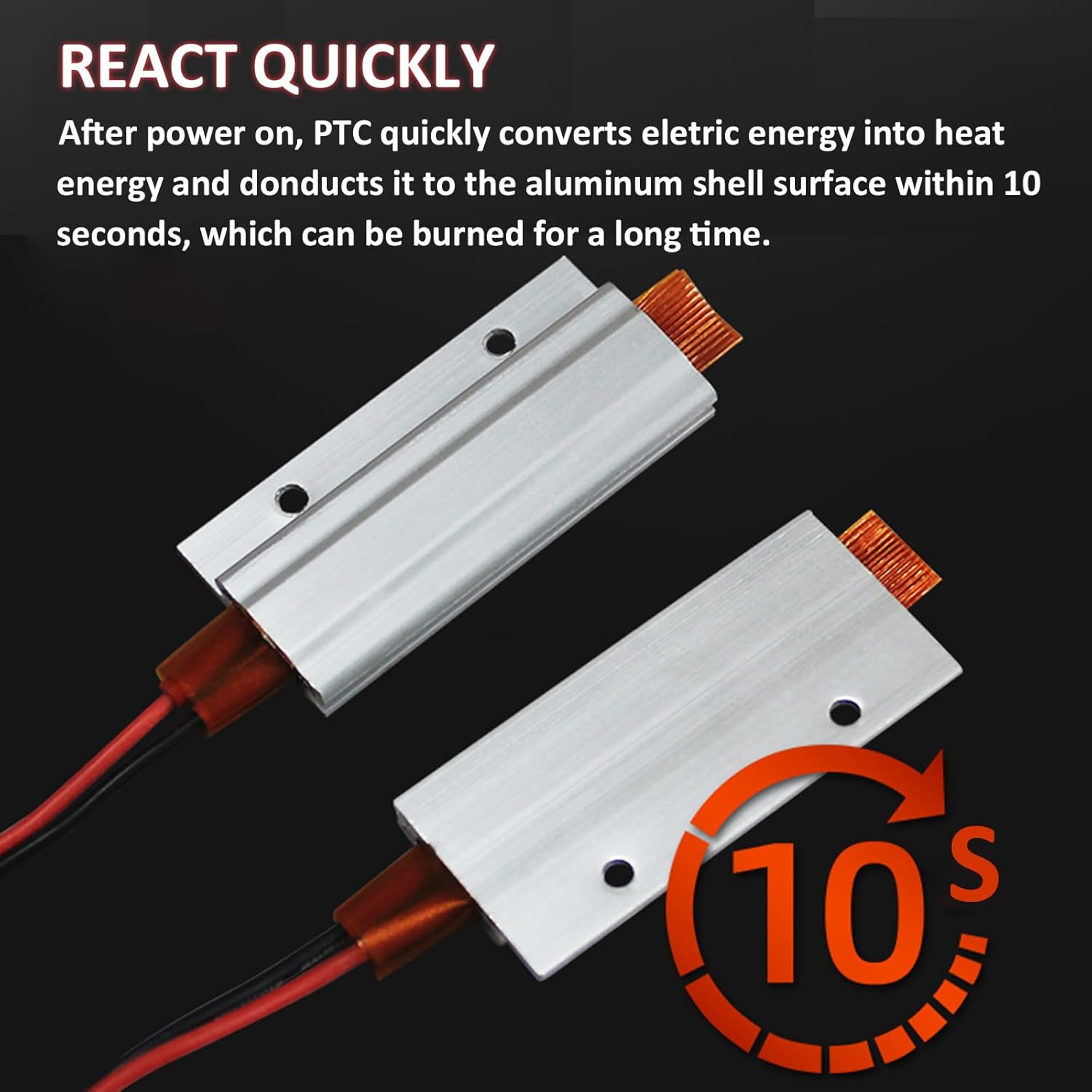
Image: PTC Heating Element showing the lead wires for connection.
5. Operating Instructions
The PTC heating element is designed for simple, self-regulating operation:
- Power On: Once connected to a 110V AC/DC power source, the element will begin to heat up rapidly, reaching its constant temperature of approximately 60°C without airflow.
- Constant Temperature: The ceramic PTC material inherently maintains a constant temperature. No external thermostat is typically required for basic operation, as it self-regulates.
- Power Variation: The actual power consumption of the PTC heater is not a fixed value but varies based on heat dissipation. The better the heat dissipation, the greater the power output. For example, impact power can be about twice the maximum power, while dry burning power is approximately 20% of the maximum power.

Image: Illustration of the PTC heating element's rapid heat conversion within 10 seconds.
6. Maintenance
The PTCYIDU heating element requires minimal maintenance:
- Cleaning: Ensure the surface of the heating element remains free from dust, debris, or obstructions that could impede heat transfer. Clean gently with a dry cloth if necessary, ensuring the device is powered off and cool.
- Wiring Inspection: Periodically check the lead wires and connections for any signs of wear, damage, or loose connections. Address any issues promptly to prevent electrical hazards.
- Environmental Check: Verify that the operating environment continues to meet the recommended conditions, especially regarding heat dissipation and humidity levels.
7. Troubleshooting
Refer to the following common questions and solutions:
- Question: Why does the temperature increase vary?
Answer: The actual temperature increase is influenced by the surrounding environment, insulation, and the extrusion temperature of the application. It is not solely determined by the heating plate itself. - Question: Why does the actual power vary?
Answer: The power of PTC heating plates is not a fixed value but a range. The better the heat dissipation, the greater the power. For instance, the impact power can be about twice the maximum power, while the dry burning power is approximately 20% of the maximum power. - Question: What should I consider for low voltage applications?
Answer: For low voltage items, it is crucial to pay attention to the current in addition to meeting the voltage requirements. - Problem: Heater is not heating or not reaching expected temperature.
Solution: Verify the power supply is 110V AC/DC. Check all wiring connections for security. Ensure adequate heat dissipation; if the heater is in a confined space without airflow, its power output and temperature rise will be limited. - Problem: Heater feels too hot or is overheating.
Solution: While PTC elements are self-regulating, ensure they are not operating in conditions that excessively restrict heat dissipation, which could lead to higher surface temperatures than desired for the application. Always ensure proper ventilation or contact with the material to be heated.
8. Safety Information
Adhere to these safety precautions when handling and operating the PTC heating element:
- Electrical Safety: Always ensure the power supply is disconnected before installation, inspection, or maintenance. Use appropriate wiring and connections suitable for 110V AC/DC.
- Hot Surface: The heating element will become hot during operation. Avoid direct contact with the heating surface to prevent burns. Allow sufficient time for the unit to cool down before handling.
- Insulation: The surface is insulated, but proper handling is still required. Do not immerse the heating element in liquids unless specifically designed for such applications.
- Ventilation: Ensure the heating element is installed in an area with adequate ventilation or heat transfer to prevent heat buildup in unintended areas.
- Intended Use: Use this product only for its intended heating applications. Do not modify the product or use it for purposes other than those specified.
- Children and Pets: Keep the heating element out of reach of children and pets, especially during operation.
9. Wide Application Examples
The PTCYIDU heating element is versatile and suitable for various small heating applications:
- Foot bath devices
- Water boilers
- Yogurt makers
- Chocolate extrusion equipment
- Coffee makers
- Car and component preheating
- Other small heating equipment

Image: Visual examples of the PTC heating element's diverse applications.
10. Warranty and Support
Your PTCYIDU PTC Heating Element comes with a return policy for your peace of mind.
- Return Policy: This product is eligible for a refund or replacement within 30 days of purchase. Please refer to the retailer's specific return policy for detailed terms and conditions.
- Customer Support: For any questions, technical assistance, or support regarding your PTCYIDU product, please contact the manufacturer directly or visit the official PTCYIDU store.

Image: PTCYIDU brand logo.
