
Introduction
This instruction manual provides essential information for the safe and efficient operation, maintenance, and troubleshooting of your Vetoper 12 Inch Gas Chainsaw, model 58h-20. Please read this manual thoroughly before operating the chainsaw to ensure proper use and to prevent injury or damage.

Image: The Vetoper 12 Inch Gas Chainsaw, showcasing its orange and black design with the guide bar and chain.
Safety Information
Operating a chainsaw can be dangerous if proper safety precautions are not followed. Always prioritize safety to prevent serious injury.
General Safety Rules:
- Always wear appropriate personal protective equipment (PPE), including safety glasses, hearing protection, gloves, and sturdy footwear.
- Ensure the work area is clear of bystanders, children, and pets.
- Do not operate the chainsaw when fatigued, under the influence of alcohol, drugs, or medication.
- Inspect the chainsaw before each use for loose parts, damage, or wear.
- Keep all handles dry, clean, and free from oil and grease.
- Never operate a chainsaw with one hand unless specifically designed for such operation and you are trained. This model is a top-handle chainsaw designed for single-hand use by trained professionals, but caution is still paramount.
Fuel Safety:
- Mix fuel and oil according to the manufacturer's instructions in a well-ventilated area.
- Do not smoke while mixing or handling fuel.
- Store fuel in approved containers away from ignition sources.
- Wipe up any spilled fuel immediately.
Chainsaw Components
Familiarize yourself with the various parts of your chainsaw before operation.

Image: A detailed diagram labeling key components of the chainsaw, including the saw chain, guide bar, engine ON/OFF switch, trigger lockout, throttle lever, choke control, fuel tank, chain oil tank, rear handle, starter handle, starter cover, belt eyelet, and rope eyelet.
- Saw Chain: The cutting component of the chainsaw.
- Guide Bar: Supports and guides the saw chain.
- Engine ON/OFF Switch: Controls the power to the engine.
- Trigger Lockout: Prevents accidental acceleration.
- Throttle Lever: Controls engine speed.
- Choke Control: Used for starting a cold engine.
- Fuel Tank: Holds the fuel mixture.
- Chain Oil Tank: Holds the chain lubricant.
- Rear Handle: Main handle for operating the chainsaw.
- Starter Handle: Used to pull-start the engine.
- Starter Cover: Protects the starter mechanism.
- Belt Eyelet/Rope Eyelet: Attachment points for carrying or securing.
Setup and Assembly
Before first use, the chainsaw requires assembly of the guide bar and chain, and proper fueling.
Package Contents:
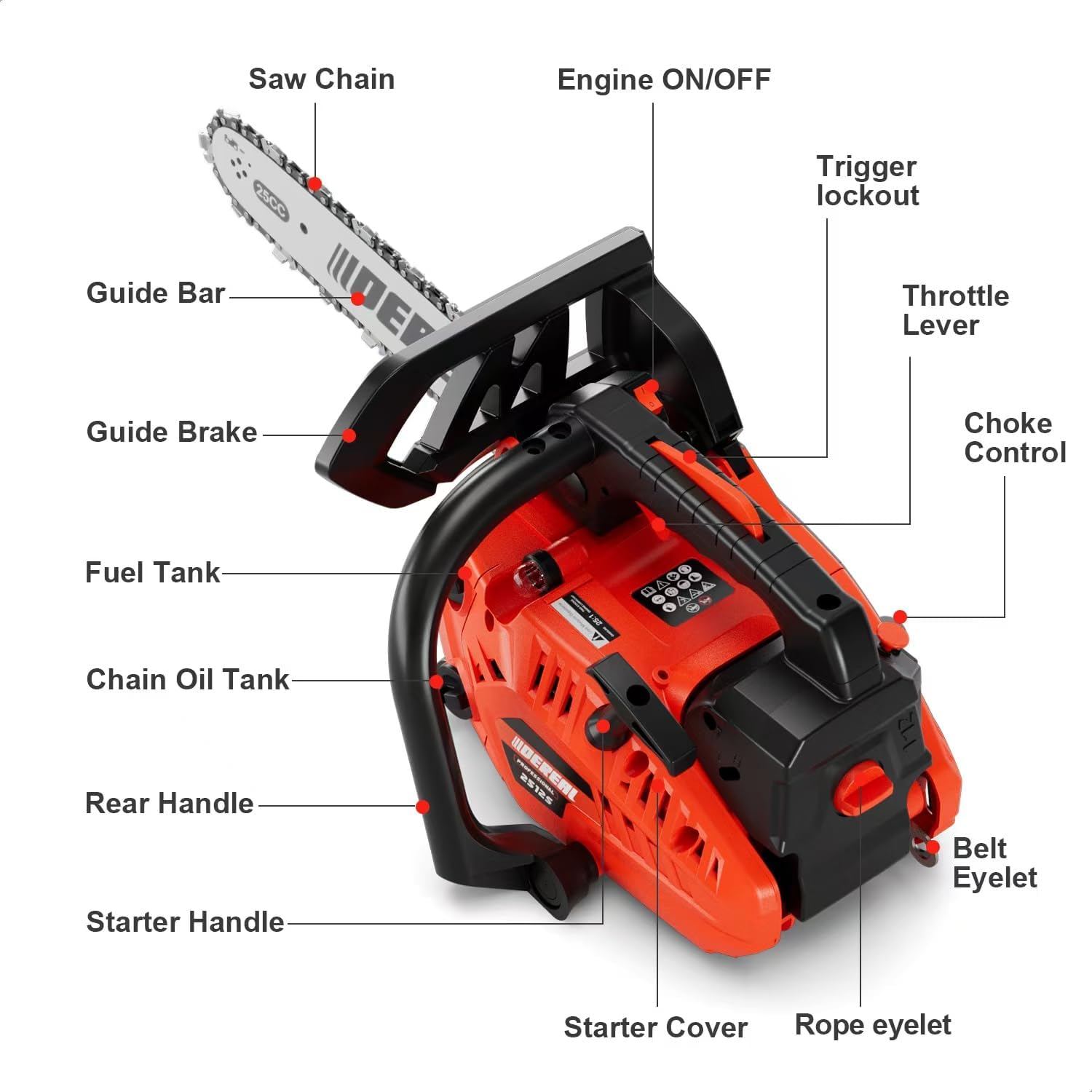
Image: The chainsaw along with its included accessories: a carrying bag, various tools (screwdrivers, wrench, file), a mixing bottle, a guide bar cover, and a spare chain.
- Chainsaw Power Head
- Guide Bar
- Saw Chain
- Guide Bar Cover
- Tool Kit (screwdrivers, wrench, file)
- Fuel Mixing Bottle
- Instruction Manual
Assembly Steps:
- Install Guide Bar and Chain:
- Remove the chain cover by loosening the nuts.
- Place the chain around the sprocket and guide bar, ensuring the cutting edges face the correct direction.
- Fit the guide bar onto the studs and align the chain with the guide bar groove.
- Replace the chain cover and hand-tighten the nuts.
- Adjust Chain Tension:
- Using the tensioning screw, adjust the chain tension. The chain should be snug but still able to be pulled freely around the guide bar by hand.
- Tighten the chain cover nuts securely.
- Fueling:
- Prepare a fuel mixture of gasoline and 2-stroke engine oil at the ratio specified in the specifications (typically 25:1 or 40:1, refer to product specifications). Use the provided mixing bottle for accuracy.
- Fill the fuel tank with the prepared mixture.
- Fill the chain oil tank with appropriate chain lubricant.
Operating Instructions
Follow these steps for safe and effective operation of your chainsaw.
Starting the Chainsaw:

Image: A visual guide demonstrating the five steps to start the chainsaw: 1. Press the oil bubble 2-3 times, 2. Press the switch shaft "I" (ON position), 3. Pull the choke, 4. Pull the starter rope until it "pops", 5. Close the choke and pull the starter rope again until it is started.
- Prime the Carburetor: Press the primer bulb 2-3 times until fuel is visible.
- Set Engine Switch: Move the engine ON/OFF switch to the "I" (ON) position.
- Engage Choke: Pull the choke control out to the full choke position.
- Pull Starter Rope: Place the chainsaw on a firm, flat surface. Hold the chainsaw firmly with one hand on the handle and pull the starter handle with the other hand until the engine "pops" or attempts to start. Do not pull the rope to its full extension.
- Disengage Choke: Once the engine "pops", push the choke control back in to the OFF position.
- Restart: Pull the starter rope again until the engine starts and runs smoothly.
- Warm-up: Allow the engine to warm up for a few moments before beginning cutting operations.
Cutting Operation:
- Always maintain a firm grip on the chainsaw with both hands (if applicable for the specific cut, though this is a top-handle model).
- Ensure stable footing and balance.
- Do not cut above shoulder height.
- Be aware of kickback and take precautions to avoid it.
- Plan your cuts to ensure the wood falls safely.
Stopping the Chainsaw:
Release the throttle lever and move the engine ON/OFF switch to the "O" (OFF) position.
Maintenance
Regular maintenance ensures optimal performance and extends the lifespan of your chainsaw.
Daily Maintenance:
- Clean the air filter.
- Check chain tension and adjust if necessary.
- Inspect the chain for sharpness and damage. Sharpen or replace as needed.
- Check the guide bar for wear and burrs.
- Ensure the chain oiler is functioning correctly.
- Clean debris from the engine cooling fins.
Periodic Maintenance:
- Clean or replace the spark plug.
- Inspect the fuel filter.
- Clean the carburetor and fuel lines.
- Check all nuts, bolts, and screws for tightness.
Troubleshooting
This section addresses common issues and their potential solutions.
| Problem | Possible Cause | Solution |
|---|---|---|
| Engine does not start | No fuel, incorrect choke setting, fouled spark plug, clogged fuel filter. | Check fuel level, adjust choke, clean/replace spark plug, clean/replace fuel filter. |
| Chainsaw lacks power | Dull chain, incorrect chain tension, clogged air filter, improper fuel mixture. | Sharpen/replace chain, adjust tension, clean air filter, ensure correct fuel mix. |
| Chain does not move | Chain brake engaged, incorrect chain tension, damaged clutch. | Disengage chain brake, adjust tension, inspect clutch (professional service recommended). |
| Excessive vibration | Loose components, damaged chain or guide bar. | Check all fasteners, inspect chain and guide bar for damage. |
If you encounter issues not listed here or if solutions do not resolve the problem, please contact customer support.
Technical Specifications
| Feature | Detail |
|---|---|
| Model Number | 58h-20 |
| Engine Displacement | 25.4CC |
| Engine Type | 2-Stroke, Gas Powered |
| Horsepower | 1.2 HP (0.9 kW) |
| Max RPM | Up to 11,000 RPM |
| Guide Bar Length | 12 Inches |
| Chain Pitch | 3/8LP |
| Chain Gauge | 0.050" |
| Weight | 8.2 pounds (operational) |
| Product Dimensions | 14 x 6 x 6 inches |
| Fuel Mix Ratio | Refer to engine manufacturer's recommendation (typically 25:1 or 40:1 gasoline to 2-stroke oil) |
| Manufacturer | Vetoper |
| UPC | 766997421661 |
Warranty and Support
Vetoper is committed to product quality. For any quality issues or questions regarding your chainsaw, please contact our customer service team.
Refer to your purchase documentation for specific warranty terms and conditions. Keep your proof of purchase for warranty claims.
Contact Information: Please refer to the contact details provided with your product packaging or on the official Vetoper website for support.