
Introduction
This manual provides instructions for the KJDEYT ANT-UV-Shark Dual Band Mobile Radio Antenna. This antenna is designed for convenient portability and use, enhancing signal reception and extending communication distance for compatible radios. It operates on dual bands: 136-174MHz and 400-470MHz, and includes four coaxial connectors for broad compatibility with handheld walkie-talkies and mobile radios.
Product Features
- Dual Band Operation: Supports 136-174MHz (VHF) and 400-470MHz (UHF) frequencies.
- Enhanced Signal Performance: Features 2.5/3dBi gain and a maximum power handling of 50W to improve signal reception and transmission.
- Versatile Connectivity: Includes a PL-259 connector for direct installation to antenna base stations or car mobile radio stations, along with four additional adapters for various handheld walkie-talkies.
- Compact Design: Super short antenna design for good concealment and effective use.
- Robust Construction: Built with an ultra-short built-in circuit board for strong signal sending and receiving capabilities.
Package Contents
Verify that all items are present in the package:
- 1 x Shark fin antenna with integrated coaxial cable (5 meters) and PL-259 connector.
- 4 x Coaxial adapters (SMA-Female, SMA-Male, BNC, SL16 male).
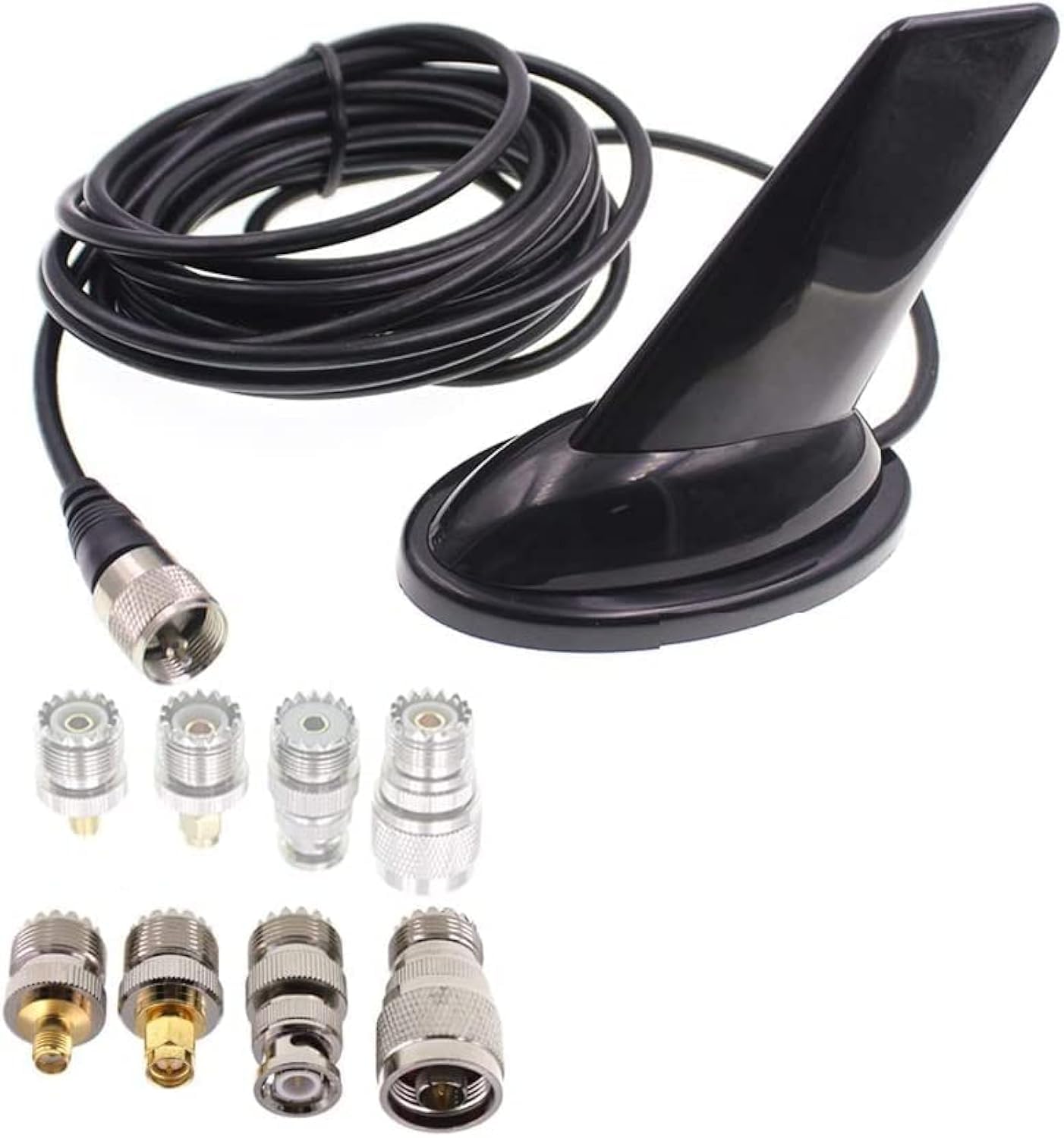
Image: The KJDEYT ANT-UV-Shark antenna, showing its shark fin design, attached coaxial cable, and the four included adapters (SMA-Female, SMA-Male, BNC, SL16 male) for various radio connections.
Setup
Follow these steps to set up your KJDEYT ANT-UV-Shark antenna:
- Identify Radio Connector: Determine the type of antenna connector on your mobile radio or handheld walkie-talkie. Common types include SMA-Female, SMA-Male, BNC, or PL-259 (UHF type).
- Select Appropriate Adapter: The antenna comes with a PL-259 connector. If your radio requires a different connector type, select one of the four provided adapters (SMA-Female, SMA-Male, BNC, SL16 male) that matches your radio's input.
- Connect Adapter (if needed): Screw the chosen adapter onto the PL-259 connector of the antenna's coaxial cable. Ensure a secure, hand-tight connection.
- Connect to Radio: Attach the antenna (with adapter, if used) to the antenna port of your radio. For mobile radios, the PL-259 connector can often connect directly. For handhelds, an adapter will typically be required.
- Position the Antenna: Place the shark fin antenna in a suitable location. For mobile use, it can be mounted on a vehicle roof or trunk lid. For portable use with handhelds, ensure it has a clear line of sight for optimal performance. The antenna base is designed for stability.

Image: The KJDEYT ANT-UV-Shark antenna connected to a handheld radio, illustrating the use of an adapter to match the radio's antenna port.

Image: The KJDEYT ANT-UV-Shark antenna connected to a mobile radio, demonstrating a direct PL-259 connection.
Operating Instructions
Once the antenna is securely connected to your radio, operate your radio as usual. The ANT-UV-Shark antenna is designed to enhance your radio's signal capabilities within its specified frequency ranges.
- Frequency Range: Ensure your radio is operating within the antenna's supported dual bands (136-174MHz VHF and 400-470MHz UHF) for optimal performance.
- Power Output: This antenna is rated for radios with a power output of less than 50W. Do not exceed this power rating to prevent damage to the antenna or radio.
- Signal Quality: For best signal quality, position the antenna with as clear a line of sight as possible to the transmitting or receiving station. Obstructions like buildings, hills, or dense foliage can reduce signal strength.
Maintenance
To ensure the longevity and optimal performance of your antenna, follow these maintenance guidelines:
- Regular Cleaning: Wipe the antenna and cable with a soft, damp cloth to remove dust and dirt. Avoid using harsh chemicals or abrasive cleaners.
- Inspect Connections: Periodically check all connections (antenna to cable, cable to adapter, adapter to radio) to ensure they are secure and free from corrosion. Loose connections can degrade signal quality.
- Cable Care: Avoid kinking, pinching, or sharply bending the coaxial cable. Store the cable neatly when not in use to prevent damage.
- Environmental Protection: While designed for outdoor use, extreme weather conditions (e.g., severe storms, prolonged exposure to saltwater) can affect performance and lifespan. Consider protecting the antenna during such conditions if possible.
Troubleshooting
If you experience issues with your antenna, refer to the following troubleshooting tips:
- Poor Signal Reception/Transmission:
- Ensure all connections are tight and correct.
- Verify the antenna is positioned with minimal obstructions.
- Confirm your radio is set to the correct frequency within the antenna's supported bands.
- Check the coaxial cable for any visible damage or kinks.
- High VSWR (Voltage Standing Wave Ratio):
- A high VSWR indicates a mismatch between the antenna and the radio, which can lead to reduced performance and potential damage to your radio.
- Ensure the antenna is correctly installed and not near large metallic objects that could detune it.
- While this antenna is designed for dual-band use, some radios or specific frequencies might exhibit higher VSWR. If possible, use a VSWR meter to check the antenna's performance with your specific radio and operating frequencies. A VSWR of 1.5:1 or lower is generally ideal, though up to 2:1 can be acceptable. Consistently high VSWR (e.g., above 2.5:1) should be addressed.
- Antenna Not Fitting Radio:
- Double-check the connector type of your radio.
- Ensure you are using the correct adapter from the provided set.
- Note that while the antenna is designed for broad compatibility, some older or rare walkie-talkie models may not be fully supported.
Specifications
| Model Number | ANT-UV-Shark |
| Frequency Range | Dual Band 136-174MHz (VHF) & 400-470MHz (UHF) |
| Gain | 2.5/3dBi |
| Max Power | 50W |
| V.S.W.R | Less than 1.5 |
| Connector Type (Antenna) | PL259 UHF Type |
| Included Coaxial Connectors | SMA-Female, SMA-Male, BNC, SL16 male |
| Antenna Height | 12cm |
| Coaxial Cable Length | 5 Meters |
| Material | Copper cord |
| Color | Black |
| Item Weight | 15.3 ounces |
| Package Dimensions | 7.05 x 6.54 x 2.44 inches |
Compatibility Note
The Dual Band Shark Fin style antenna is equipped with 4 additional adaptors to support a wide range of mobile radios and handheld walkie-talkies. While it aims to achieve 90% compatibility, we cannot guarantee support for 100% of all walkie-talkie models. Older or rare style walkie-talkies may not be fully supported.
Warranty Information
For specific warranty details, please refer to the product packaging or contact the retailer from whom the product was purchased. Standard warranty terms typically cover manufacturing defects for a limited period from the date of purchase.
Customer Support
If you have any questions, require technical assistance, or encounter issues not covered in this manual, please contact KJDEYT customer support or the authorized dealer where you purchased the product. Please have your product model number (ANT-UV-Shark) and purchase information ready when contacting support.