
1. Introduction
This instruction manual provides comprehensive guidance for the assembly, operation, and maintenance of your Dancing Wings Hobby F2504 Aion 2.5M Electric Glider Kit. This kit is designed for adult hobbyists and requires assembly. Please read this manual thoroughly before beginning assembly or operation to ensure safe and correct use of your model glider.
2. Safety Information
Operating remote-controlled aircraft requires caution. Adhere to the following safety guidelines:
- Adult Supervision: This product is intended for adults. Ensure proper understanding and adherence to all instructions.
- Flying Area: Operate the glider in open, clear areas, away from people, buildings, power lines, and other obstacles. Avoid flying near airports or restricted airspace.
- Weather Conditions: Do not fly in strong winds, rain, or other adverse weather conditions.
- Battery Safety: Use only recommended batteries (3S 2200-2800mAh LiPo). Handle LiPo batteries with care, charge them in a safe environment, and never overcharge or discharge them.
- Propeller Safety: The propeller can cause injury. Always disconnect the battery before handling the motor or propeller. Keep hands and loose clothing clear of the propeller when the battery is connected.
- Electronic Components: Ensure all electronic components (motor, ESC, servos, receiver) are correctly installed and connected according to the instructions.
- Pre-Flight Checks: Always perform a thorough pre-flight check to ensure all controls are functioning correctly and all parts are securely fastened.
3. Package Contents
The F2504 kit includes the following components:
- F25 Aion Glider KIT (2.5M Balsawood Laser Cut Parts)
- MM2216C 920KV Motor
- 30A E-Power Electronic Speed Controller (ESC)
- 9g Servos (6 pieces)
- Folding Propeller (10-11 inch, metal)
- Instruction Manual (this document)
- Decal Sheet
- Various small parts for assembly (pushrods, control horns, hardware)
Note: A receiver (RX ≥6CH) and a 3S 2200-2800mAh LiPo battery are required but not included in this kit.

Image: Overview of the F2504 kit components, showing the unassembled balsawood glider parts, motor, electronic speed controller (ESC), six 9g servos, and a folding propeller.

Image: Detailed view of the laser-cut balsawood sheets, various small wooden parts, and hardware included in the kit, ready for assembly.

Image: Another detailed view of the kit contents, highlighting the balsawood parts, small hardware, and the included decal sheet for finishing the glider.
4. Assembly Instructions
The F2504 Aion glider is an unassembled kit. Detailed step-by-step plans are provided within the box. The following is a general overview of the assembly process. Refer to the included 1:1 plans and detailed manual for specific instructions and diagrams.
- Preparation: Unpack all components and verify against the package contents list. Gather necessary tools such as hobby knife, sandpaper, wood glue (CA glue recommended), and small clamps.
- Fuselage Assembly: Begin by assembling the fuselage sections according to the plans. Ensure all parts are aligned and glued securely.
- Wing Assembly: Construct the wing panels. The kit features laser-cut parts for accurate construction. Pay close attention to the dihedral angles and ensure the wing structure is rigid.
- Tail Section Assembly: Assemble the horizontal and vertical stabilizers. Attach them to the fuselage, ensuring correct alignment.
- Motor Installation: Mount the MM2216C 920KV motor to the front of the fuselage. Ensure it is securely fastened and aligned.
- ESC and Servo Installation: Install the 30A ESC and the six 9g servos in their designated locations within the fuselage and wings. Connect the servos to the control surfaces (ailerons, elevator, rudder) using the provided pushrods and control horns.
- Receiver Installation: Install your ≥6CH receiver and connect all electronic components (motor, ESC, servos) to the receiver according to your radio system's instructions.
- Propeller Attachment: Attach the folding propeller to the motor shaft. Ensure it is balanced and rotates freely.
- Covering (Optional): If desired, cover the balsawood frame with appropriate covering film (not included in F2504 kit) for durability and aesthetics.
- Final Checks: Before flight, perform a thorough check of all connections, control surface movements, and center of gravity (CG).

Image: Top-down view of the fully assembled balsawood frame of the Aion glider, showcasing the intricate laser-cut structure of the wings and fuselage.
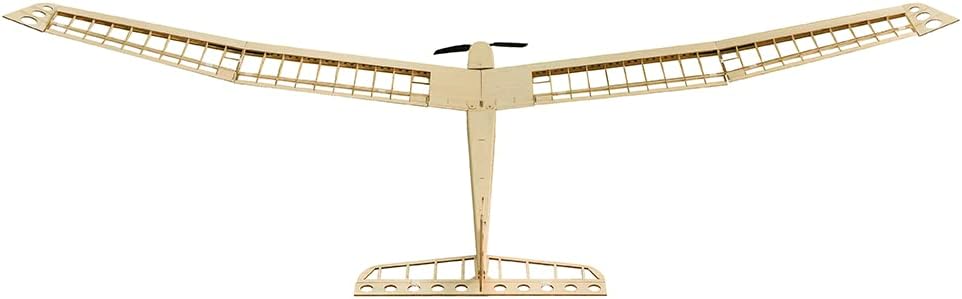
Image: Front view of the assembled balsawood frame, highlighting the propeller mount and the leading edge of the wings.

Image: Side view of the assembled balsawood frame, showing the slender fuselage and the profile of the wing and tail sections.
5. Operating Instructions
The Aion 2.5M Electric Glider is designed for slow, controlled flight, making it easy to operate once assembled and trimmed correctly.
- Pre-Flight Check:
- Ensure the battery is fully charged and securely installed.
- Turn on your transmitter first, then connect the glider's battery.
- Verify all control surfaces (ailerons, elevator, rudder) respond correctly to transmitter inputs.
- Check the motor for proper function and propeller security.
- Confirm the Center of Gravity (CG) is within the recommended range as specified in the detailed manual.
- Take-off:
- Hand launch the glider into the wind with a gentle, firm toss, applying partial throttle.
- Gradually increase throttle as the glider gains altitude.
- Flight Control:
- Use the ailerons for roll control, elevator for pitch (climb/dive), and rudder for yaw (directional control).
- The glider performs well with aileron, elevator, rudder, and motor control, allowing for precise maneuvers.
- Utilize the motor for climbing and power-off gliding to conserve battery and extend flight time.
- Landing:
- Approach the landing area into the wind.
- Reduce throttle and gradually descend, using elevator and rudder for control.
- Flare gently just above the ground to achieve a smooth touchdown.
- Post-Flight:
- Disconnect the glider's battery first, then turn off your transmitter.
- Inspect the glider for any damage.

Image: An assembled and covered Aion glider being held by a person, demonstrating its size and readiness for flight in an open outdoor environment.
Video: Official flight demonstration of the F25 2.5M Balsa Glider AION. This video showcases the glider's flight characteristics and performance in the air.
6. Maintenance
Regular maintenance ensures the longevity and safe operation of your glider.
- Inspection: After each flight, inspect the airframe for any damage, cracks, or loose parts. Check control surfaces for free movement and secure hinges.
- Electronics: Ensure all wiring connections are secure. Check motor and ESC for signs of overheating.
- Propeller: Inspect the propeller for nicks or damage. Replace if necessary to maintain balance and efficiency.
- Cleaning: Keep the glider clean from dirt and debris. Use a soft cloth to wipe down surfaces.
- Storage: Store the glider in a cool, dry place, away from direct sunlight and extreme temperatures. The detachable wing design allows for easier transport and storage.
7. Troubleshooting
| Problem | Possible Cause | Solution |
|---|---|---|
| Glider does not respond to controls. | Transmitter off, battery disconnected, receiver not bound, faulty servo/ESC. | Ensure transmitter is on. Check battery connection. Re-bind receiver to transmitter. Inspect and replace faulty components. |
| Motor not spinning. | Battery low, ESC not armed, motor/ESC connection loose, faulty motor/ESC. | Charge battery. Ensure throttle is at zero before connecting battery to arm ESC. Check all connections. Test motor/ESC. |
| Glider flies erratically or is difficult to control. | Incorrect CG, control surfaces reversed, trim issues, damaged airframe. | Verify CG. Check control surface direction on transmitter. Adjust trims. Inspect airframe for damage. |
| Short flight time. | Battery not fully charged, inefficient flying, damaged propeller. | Ensure battery is fully charged. Practice efficient gliding. Replace damaged propeller. |
8. Specifications
| Feature | Detail |
|---|---|
| Model | F2504 Aion Electric Glider Kit |
| Wingspan | 2500mm (2.5 meters) |
| Length | 1255mm |
| Flying Weight | Approximately 1.1kg |
| Material | Balsawood (Laser Cut) |
| Motor (Included) | MM2216C 920KV Brushless Motor |
| ESC (Included) | 30A E-Power Electronic Speed Controller |
| Servos (Included) | 6 x 9g Servos |
| Propeller (Included) | Folding Propeller (10-11 inch) |
| Recommended Battery (Not Included) | 3S 2200-2800mAh LiPo |
| Recommended Receiver (Not Included) | ≥6 Channel Receiver |
| Control Functions | Aileron, Elevator, Rudder, Motor |

Image: Infographic detailing the key specifications of the F25 2.5M Aion Glider, including wingspan, length, flying weight, motor, ESC, battery, servos, and propeller size.
9. Warranty and Support
For warranty information, technical support, or inquiries regarding replacement parts, please contact Dancing Wings Hobby directly through their official channels or the retailer from whom the product was purchased. Please have your model number (F2504) and purchase details available when contacting support.
Visit the official Dancing Wings Hobby Store for more information and products.