1. Introduction
This manual provides essential instructions for the safe and efficient operation of your OOYCYOO MPPT 100A Solar Charge Controller. This device is designed to optimize power harvesting from your solar panels and manage battery charging for 12V, 24V, 36V, and 48V battery systems. It features advanced Maximum Power Point Tracking (MPPT) technology, ensuring high conversion efficiency and compatibility with various battery types including AGM, Gel, Flooded, and Lithium batteries.
Key features include a backlight LCD display, KWH charge display, enhanced convection cooling, and multiple safety protections. The controller supports a maximum PV input voltage of 150V and a maximum input power of 5000W for 48V systems.
2. Safety Instructions
- Read all instructions carefully before installation and operation.
- Ensure all wiring is correctly polarized and securely connected to prevent damage to the controller, batteries, or solar panels.
- Always disconnect the solar panel and battery power before installing or adjusting the controller.
- Install the controller in a well-ventilated area, away from flammable materials and direct sunlight.
- Do not disassemble or attempt to repair the controller. Contact qualified personnel for service.
- Wear appropriate personal protective equipment, including eye protection, during installation.
- Ensure the battery bank is properly fused and protected.
3. Product Overview
3.1 Components and Interface
The OOYCYOO MPPT 100A Solar Charge Controller features a clear LCD display and various terminals for connection. Below is an illustration of the main components and their functions.

- Solar Panel Terminal: Connects to the solar panel array.
- Battery Terminal: Connects to the battery bank.
- Load Terminal: Connects to DC loads.
- USB 5V 2.4A Ports: For charging small electronic devices.
- RS485 Communication Port: For external communication and monitoring.
- Remote Temp Sensor Port: For connecting the included temperature sensor to monitor battery temperature.
- 5S RESET Button: Used for resetting the controller or accessing certain settings.
- LCD Display: Shows real-time system status and parameters.
3.2 Key Features
- MPPT Technology: Maximum Power Point Tracking for optimal solar energy harvesting, with a tracking rate of ≥99% and conversion rate >98%.
- Auto System Voltage Recognition: Automatically identifies 12V, 24V, 36V, or 48V battery systems.
- Wide Battery Compatibility: Supports AGM, Gel, Flooded, and Lithium (LiFePO4, Li(NiCoMn)O2) battery types. User-programmable settings for absorption voltage, floating voltage, and low voltage disconnect.
- Comprehensive Protection: Includes PV over current/power, PV short circuit, PV reverse polarity, night reverse charging, battery reverse polarity, battery over voltage, battery over discharge, battery overheating, controller overheating, lithium battery low temperature, load short circuit, load overload, and TVS high voltage transients.
- Efficient Cooling: Built-in cooling fan activates when temperature >45℃ and deactivates <40℃, extending product life.
- LCD Display: Backlit display shows real-time data including KWH charge, voltage, current, and other system parameters.

4. Setup and Installation
4.1 Mounting the Controller
- Choose a dry, well-ventilated location, protected from direct sunlight, high temperatures, and moisture.
- Ensure there is sufficient space around the controller for proper heat dissipation, especially above and below the unit where cooling fans are located.
- Mount the controller vertically on a non-flammable surface using appropriate screws.
4.2 Wiring Connections
Important: Follow the connection order precisely to avoid damage. Connect the battery first, then the solar panels, and finally the load.
- Connect the Battery: Connect the positive and negative terminals of the battery bank to the corresponding battery terminals on the controller. Ensure correct polarity. The controller will automatically detect the system voltage.
- Connect the Solar Panels: Connect the positive and negative leads from your solar panel array to the corresponding PV terminals on the controller. Ensure correct polarity. The controller will begin charging the battery.
- Connect the DC Load (Optional): Connect your DC loads to the load terminals on the controller. Ensure correct polarity.
- Connect Temperature Sensor: Plug the included temperature sensor into the designated port on the controller and place the sensor near the battery for accurate temperature compensation.
- Connect Remote Meter (Optional): If using an external remote meter, connect it to the RS485 communication port.

4.3 Battery Type Configuration
The controller is compatible with various battery types. You can configure the charging parameters for optimal performance and battery longevity.
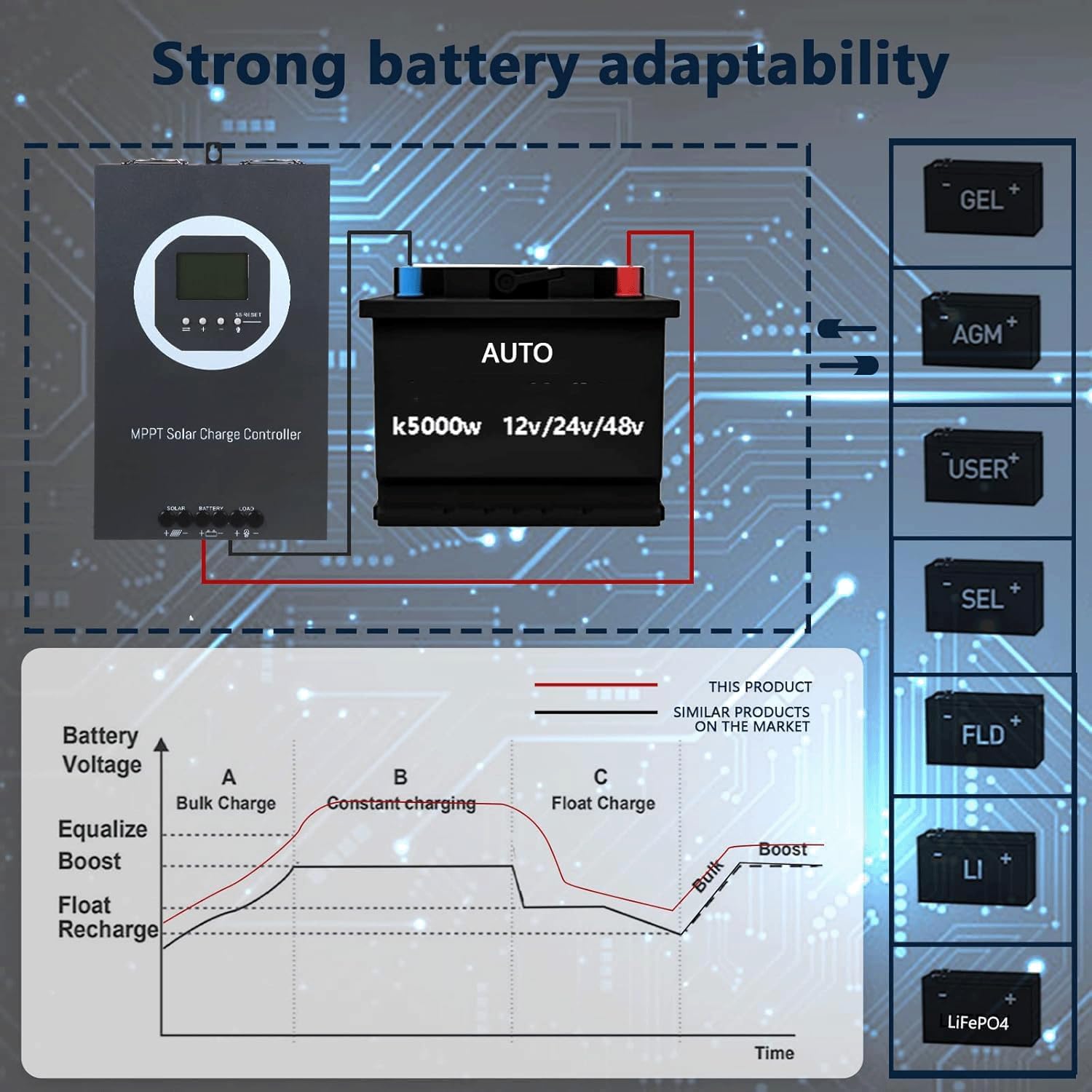
- Access the settings menu on the LCD display to select your battery type (AGM, Gel, Flooded, Lithium).
- For Lithium batteries or custom requirements, select 'USER' mode to manually set absorption voltage, float voltage, and low voltage disconnect thresholds. Refer to your battery manufacturer's specifications for recommended values.
5. Operating Instructions
5.1 LCD Display and Navigation
The controller's LCD display provides real-time information about your solar system. Use the 'SELECT' buttons to navigate through different screens and parameters.

- Main Screen: Displays current battery voltage, charging current, solar panel voltage, and load status.
- KWH Display: Shows the total accumulated charge in kilowatt-hours.
- Parameter Settings: Access various settings such as battery type, load timer, and protection thresholds.
5.2 Load Control
The controller includes a load timer function, allowing you to control when your DC loads are active.
- Navigate to the load timer settings on the LCD display.
- Set the desired ON/OFF times for your connected DC loads.
6. Maintenance
- Regular Inspection: Periodically check all wiring connections for tightness and corrosion.
- Cleaning: Keep the controller clean and free from dust. Use a dry cloth to wipe the exterior. Ensure ventilation openings are not obstructed.
- Temperature: Ensure the operating environment temperature remains within the specified range to prevent overheating. The built-in fan will assist with cooling.
- Battery Health: Monitor battery voltage and health regularly. Ensure battery terminals are clean and free of corrosion.
7. Troubleshooting
This section addresses common issues you might encounter with your solar charge controller.
| Problem | Possible Cause | Solution |
|---|---|---|
| Controller not turning on / No display | Battery not connected or low voltage; Reverse polarity connection. | Check battery connections and voltage. Ensure correct polarity. Charge battery if voltage is too low. |
| No charging from solar panels | Solar panels not connected; PV voltage too low/high; Reverse PV polarity; Shading on panels. | Check PV connections and polarity. Ensure PV voltage is within controller's operating range (e.g., 18V-96V for 12V system). Clear any shading. |
| Load not working | Load disconnected; Overload; Short circuit; Low battery voltage disconnect. | Check load connections. Reduce load. Check for short circuits. Charge battery. |
| Overheating | Poor ventilation; Excessive ambient temperature; Overload. | Ensure adequate airflow around the controller. Relocate to a cooler area if necessary. Reduce load. |
| Inaccurate voltage readings | Loose connections; Faulty sensor. | Check all wiring connections. Ensure temperature sensor is properly connected and placed. |
8. Specifications
Detailed technical specifications for the OOYCYOO MPPT 100A Solar Charge Controller.
| Parameter | Value |
|---|---|
| Rated Charge Current | 100A |
| System Nominal Voltage | 12V/24V/36V/48V DC Auto Identifying |
| Max. PV Open Circuit Voltage | 150VDC |
| Max. PV Input Power (12V System) | 1300W (Voc ≤96V) |
| Max. PV Input Power (24V System) | 2600W (Voc ≤112V) |
| Max. PV Input Power (36V System) | 3800W |
| Max. PV Input Power (48V System) | 5000W (Voc ≤150V) |
| MPPT Best Working Voltage Range (12V) | DC18V-DC96V |
| MPPT Best Working Voltage Range (24V) | DC36V-DC112V |
| MPPT Best Working Voltage Range (48V) | DC72V-DC150V |
| Maximum DC/DC Transfer Efficiency | ≥98.7% |
| Power Terminal | 10 AWG |
| Product Dimensions | 12"L x 7.8"W x 3.2"H (30.5 x 19.8 x 8.1 cm) |
| Item Weight | 9.04 pounds (4.1 kg) |
| Material | Plastic |
| Display Type | LCD |
| Operating Temperature | 4℃ to 40℃ (approximate, based on fan operation) |
| UPC | 768415110171 |
9. Warranty and Support
For warranty information and technical support, please refer to the documentation included with your purchase or contact OOYCYOO customer service through their official channels. Ensure you have your product model and purchase details available when seeking support.


