
Introduction
This manual provides essential information for the proper use, installation, and maintenance of the Generic HT7533 series three-terminal voltage regulators. These components are designed to provide a stable fixed output voltage from a higher, unregulated input voltage. Please read this manual thoroughly before using the product.
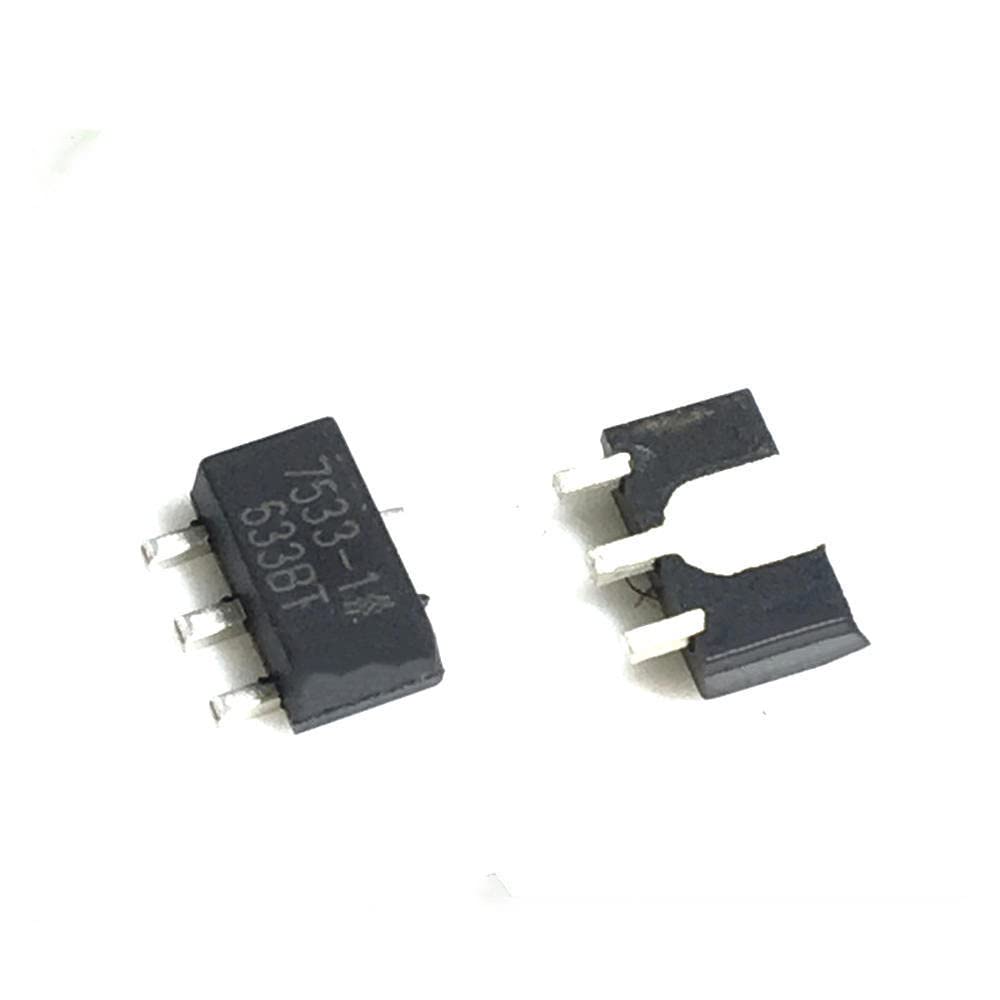
This image displays a set of HT7533 series three-terminal voltage regulators in SOT89 package.
Setup
The HT7533 series regulators are three-terminal devices, typically featuring an input (VIN), output (VOUT), and ground (GND) pin. Correct pin identification is crucial for proper operation and to prevent damage.
- Pin Identification: Refer to the specific datasheet for the HT7533-1, HT7533A-1, or HT7533 to identify the VIN, VOUT, and GND pins for the SOT89 package. Pinouts can vary slightly between manufacturers or specific sub-models.
- Input Voltage: Ensure the input voltage (VIN) is within the specified operating range for the device. Applying a voltage outside this range can damage the regulator.
- Output Capacitors: It is highly recommended to use input and output decoupling capacitors for stable operation. Typically, a 0.1µF ceramic capacitor on the input and a 1µF to 10µF capacitor on the output (ceramic or tantalum) are used, placed as close as possible to the regulator pins.
- Ground Connection: Ensure a solid ground connection for optimal performance and noise reduction.
- Heat Dissipation: For applications drawing higher currents, consider the thermal characteristics of the SOT89 package. Adequate PCB copper area or other heat sinking methods may be required to prevent overheating.
Operating
Once correctly set up, the HT7533 series regulator will provide a stable 3.3V output voltage, provided the input voltage and load current are within the device's specifications.
- Input Voltage Range: The regulator typically requires an input voltage slightly higher than its output voltage (e.g., 3.8V to 7V for a 3.3V output, depending on dropout voltage). Consult the datasheet for precise values.
- Output Current: The maximum output current capability varies by specific model and thermal conditions. Exceeding this limit can lead to voltage drop, overheating, or permanent damage.
- Thermal Management: Monitor the device temperature during operation, especially under heavy loads. If the device becomes excessively hot, it may enter thermal shutdown or fail. Ensure proper heat dissipation as mentioned in the Setup section.
- Stability: The recommended input and output capacitors are crucial for maintaining output voltage stability and preventing oscillations.
Maintenance
As a solid-state electronic component, the HT7533 series regulator requires minimal maintenance. However, proper handling and storage are essential for its longevity and performance.
- Storage: Store components in a dry, cool environment, preferably in anti-static bags or containers to prevent electrostatic discharge (ESD) damage.
- Handling: Handle components with care, avoiding excessive mechanical stress on the pins or package. Use appropriate ESD precautions when working with the regulators.
- Cleaning: If necessary, clean the components or PCB area with isopropyl alcohol and a soft brush. Ensure the area is completely dry before applying power.
Troubleshooting
If the regulator is not functioning as expected, consider the following common issues and solutions:
- No Output Voltage:
- Verify input voltage (VIN) is present and within the specified range.
- Check all pin connections (VIN, VOUT, GND) for correct polarity and continuity.
- Ensure the load is not drawing excessive current, potentially causing the regulator to enter current limit or thermal shutdown.
- Incorrect Output Voltage:
- Confirm the input voltage is stable and above the minimum required for regulation.
- Check for short circuits on the output.
- Verify the presence and correct values of input/output decoupling capacitors.
- Measure the actual output voltage under no-load and full-load conditions to identify potential load regulation issues.
- Overheating:
- Reduce the load current if it exceeds the device's capabilities.
- Improve heat dissipation by increasing PCB copper area connected to the ground pin or adding a small heatsink if applicable.
- Ensure the input-to-output voltage differential is not excessively high, as this increases power dissipation.
Specifications
The following specifications are typical for the HT7533 series three-terminal voltage regulators. Always refer to the manufacturer's official datasheet for the most accurate and detailed information for your specific part number.
| Feature | Detail |
|---|---|
| Brand | Generic |
| Model Numbers | HT7533-1, HT7533A-1, HT7533, 7533-1 |
| Package Type | SOT89 |
| Output Voltage | 3.3V (Fixed) |
| Terminal Type | Solder |
| Material | Copper (Internal lead frame/connections) |
| Manufacturer Part Number | WsijxoPa_11796 |
| ASIN | B0BWF3PLHF |
Warranty and Support
Specific warranty and support information for this Generic product is not available in the provided product details. For any inquiries regarding warranty or technical support, please contact your point of purchase or the component supplier directly.