1. Introduction
This manual provides essential instructions for the safe and efficient assembly, operation, and maintenance of your Voohek YC810 Drywall Lift Panel Hoist. Please read this manual thoroughly before use to ensure proper handling and to prevent injury or damage to the equipment.
The Voohek YC810 is designed to assist a single operator in lifting and positioning drywall panels for ceiling and wall installations. It features a sturdy steel construction, adjustable height, and lockable caster wheels for mobility and stability.
2. Safety Information
- Always wear appropriate personal protective equipment (PPE), including safety glasses, gloves, and steel-toed boots.
- Ensure the work area is clear of obstructions and well-lit.
- Verify that all components are securely assembled and in good working condition before each use.
- Do not exceed the maximum load capacity of 150 lbs (68 kg). Overloading can cause equipment failure and serious injury.
- Engage the wheel brakes when the lift is in position to prevent unintended movement.
- Keep hands and clothing clear of moving parts, especially the winch and cables.
- Never leave a loaded lift unattended.
- Lower the lift completely and secure it when not in use or during transport.
- Do not modify the equipment. Use only Voohek approved replacement parts.
3. Components Overview
The Voohek YC810 Drywall Lift consists of the following main components:
- Tripod Base Assembly: Provides stability and includes rolling caster wheels, some with lockable brakes.
- Frame Assembly: The main vertical support structure, housing the winch assembly and telescoping lift sections.
- Winch Assembly: Hand-operated mechanism with a brake for raising and lowering the cradle.
- Cradle Assembly: The platform that holds the drywall panel, including detachable cross arms.
- Two Cradle Cross-Arm Assemblies: Extendable arms that support the drywall panel on the cradle.

Image: The Voohek YC810 Drywall Lift in its fully assembled state, showcasing the main frame, base, and cradle with extended arms.
4. Setup and Assembly
The Voohek YC810 Drywall Lift is designed for tool-free assembly. Follow these steps:
- Unpack Components: Carefully remove all parts from the packaging. Verify all components listed in the "Components Overview" section are present.
- Assemble the Base:
- Unfold the tripod base until it locks into position.
- Ensure the support rods are properly engaged to stabilize the base.
- Check that the lockable caster wheels are functioning correctly.
- Attach Frame Assembly: Insert the main frame assembly into the center of the tripod base. Secure it firmly.
- Install Cradle Assembly:
- Mount the cradle assembly onto the top of the frame assembly.
- Attach the two detachable cross-arm assemblies to the cradle. Ensure they are securely fastened with the provided pins or locking mechanisms.
- Install Winch Handle: Attach the handle to the winch wheel.
- Final Check: Before first use, visually inspect all connections and moving parts to ensure they are secure and free from damage.
Video: This video demonstrates the assembly process for a similar drywall lift model (YC113plus). It shows how to unfold the base, attach the main mast, install the cradle arms, and secure the winch handle. While the model number differs, the assembly steps are generally applicable to the YC810.
5. Operating Instructions
Operating the Voohek YC810 Drywall Lift requires careful attention to safety and proper technique.
5.1 Loading a Drywall Panel
- Ensure the lift is on a stable, level surface and the caster wheel brakes are engaged.
- Lower the cradle assembly to its lowest position (approximately 34 inches off the floor) using the winch.
- Position the cradle arms to accommodate the size of your drywall panel (up to 4'x16'). The arms are adjustable from 49" to 114".
- Carefully place the drywall panel onto the cradle arms. Ensure the panel is centered and stable.

Image: A drywall panel securely loaded onto the Voohek YC810 Drywall Lift, ready for elevation. The lift is positioned in a room under construction.
5.2 Lifting and Positioning
- Once the panel is loaded, slowly turn the winch handle to raise the cradle. The built-in brake will hold the panel at the desired height.
- Guide the panel towards the ceiling or wall, adjusting the height as needed. The lift can reach a maximum height of 11 feet (132 inches).
- The cradle can be tilted for ceiling installations and rotated 360 degrees for precise positioning.
- Once the panel is in place, secure it to the framing using appropriate fasteners.

Image: A worker on scaffolding installing a drywall panel onto a ceiling, assisted by the Voohek YC810 Drywall Lift which holds the panel in position.
5.3 Lowering and Unloading
- After securing the drywall panel, slowly release the winch brake to lower the cradle.
- Once the cradle is fully lowered, carefully remove any remaining drywall pieces.
- Engage the wheel brakes if moving the lift to a new location.
6. Maintenance
Regular maintenance ensures the longevity and safe operation of your Voohek YC810 Drywall Lift.
- Cleaning: Wipe down the lift after each use to remove dust and debris. Use a damp cloth and mild detergent if necessary.
- Lubrication: Periodically lubricate moving parts, such as the winch mechanism, cables, and telescoping sections, with a suitable lubricant to ensure smooth operation.
- Inspection: Regularly inspect all bolts, nuts, and pins for tightness. Check the steel cables for fraying or damage. Inspect caster wheels for wear and ensure brakes are functional.
- Storage: When not in use, store the lift in a dry, protected area. It can be disassembled for compact storage.
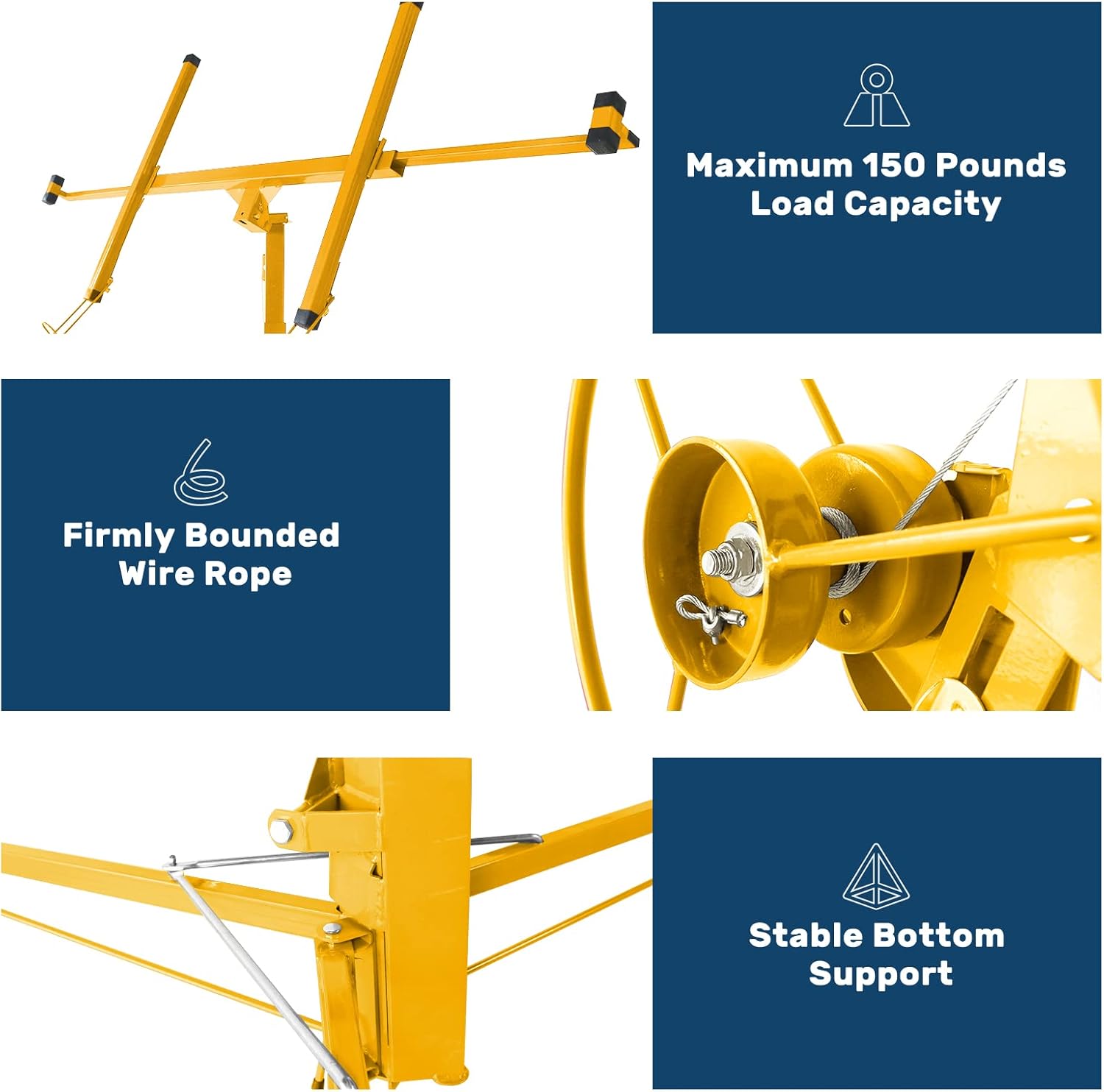
Image: A detailed view of the Voohek YC810 Drywall Lift's winch mechanism, showing the firmly bounded wire rope and the hand wheel for operation. Regular inspection of these parts is crucial for safety.
7. Troubleshooting
| Problem | Possible Cause | Solution |
|---|---|---|
| Lift does not raise or lowers unevenly. | Cable tangled or damaged; winch mechanism obstructed; uneven load. | Inspect cable for tangles or damage. Clear any obstructions from the winch. Re-center the drywall panel. |
| Caster wheels do not roll smoothly or lock. | Debris in wheels; damaged wheels; brakes engaged. | Clean wheels. Disengage brakes. Replace damaged wheels if necessary. |
| Lift feels unstable during operation. | Base not fully extended; uneven surface; overloaded. | Ensure base is fully extended and locked. Move to a level surface. Do not exceed load capacity. |
8. Specifications
| Feature | Specification |
|---|---|
| Brand | Voohek |
| Model Number | YC810 |
| Maximum Load Capacity | 150 lbs (68 kg) |
| Maximum Lifting Height | 11 ft (132 inches) |
| Minimum Loading Height | Approx. 34 inches |
| Adjustable Telescopic Arm Length | 49 inches to 114 inches |
| Compatible Panel Size | Up to 4 ft x 16 ft |
| Material | Alloy Steel |
| Item Weight | 76.6 pounds |
| Product Dimensions (Extended) | 116 x 35.56 x 132 inches (L x W x H) |
| Caster Wheels | 4-inch, lockable |
| Power Source | Hand chain (manual winch) |

Image: Diagram illustrating the minimum (55.9 inches) and maximum (132 inches) height capabilities of the Voohek YC810 Drywall Lift.

Image: Close-up view of the adjustable cradle arms, showing their extendable range from 49.2 to 115.7 inches and the 360-degree rotation feature for versatile panel positioning.
9. Warranty and Support
For warranty information, technical support, or to order replacement parts, please contact Voohek customer service. Refer to your purchase documentation for specific warranty terms and contact details.
You can also visit the official Voohek Store on Amazon for additional product information and support resources: Voohek Store
