Introduction
This manual provides comprehensive instructions for the NOVOO 11-in-1 USB-C Triple Display Docking Station. This device expands the connectivity of your USB-C enabled laptop, offering multiple display outputs, high-speed data transfer ports, network connectivity, and power delivery capabilities. Please read this manual thoroughly before use to ensure proper operation and to maximize the benefits of your docking station.

Image: Overview of the NOVOO 11-in-1 USB-C Triple Display Docking Station, showcasing its compact design and various ports including USB, HDMI, DisplayPort, Ethernet, and card reader slots.
Product Features
The NOVOO 11-in-1 USB-C Triple Display Docking Station offers the following features:
- Triple Display Output: Two HDMI ports (up to 4K@60Hz) and one DisplayPort (up to 8K@30Hz or 4K@120Hz, depending on laptop DP version).
- High-Speed Data Transfer: Two USB 3.0 ports (up to 5Gbps) and two USB 2.0 ports (for peripherals like keyboard/mouse).
- Memory Card Reader: SD and TF card slots (up to 104Mbps).
- Gigabit Ethernet: RJ45 port for stable wired network connection (up to 1000Mbps).
- Power Delivery: USB-C PD charging port (up to 100W input) to power your laptop.
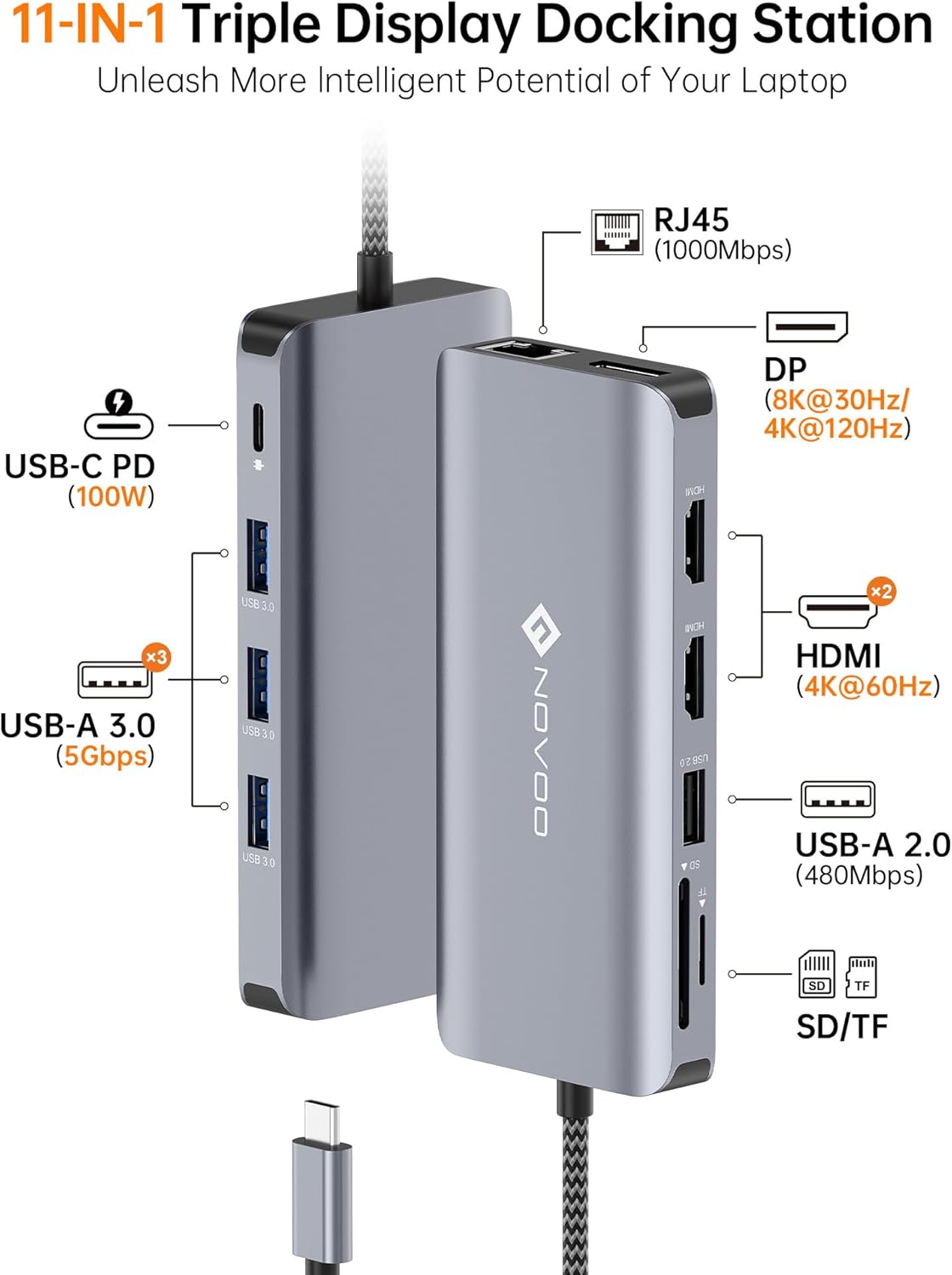
Image: Detailed diagram illustrating each port on the docking station, including USB-C PD, USB-A 3.0, USB-A 2.0, SD/TF card slots, HDMI, DisplayPort, and RJ45 Ethernet, along with their respective specifications.
Setup Instructions
- Verify Laptop Compatibility: Ensure your laptop's USB-C port supports full functionality (Power Delivery + DisplayPort Alt Mode + Data Transfer). Refer to your laptop's specifications or user manual. Ports that only support charging or data transfer will not enable all docking station features.
- Connect to Laptop: Plug the integrated USB-C cable from the docking station into your laptop's compatible USB-C port.
- Connect Power Adapter (Optional but Recommended): For optimal performance and to charge your laptop, connect your laptop's original USB-C power adapter (up to 100W) to the docking station's USB-C PD input port.
- Connect External Displays:
- For HDMI displays, connect HDMI cables from your monitors to the HDMI ports on the docking station.
- For DisplayPort displays, connect a DisplayPort cable from your monitor to the DP port on the docking station.
- Connect Peripherals: Plug your USB devices (e.g., keyboard, mouse, external hard drives, USB flash drives) into the available USB 3.0 and USB 2.0 ports.
- Connect Network Cable: For a wired internet connection, plug an Ethernet cable into the RJ45 port on the docking station.
- Insert Memory Cards: If needed, insert SD or TF cards into their respective slots.

Image: Visual guide for checking laptop USB-C port compatibility, distinguishing between full-function ports (Data + PD + DisplayPort Alt) and limited ports (Charging only, Data only, Data + charging only).
Operating Instructions
Display Configuration
The docking station supports various display modes depending on your operating system and laptop capabilities.
- Windows Systems: Supports both Mirror Mode (AAAA) and Extend Mode (ABBB/ABCD) for dual or triple displays (MST mode).
- macOS Systems: Supports Mirror Mode (AAAA) and Extend Mode (ABBB). Due to macOS limitations, all extended monitors will display the same content.
To configure your displays, access your operating system's display settings:
- Windows: Right-click on the desktop, select "Display settings," then choose your preferred display mode (Duplicate these displays, Extend these displays).
- macOS: Go to "System Settings" > "Displays," then arrange or mirror displays as desired.

Image: Visual representation of different display configurations (Mirror Mode, Extend Mode) for both Windows and macOS, highlighting the differences in multi-monitor support between operating systems.
Data Transfer
Utilize the USB 3.0 ports for high-speed data transfer and the USB 2.0 ports for connecting standard peripherals.
- USB 3.0 Ports (x2): Ideal for external hard drives, SSDs, and other devices requiring fast data transfer (up to 5Gbps).
- USB 2.0 Ports (x2): Suitable for keyboards, mice, printers, and other low-bandwidth devices.
- SD/TF Card Reader: Insert your SD or TF (MicroSD) cards to access photos and videos directly (up to 104Mbps).

Image: A laptop connected to the docking station, demonstrating the use of USB 3.0 ports for external storage and SD/TF card slots for memory cards, emphasizing high-speed data transfer capabilities.
Power Delivery
The USB-C PD port allows you to charge your laptop while using the docking station. Connect your laptop's power adapter to this port.
- Supports up to 100W power input.
- Actual power output to the laptop depends on the connected power adapter and the power consumption of the docking station and connected peripherals.
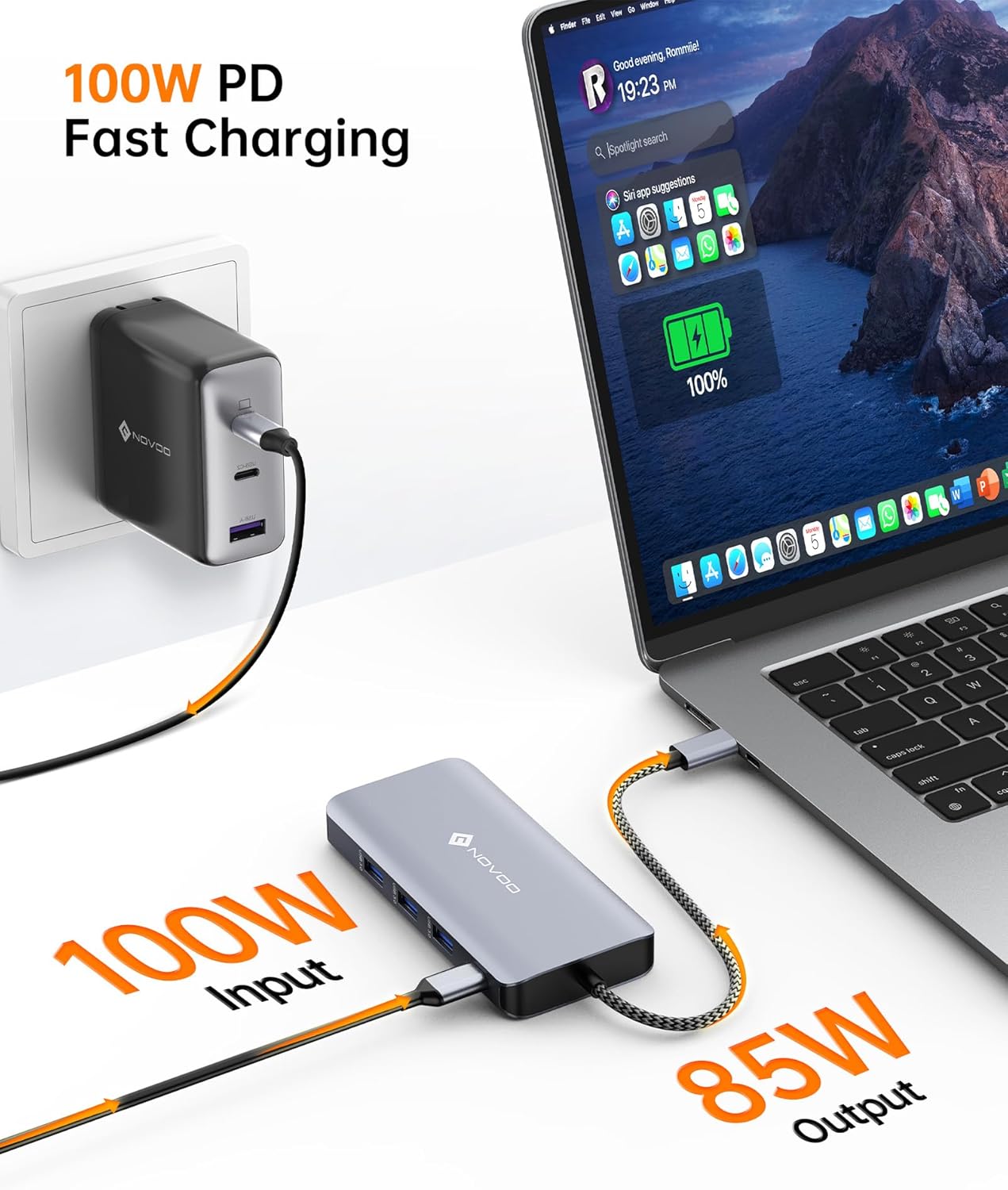
Image: A NOVOO docking station connected to a laptop and a wall charger, illustrating the 100W Power Delivery feature for fast charging the laptop.
Network Connection
The Gigabit Ethernet port provides a stable and fast wired network connection.
- Supports speeds up to 1000Mbps (1 Gigabit per second).
- Ensures reliable internet access, especially beneficial for large file transfers or online gaming.

Image: A close-up of the docking station's RJ45 Ethernet port with a connected network cable, indicating a stable 1000Mbps Gigabit Ethernet connection.
Maintenance
- Keep the docking station clean and free from dust. Use a soft, dry cloth for cleaning.
- Avoid exposing the device to extreme temperatures, humidity, or direct sunlight.
- Do not attempt to disassemble or repair the docking station yourself. This may void the warranty and cause damage.
- Ensure cables are connected securely but without excessive force to prevent port damage.
Troubleshooting
- No Display Output:
- Ensure your laptop's USB-C port supports DisplayPort Alt Mode.
- Check all cable connections (USB-C to laptop, HDMI/DP to monitors).
- Verify monitor input source is correctly selected.
- Restart your laptop and reconnect the docking station.
- Update your laptop's graphics drivers.
- Laptop Not Charging:
- Confirm your laptop's USB-C port supports Power Delivery.
- Ensure your power adapter is connected to the docking station's PD port and is functioning correctly.
- Check if the power adapter provides sufficient wattage for your laptop and the docking station.
- USB Devices Not Recognized:
- Reconnect the USB device.
- Try a different USB port on the docking station.
- Connect the device directly to your laptop to confirm it functions independently.
- Ethernet Connection Issues:
- Check the Ethernet cable connection to both the docking station and your router/modem.
- Verify your network settings on your laptop.
- Try a different Ethernet cable.
- Intermittent Connectivity / Device Gets Warm:
- Ensure adequate ventilation around the docking station.
- Reduce the number of high-power devices connected simultaneously if possible.
- Ensure the power adapter is connected for stable operation, especially with multiple displays and peripherals.
Specifications
| Feature | Detail |
|---|---|
| Model | 11 in 1 DP |
| Product Dimensions | 3.94 x 1.57 x 0.39 inches |
| Item Weight | 0.705 ounces |
| Hardware Interface | Ethernet, HDMI, MicroSD, USB 2.0, USB 3.0, USB Type C |
| HDMI Output | 2x HDMI (up to 4K@60Hz) |
| DisplayPort Output | 1x DP (up to 8K@30Hz / 4K@120Hz with DP 1.4 HBR3 DSC enabled) |
| USB 3.0 Ports | 2x USB-A (up to 5Gbps) |
| USB 2.0 Ports | 2x USB-A (for keyboard/mouse) |
| Card Reader | SD/TF (up to 104Mbps) |
| Ethernet Port | RJ45 Gigabit Ethernet (up to 1000Mbps) |
| Power Delivery | USB-C PD (up to 100W input) |
| Compatible Devices | Laptops with full-featured USB Type-C port (e.g., M1/M2 MacBook Pro/Air, Dell XPS, Lenovo Yoga, Microsoft Surface, HP Spectre/Elite) |
Warranty and Support
NOVOO products are designed for reliability and performance. For warranty information and technical support, please refer to the warranty card included with your product or visit the official NOVOO website. Keep your purchase receipt for warranty claims.
For further assistance, you may contact NOVOO customer support through their official channels.


