1. Introduction
The CHNADKS HFS-20 is an upgraded portable nuclear radiation detector designed for monitoring X, Beta (β), and Gamma (γ) rays. This handheld instrument features an LCD display, two measurement alert methods, and recording capabilities, making it accessible for various users.
It is widely applicable in environments where ionizing radiation may be present, such as homes, irradiation processing facilities, health and epidemic prevention sectors, and for personal radiation dose supervision and protection.

Image: Wide range of applications for the CHNADKS HFS-20 detector.
2. Package Contents
Upon opening the package, please verify that all items listed below are present and in good condition:
- CHNADKS HFS-20 Nuclear Radiation Detector
- Zippered Carrying Case with foam padding
- USB Type-C Charging Cable
- User Manual
- Certificate of Conformity
- Wrist Strap
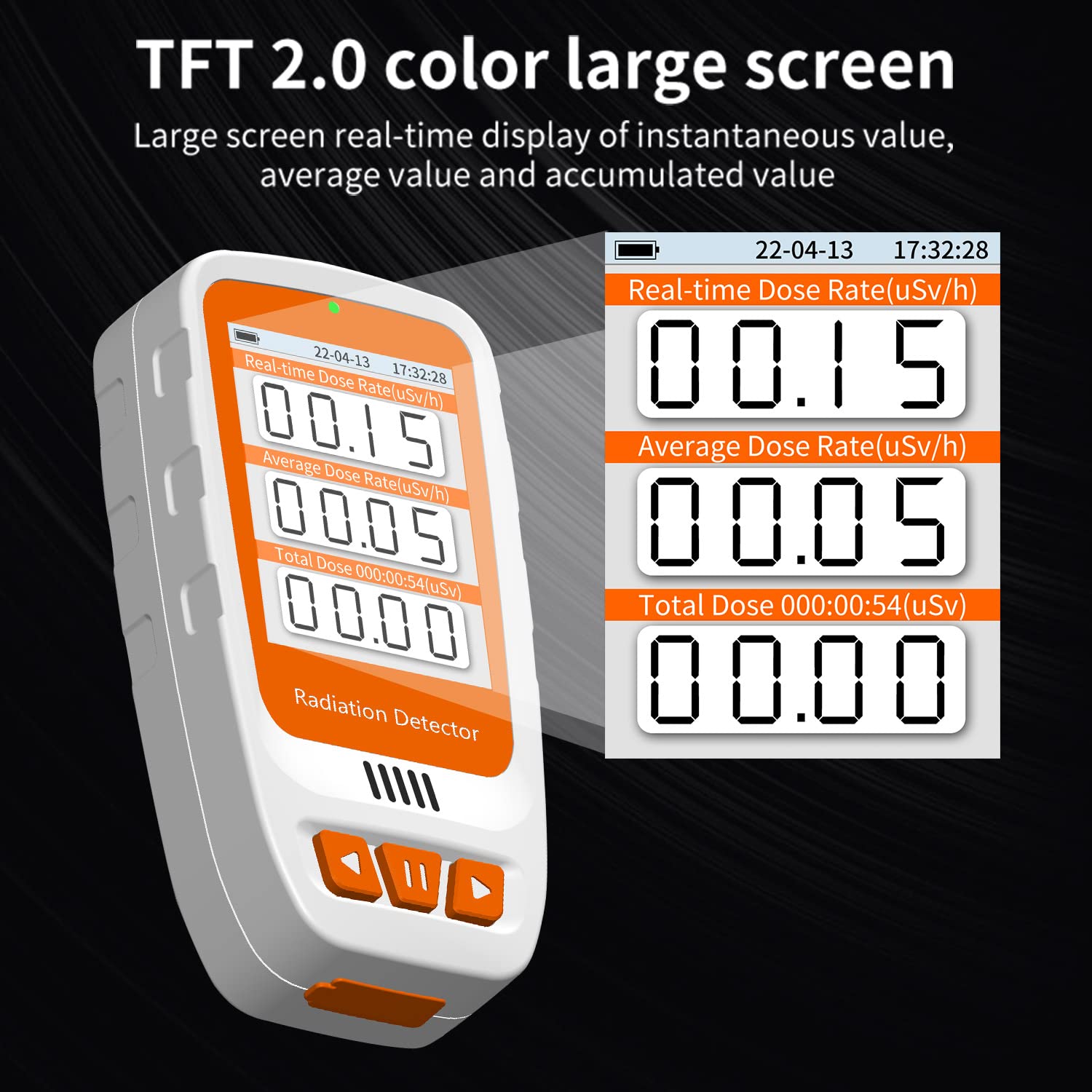
Image: Contents of the CHNADKS HFS-20 product package.
3. Product Overview
The HFS-20 detector is a compact, handheld device designed for ease of use and portability. It features a clear display and intuitive controls.
3.1 Device Components
- Display Screen: TFT 2.0 color large screen for real-time, average, and accumulated value display.
- Control Buttons: Intuitive buttons for navigation and selection.
- Buzzer: Provides audible alerts.
- Light Tips: Visual indicators for alerts.
- Charging Interface: USB Type-C port located at the bottom for convenient recharging.
- Sensor: The GM counter sensor is located on the right side of the device. For accurate readings, position this side closest to the source being monitored.
- Back Clamp: For attaching the device to clothing or other surfaces.

Image: Labeled diagram of the CHNADKS HFS-20 device components.

Image: The TFT 2.0 color large screen displaying radiation values.
4. Setup
4.1 Charging the Device
The HFS-20 is equipped with a rechargeable Lithium Ion battery. Connect the provided USB Type-C cable to the charging port at the bottom of the device and to a suitable USB power source. The green light indicates charging, and it turns off when fully charged.
4.2 Power On/Off
To power on the device, press and hold the pause/select button (center button) for approximately 3 seconds. The device will start up and display the main interface. To power off, press and hold the same button for 3 seconds until the device shuts down.
4.3 Initial Settings
After powering on, you can access the settings menu by pressing any of the control buttons. Use the left and right arrow buttons to navigate through the menu options. The main menu typically includes options for:
- Language: Select your preferred language.
- Units: Switch between measurement units such as uSv (microsieverts) and uGy (micrograys).
- Clock: Set the current year, month, and day.
5. Operating Instructions
5.1 Radiation Measurement
From the main interface, the device displays real-time dose rate, average dose rate, and total accumulated dose. The sensor is located on the right side; ensure this side is positioned towards the area or object you wish to monitor for optimal accuracy.
5.2 Timer Measurement
The timer measurement function allows for scheduled monitoring. In the timer measurement menu, you can set:
- Start Delay: Set a delay from 00-99 hours before measurement begins.
- Measurement Time: Define the duration of the measurement from 00-999 hours.
Each completed timer measurement automatically saves a history record. The device can store up to 10 history records.
5.3 Alarm Settings
The HFS-20 features sound and light dual alarms. You can customize the alarm settings:
- Over-Limit Alarm: Set the instantaneous dose alarm limit (range: 0.1 uSv - 999 uSv).
- Total Dose Alarm: Set the accumulated dose alarm limit (range: 1 uSv - 9999 uSv).
- Alarm Volume: Adjust the volume of the audible alarm.
- Number of Alarms: Configure how many times the alarm sounds.

Image: Sound and light dual alarm system of the HFS-20.
5.4 Viewing and Deleting Records
Navigate to the 'Records' menu to view saved measurement history. You can also access a data deletion interface to clear current data or delete historical records as needed.
5.5 User Interface Demonstration Video
Video: A demonstration of the CHNADKS HFS-20's user interface, including power on/off, menu navigation, and setting adjustments.
6. Maintenance
To ensure the longevity and accurate performance of your CHNADKS HFS-20 Nuclear Radiation Detector, follow these maintenance guidelines:
- Cleaning: Use a soft, dry cloth to clean the device. Avoid using abrasive cleaners or solvents that could damage the screen or casing.
- Storage: Store the device in its protective carrying case when not in use. Keep it in a cool, dry place away from direct sunlight, extreme temperatures, and high humidity.
- Battery Care: Recharge the device regularly, even if not in frequent use, to maintain battery health. Avoid fully discharging the battery for extended periods.
- Handling: Handle the device with care to prevent drops or impacts, which could affect the sensitive internal components, especially the GM counter sensor.
7. Troubleshooting
If you encounter issues with your HFS-20 detector, consider the following common troubleshooting steps:
- Device Does Not Power On: Ensure the battery is charged. Connect the device to a power source using the USB Type-C cable and allow it to charge for some time before attempting to power on again.
- Inaccurate or Unexpected Readings: Verify that the GM counter sensor (located on the right side of the device) is properly positioned towards the area being measured. Ensure there are no obstructions. Background radiation levels can vary, so compare readings in different known environments.
- Alarm Not Sounding: Check the alarm volume settings in the device menu. Ensure the alarm limits are set appropriately for the radiation levels you expect to detect.
- Screen Freezes or Malfunctions: Try powering off the device by holding the pause/select button for 3 seconds. If it does not respond, allow the battery to fully discharge and then recharge before attempting to power on again.
If these steps do not resolve the issue, please contact customer support for further assistance.
8. Specifications
Below are the technical specifications for the CHNADKS HFS-20 Nuclear Radiation Detector:
| Feature | Specification |
|---|---|
| Sensor | GM counter tube |
| Measurement Range | 0.08 uSv - 50 mSv |
| Measurement Accuracy | -17%... +25% (based on 137Cs γ) |
| Measurable Rays | X-ray, Gamma (γ) Ray, and hard Beta (β) radial |
| Battery Type | 1 Lithium Ion battery (included) |
| Battery Capacity | 1800mAh, 6.66Wh |
| Endurance Time | 14 days (continuous measurement without particle sound) |
| Charging Interface | USB Type-C |
| Alarm Response Time | <10s |
| Alarm Threshold Deviation | -17%... +25% |
| Product Dimensions | 8.8 x 4.3 x 1.9 cm |
| Product Weight | 100 g |

Image: Product parameters and dimensions of the HFS-20.
9. Safety Information
Understanding and mitigating the risks associated with nuclear radiation is crucial. This device is designed to help monitor radiation levels, but it does not provide protection against radiation exposure. Always adhere to local safety regulations and guidelines when working in environments with potential radiation hazards.
- Familiarize yourself with the device's alarm settings and respond appropriately to alerts.
- Do not rely solely on this device for critical safety decisions without consulting qualified professionals.
- Keep the device away from strong electromagnetic fields, which may interfere with its operation.

Image: Potential health hazards associated with nuclear radiation exposure.
10. Warranty and Support
For warranty information, technical support, or any inquiries regarding your CHNADKS HFS-20 Nuclear Radiation Detector, please refer to the contact details provided in your product packaging or visit the official CHNADKS website. Please retain your proof of purchase for warranty claims.


