
Amewi 26095
Amewi Tornado High-Speed RC Boat User Manual
Model: 26095
1. Important Safety Warnings
Failure to follow these safety instructions may result in injury or damage to the product.
- Age Recommendation: This product is not a toy and is suitable for users aged 14 years and older. Adult supervision is required for younger users.
- Small Parts: Contains small parts that could be a choking hazard. Keep away from children under 3 years.
- Battery Safety:
- Use only the specified LiPo battery (3S, 11.1V, 1600mAh, 30C) and charger.
- WARNING: The included USB charger may not be suitable for multi-cell LiPo batteries and poses a fire risk. It is highly recommended to use a qualified LiPo charger with balancing function for safe charging.
- Never leave batteries charging unattended.
- Charge batteries on a non-flammable surface away from flammable materials.
- Do not overcharge or over-discharge batteries.
- Store LiPo batteries at a storage voltage (approx. 3.7V per cell) in a fireproof bag or container.
- If the battery swells, leaks, or becomes hot, discontinue use immediately and dispose of it properly.
- Water Operation: Operate the boat only in open water areas free from obstacles, swimmers, or wildlife.
- Propeller Hazard: Keep hands, fingers, loose clothing, and hair away from the rotating propeller when the boat is powered on.
- Electrical Components: Ensure all electrical components are dry before and after use. Avoid contact with water inside the hull.
- Maintenance: Perform regular maintenance as described in this manual to ensure safe operation and product longevity.
2. Package Contents
Verify that all items listed below are included in your package:
- Amewi Tornado High-Speed RC Boat
- 2.4GHz Transmitter (Remote Control)
- LiPo Battery (3S, 11.1V, 1600mAh)
- USB Charger (for LiPo battery)
- Boat Stand
- Spare Propeller
- Hex Wrench
- Instruction Manual

Image: Complete package contents of the Amewi Tornado RC Boat, showing the boat, remote control, battery, charger, boat stand, and small accessories.
3. Product Overview
3.1 Boat Components
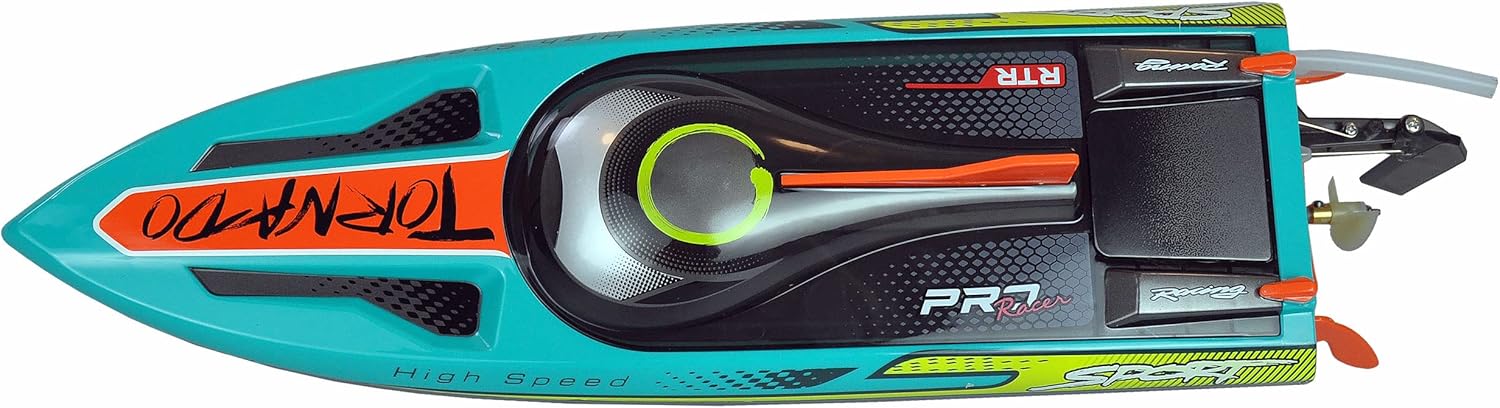
Image: Top view of the Amewi Tornado RC Boat, highlighting the sleek design and main body.
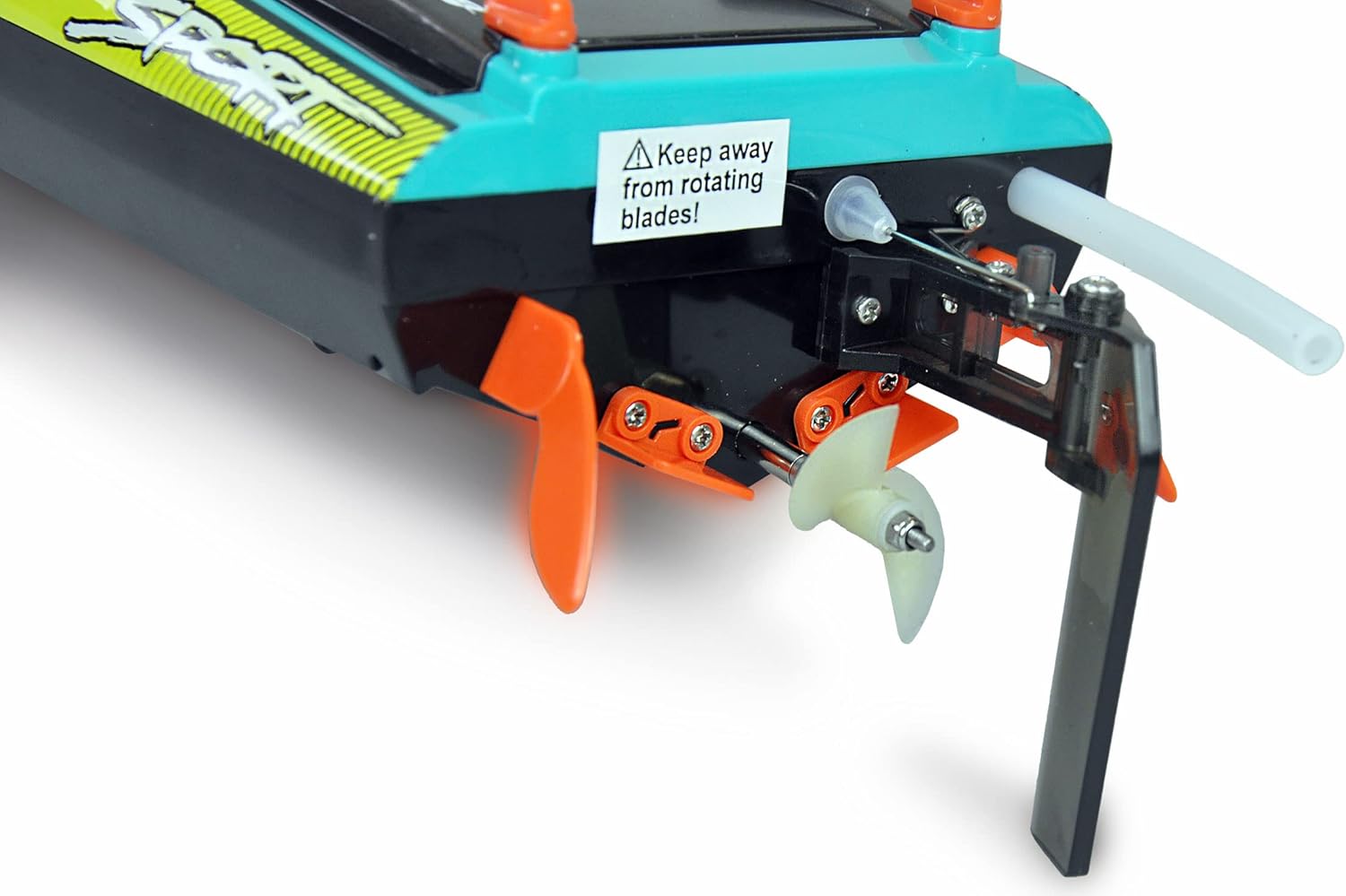
Image: Close-up of the boat's stern, detailing the propeller, rudder, and water cooling system outlet.
3.2 Transmitter (Remote Control)
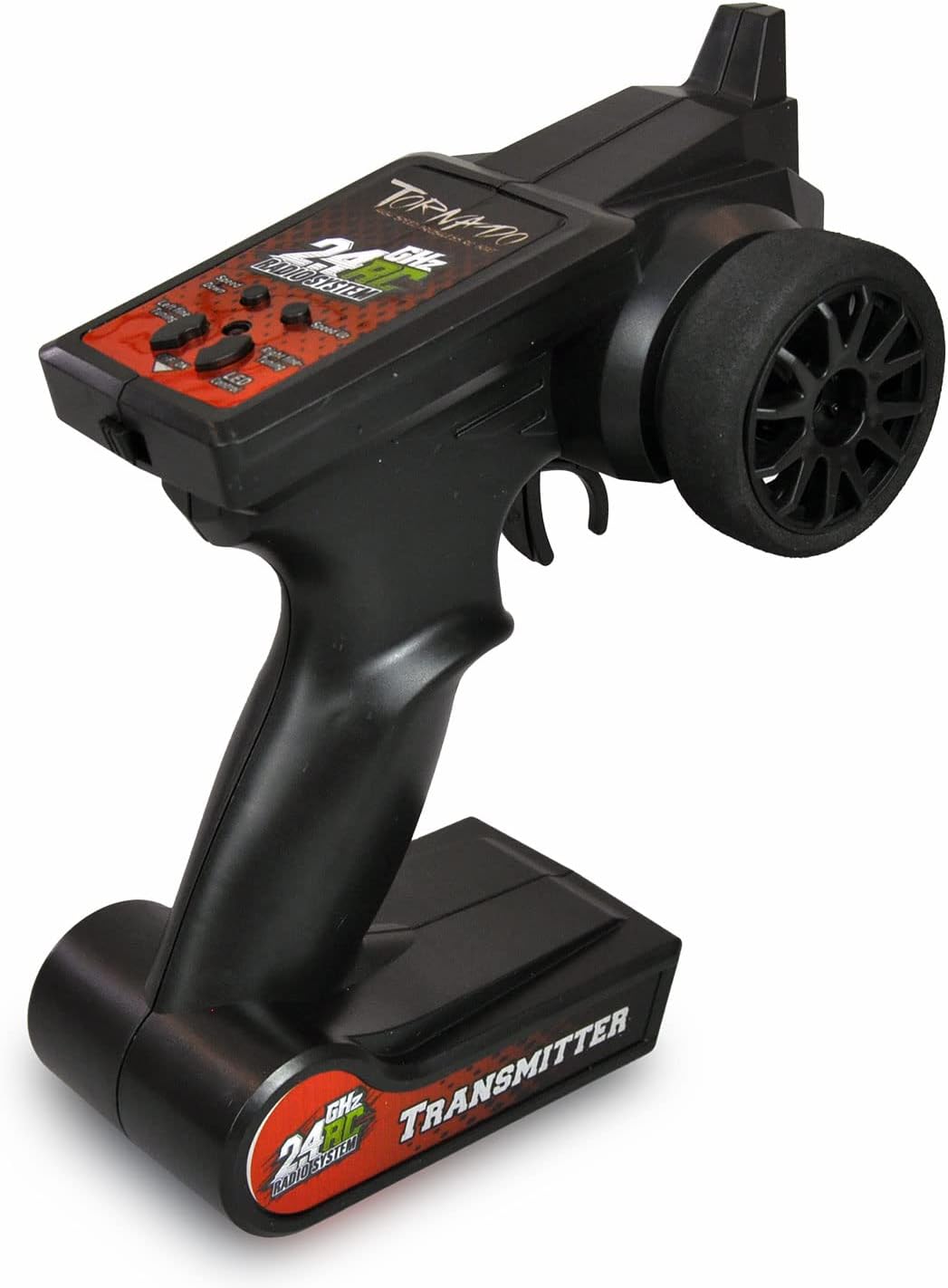
Image: The 2.4GHz pistol-grip style transmitter for controlling the Amewi Tornado RC Boat.
The transmitter features a steering wheel for directional control and a trigger for throttle (forward/reverse). It operates on a 2.4GHz frequency for reliable communication.
4. Setup
4.1 Charging the LiPo Battery
Before first use, fully charge the included LiPo battery. Connect the battery to the provided USB charger. The charger's indicator light will show charging status (refer to charger manual for specific light indications). Charging time may vary.
Important Battery Charging Note:
While a USB charger is included, it is strongly recommended to invest in a dedicated LiPo balance charger for multi-cell batteries (like the 3S battery in this boat). A proper balance charger ensures each cell is charged equally, prolonging battery life and significantly reducing the risk of overcharging and potential fire hazards. Always supervise charging.
4.2 Installing the Boat Battery
- Carefully remove the boat's canopy/hatch to access the internal compartment.
- Place the charged LiPo battery into the battery compartment. Secure it using the provided hook-and-loop straps to prevent movement during operation.
- Connect the battery's XT60 connector to the boat's ESC (Electronic Speed Controller) connector.
- Ensure all wires are neatly tucked away and do not interfere with moving parts or the hatch closure.
- Securely reattach the canopy/hatch, ensuring a watertight seal.

Image: Internal view of the boat's hull, showing the placement of the LiPo battery secured by straps and connected to the electronics.
4.3 Transmitter Battery Installation
Open the battery compartment on the bottom of the transmitter. Insert the required batteries (usually AA, not included) according to the polarity markings. Close the compartment cover securely.
4.4 Binding the Transmitter and Receiver
The boat and transmitter are typically pre-bound from the factory. If re-binding is necessary, follow these steps:
- Ensure both the boat battery and transmitter batteries are installed and charged.
- Turn on the transmitter first.
- Connect the boat's battery. The receiver in the boat will attempt to bind with the transmitter.
- Wait for the indicator lights on both the transmitter and receiver to show a solid connection (refer to specific light patterns in the separate transmitter manual if provided).
- Test the controls (steering and throttle) to ensure proper function before placing the boat in water.
4.5 Propeller and Rudder Check
Before each use, ensure the propeller is securely attached and free from damage. Check that the rudder moves freely and responds correctly to steering inputs from the transmitter.
4.6 Drive Shaft Lubrication
Crucial Maintenance Point:
The drive shaft (the shaft connecting the motor to the propeller) requires lubrication before every use, or at least after every second use, to prevent water ingress and reduce wear. Use a marine-grade grease or specialized shaft grease for RC boats. Do NOT use general oils or petroleum jelly as they are not suitable for this application and may cause damage or water leaks.
- Remove the propeller.
- Carefully pull the drive shaft slightly out from the stern of the boat.
- Apply a small amount of suitable grease along the exposed shaft.
- Push the shaft back into place and reattach the propeller.
5. Operating Instructions
5.1 Pre-Operation Checklist
- LiPo battery fully charged and securely installed.
- Transmitter batteries installed and power on.
- Boat and transmitter are bound.
- Propeller and rudder are free from obstructions and move correctly.
- Drive shaft is lubricated.
- Hatch is securely closed and watertight.
- Operating area is clear of obstacles and safe for RC boat use.
5.2 Launching the Boat
Gently place the boat into the water. Ensure the boat is floating level and no water is entering the hull.
5.3 Controlling the Boat
- Forward: Pull the throttle trigger on the transmitter.
- Reverse: Push the throttle trigger forward (away from you).
- Steering: Turn the steering wheel on the transmitter left or right.
- Speed Adjustment: The transmitter may have a speed adjustment dial or switch. For beginners, it is recommended to start at a lower speed setting.
5.4 Self-Righting Function
If the boat flips over during operation, it is designed with a self-righting feature. By quickly applying forward and reverse throttle, you can rock the boat to flip it back upright. This may require several attempts, especially in choppy water.
5.5 Low Battery Warning
When the boat's battery is low, the boat will typically slow down significantly or the transmitter may emit an audible warning. When this occurs, immediately bring the boat back to shore to avoid losing power in the water.
5.6 Retrieving the Boat
Always retrieve the boat manually once the battery is low or operation is complete. Do not attempt to swim after the boat.
6. Maintenance
6.1 After Each Use
- Remove the boat from the water and disconnect the battery immediately.
- Open the hatch and carefully inspect for any water ingress. If water is present, dry it thoroughly and investigate the cause.
- Wipe down the entire boat, inside and out, with a soft, dry cloth. Ensure all electronic components are completely dry.
- Remove the propeller and clean any debris (weeds, fishing line, etc.) from the propeller and drive shaft.
6.2 Regular Maintenance
- Drive Shaft Lubrication: As mentioned in Section 4.6, lubricate the drive shaft before every use or every second use. This is critical for preventing water intrusion and ensuring smooth operation.
- Rudder and Steering Linkage: Check for any looseness or damage. Ensure smooth movement.
- Propeller Inspection: Regularly inspect the propeller for chips, cracks, or bends. Replace if damaged.
- Hull Integrity: Periodically check the hull for cracks or damage that could compromise its watertight seal.
6.3 Storage
When storing the boat for extended periods:
- Ensure the boat is completely clean and dry.
- Disconnect and remove the LiPo battery from the boat. Store the LiPo battery at its storage voltage (approx. 3.7V per cell) in a cool, dry place, preferably in a fireproof bag.
- Remove batteries from the transmitter.
- Store the boat in a cool, dry place away from direct sunlight and extreme temperatures.
7. Troubleshooting
| Problem | Possible Cause | Solution |
|---|---|---|
| Boat does not respond to transmitter. |
|
|
| Boat is slow or loses power quickly. |
|
|
| Boat flips over frequently / unstable. |
|
|
| Water inside the hull. |
|
|
| Charger gets hot or smells. |
|
|
8. Specifications
| Feature | Detail |
|---|---|
| Model Number | 26095 |
| Dimensions (L x W x H) | 47 x 12.5 x 9 cm |
| Weight | 617 grams |
| Recommended Age | 14 years and up |
| Max Speed | 65 km/h |
| Motor Type | Brushless Outrunner |
| Battery Type | LiPo, 3S, 11.1V, 1600mAh, 30C, soft case, XT60 connector |
| Battery Dimensions | 74 x 35 x 24 mm |
| Battery Weight | 120 g |
| Main Material | ABS Plastic |
| Radio Control Type | 2.4 GHz Radio |
| Color | Multicolor |
9. Warranty and Support
Amewi products are designed for quality and performance. For warranty information, technical support, or spare parts availability, please refer to the documentation included with your purchase or visit the official Amewi website. Please note that availability of spare parts information is not provided in this manual.
Keep your purchase receipt as proof of purchase for any warranty claims.
Related Documents - 26095
 |
Benutzerhandbuch: Wasserfester Brushless ESC (RTR-Version) - Funktionen, Daten & Programmierung Umfassende Anleitung für den wasserfesten Brushless ESC (RTR-Version). Erfahren Sie mehr über Funktionen, technische Daten, Erstinstallation, Kalibrierung und Programmierung dieser leistungsstarken Regler für RC-Fahrzeuge. |
 |
AMEWI Baiting 2500 V2 RC Bait Boat Manual: Operation, Setup & Safety Guide Comprehensive user manual for the AMEWI Baiting 2500 V2 remote-controlled bait boat. Covers setup, operation, GPS features, safety warnings, battery handling, disposal, troubleshooting, and wiring diagrams. |
 |
AMEWI GHOST HIGH-SPEED RACING 1:10 RTR RC Car Instruction Manual Comprehensive instruction manual for the AMEWI GHOST HIGH-SPEED RACING 1:10 RTR remote control car. Covers setup, charging, operation, safety guidelines, battery disposal, and maintenance for this consumer RC toy. |
 |
AMEWI Raven 4x4 Brushless Monster Truggy: User Manual and Operating Instructions Comprehensive user manual and operating instructions for the AMEWI Raven 4x4 Brushless Monster Truggy, covering safety, setup, operation, maintenance, parts identification, and technical specifications. |
 |
AMEWI Hyper Go Citroen C3 WRC 1:14 RTR RC Car Operation Manual Comprehensive operation manual for the AMEWI Hyper Go Citroen C3 WRC 1:14 RTR remote-controlled car. Covers safety, battery handling, operation, technical specifications, and box contents. Features detailed instructions for setup and use. |
 |
AMEWI NEON HORNET 26090 RC Boat Instruction Manual This instruction manual provides detailed guidance for operating and maintaining the AMEWI NEON HORNET 26090 RC boat. It covers safety precautions, setup, operation, troubleshooting, and component information. |