
1. Introduction
The ANCEL BM700 is a diagnostic scan tool designed for comprehensive system analysis of BMW group vehicles. It also provides standard OBD2 engine diagnostics for other vehicle makes and models. This manual provides instructions for setup, operation, maintenance, and troubleshooting of the device.
2. Package Contents
The ANCEL BM700 package includes the following items:
- 1 x ANCEL BM700 Diagnostic Scan Tool
- 1 x 20-pin Female Adapter (for older BMW models)
- 1 x USB Cable (for updates)
- 1 x User Manual (this document)
3. Product Overview
The ANCEL BM700 features a 2.8-inch TFT 262K true color display LCD for clear data presentation. It is designed for ease of use, suitable for both beginners and professionals.

Image: Front view of the ANCEL BM700 diagnostic tool, displaying its user interface with menu options like OBDII, For BMW, Oil Reset, EPB Reset, BAT, BMS Reset, ETCS Reset, and Tool Setup.
3.1 Device Components
- Display Screen: 2.8" TFT 262K true color LCD.
- Navigation Buttons: For menu selection and data scrolling.
- OK Button: Confirms selections.
- ESC Button: Exits current screen or cancels operation.
- I/M Button: Quick access to I/M Readiness status.
- OBD2 Cable: Connects to the vehicle's OBD2 port.
- USB Port: For software updates.

Image: Diagram highlighting the user-friendly design of the ANCEL BM700, pointing out the redesigned interface, well-made cover, and USB port for connectivity.
4. Setup and Connection
To begin using the ANCEL BM700, follow these steps to connect it to your vehicle:
- Locate the OBD2 Port: The 16-pin OBD2 diagnostic port is typically located under the dashboard on the driver's side.
- Connect the BM700: Plug the BM700's OBD2 cable into the vehicle's OBD2 port.
- For Older BMW Models (20-pin port):
- Locate the 20-pin diagnostic port, usually found under the hood.
- Connect the 20-pin female adapter to the vehicle's 20-pin port.
- Connect the BM700's 16-pin OBD2 cable to the 20-pin adapter.
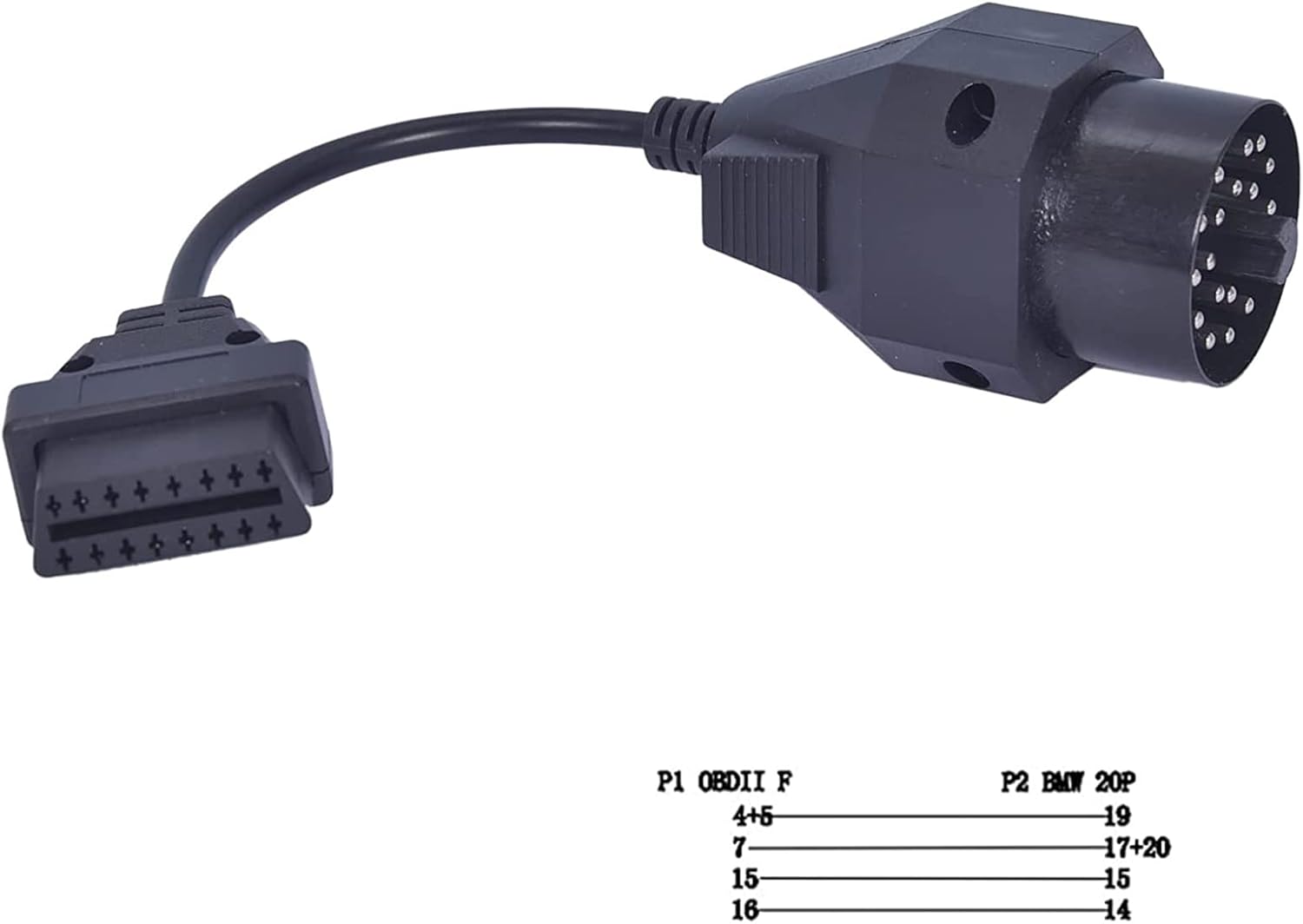
Image: A 20-pin to 16-pin OBD2 adapter cable, used for connecting the BM700 to older BMW vehicles with a 20-pin diagnostic port.

Image: A detailed diagram illustrating the pinout connections between the 16-pin OBDII female connector and the 20-pin BMW male connector on the adapter cable.
- Power On: Once connected, the BM700 will power on automatically from the vehicle's battery.
- Start Vehicle (Optional): For some diagnostic functions, the vehicle's ignition may need to be in the ON position or the engine running. Follow on-screen prompts.
5. Operating Instructions
5.1 Basic OBD2 Functions (for all compatible vehicles)
The BM700 can perform standard OBD2 diagnostics for engine systems on any OBD2 compliant vehicle (1996 and newer in the USA, 2001 for gasoline vehicles in Europe, 2004 for diesel vehicles in Europe).
- Read Codes: Displays Diagnostic Trouble Codes (DTCs) stored in the vehicle's computer.

Image: Screenshot of the ANCEL BM700 display showing the "Read Codes" menu option, which presents diagnostic trouble codes after scanning the vehicle.
- Erase Codes: Clears DTCs from the vehicle's computer and turns off the Check Engine Light (CEL). Ensure repairs are completed before clearing codes.

Image: Screenshot of the ANCEL BM700 display showing the "Clear Codes" menu option, used to clear fault codes after repairs are performed.
- I/M Readiness: Checks the status of emission-related monitoring systems.

Image: Screenshot of the ANCEL BM700 display showing the "I/M Readiness" menu option, which checks the status of emission-related systems.
- Data Stream: Displays live sensor data from the vehicle.

Image: Screenshot of the ANCEL BM700 display showing the "Data Stream" menu option, which allows viewing of live sensor data from the vehicle.
- EVAP System Test: Initiates a leak test for the vehicle's Evaporative Emission Control System.

Image: A diagram illustrating the components of an EVAP system alongside the ANCEL BM700 screen showing the "Evap System Test" option, which initiates a leak test for the vehicle's EVAP system.
- Vehicle Information: Retrieves vehicle identification number (VIN), calibration ID, and calibration verification number (CVN).

Image: The ANCEL BM700 displaying its "Diagnostic Menu" with options like Read Codes, Erase Codes, I/M Readiness, Data Stream, EVAP System Test, and Vehicle Information, along with a sample data stream output.
5.2 BMW Group Vehicle Specific Functions
The BM700 offers advanced diagnostic and service functions specifically for BMW, MINI, and Rolls-Royce vehicles.

Image: The ANCEL BM700 screen displaying icons for various vehicle systems (TPMS, Oil, SAS, Engine, Battery, ABS, Airbag, Transmission, ESP, Immobilizer, Suspension, Drivetrain), indicating its capability for all-system diagnosis on BMW group vehicles.
- Full System Diagnosis: Accesses and diagnoses all available electronic control units (ECUs) in BMW group vehicles, including engine, transmission, ABS, airbags, etc.
- CBS Reset/Correct: Performs Condition Based Service resets and corrections.
- EPB Reset: Resets the Electronic Parking Brake after service.
- Battery Registration & Testing: Registers a new battery to the vehicle's system and performs battery health checks.

Image: A step-by-step guide demonstrating how to perform BMW battery registration and testing using the ANCEL BM700, including replacing the battery, choosing registration, entering new battery digits, and confirming the process.

Image: A guide for BMW battery management, detailing steps for battery registration, its purpose, and important notes regarding compatibility and battery type matching.
- SAS Learning (Steering Angle Sensor): Calibrates the steering angle sensor.

Image: A visual representation of the SAS Reset function, showing a steering wheel and indicating that steering angle sensor calibration stores the current steering wheel position and clears fault memory after successful calibration.
- Fuel Pump Reset: Resets the fuel pump system (for F-series chassis only). Ensure no fuel leaks before resetting.

Image: A diagram illustrating the fuel system and the Fuel Pump Reset function, noting it is for F-series chassis only and requires checking for fuel leaks before use.
- EGS Clear Adaption: Clears transmission adaptation values.
- Idle Speed Adjustment: Adjusts the engine's idle speed.
- DPF Regeneration: Initiates Diesel Particulate Filter regeneration.

Image: A diagram showing the DPF system and explaining the DPF Reset function, which allows for DPF-related code clearing, light resetting, injection rate management, and particle burn-off.
- TPS Adjustment: Adjusts the Throttle Position Sensor.
- Injector Coding: Codes new or replaced fuel injectors.

Image: A diagram illustrating fuel injectors and the Injector Coding function, explaining its importance for addressing issues like leaking or dead injectors that might be missed by other diagnostics.
- Airbag Reset: Clears airbag fault codes and warning lights.

Image: A diagram of a car interior highlighting airbag locations, explaining the Airbag Reset function which reads and clears DTCs, displays live sensor data, and assists in clearing SRS airbag warning lights.
- Oil Service Reset: Resets the oil life reminder after an oil change.

Image: A hand pouring oil into a car engine, illustrating the Oil Service Reset function which resets the oil life reminder after an oil change, ensuring proper calculation of the next service interval.
- ABS Bleeding: Performs ABS bleeding procedures.

Image: A diagram showing brake components and a car chassis, explaining the ABS Bleeding function, which is necessary after changing any part of the brake system to ensure proper brake pedal position.
- Transmissions Learning: Reads and clears transmission fault codes, displays live data, and ensures optimal transmission performance.

Image: A diagram of a car's transmission system, illustrating the Transmissions Learning function, which reads/clears fault codes, displays live data (fluid temperature, clutch actuation, pressure), and optimizes transmission performance.

Image: The ANCEL BM700 displaying its "Special Functions" menu, showcasing advanced features like CBS Reset/Correct, EPB Reset, Battery Registration, SAS Learning, Fuel Pump Reset, EGS Clear Adaption, Idle Speed Adjustment, DPF Regeneration, TPS Adjustment, and Injector Coding.
5.3 Software Update Procedure
To ensure optimal performance and access to the latest vehicle data, it is recommended to regularly update the BM700 software.
- Connect the BM700 to a computer using the provided USB cable.
- Visit the official ANCEL website (www.anceltech.com) and navigate to the "Download Center."
- Select the BM700 product model.
- Download the latest update software.
- Follow the on-screen instructions on your computer to install the update.
- Once the update is complete, disconnect the BM700.

Image: A five-step visual guide for updating the ANCEL BM700 software, showing connection to a computer, visiting the ANCEL download center, selecting the product, clicking update, and confirming completion.
6. Vehicle Compatibility
The ANCEL BM700 is compatible with a wide range of BMW, MINI, and Rolls-Royce vehicles. For non-BMW vehicles, it supports standard OBD2 engine diagnostics.
6.1 BMW Series Compatibility

Image: A detailed table outlining the compatibility of the ANCEL BM700 with various BMW 1, 2, 3, 4, 5, 6, 7, and 8 Series models, including chassis codes and manufacturing years.

Image: A detailed table outlining the compatibility of the ANCEL BM700 with various BMW X, Z, and I Series models, including chassis codes and manufacturing years.
6.2 MINI and Rolls-Royce Compatibility

Image: A detailed table outlining the compatibility of the ANCEL BM700 with various MINI and Rolls-Royce models, including chassis codes and manufacturing years.
7. Specifications
| Display: | 2.8-inch TFT 262K true color LCD |
| Operating Voltage: | 9-18V DC (from vehicle OBD2 port) |
| Connectivity: | 16-pin OBD2 standard, 20-pin adapter for older BMW |
| Power Source: | Battery Powered (via vehicle) |
| Operating System: | Proprietary (Windows 7 mentioned for update software compatibility) |
| Dimensions: | Not specified |
| Weight: | Not specified |
8. Maintenance
- Cleaning: Wipe the device with a soft, damp cloth. Do not use abrasive cleaners or solvents.
- Storage: Store the device in a dry, cool environment away from direct sunlight and extreme temperatures.
- Cable Care: Avoid bending or twisting the diagnostic cable excessively to prevent damage.
- Software Updates: Regularly update the software as described in Section 5.3 to ensure optimal performance and compatibility.
9. Troubleshooting
| Problem | Possible Cause | Solution |
|---|---|---|
| Device does not power on. |
|
|
| Communication error with vehicle. |
|
|
| Screen is blank or frozen. |
|
|
10. Warranty and Technical Support
For warranty information and technical assistance, please refer to the official ANCEL website or contact their customer support directly. Details regarding warranty periods and support channels are typically provided with your purchase documentation or on the manufacturer's website.
Official Website: www.anceltech.com


