1. Introduction
This manual provides detailed instructions for the installation, operation, and maintenance of your PowerColor Fighter AMD Radeon RX 6500 XT Gaming Graphics Card. Please read this manual thoroughly before installation to ensure proper setup and optimal performance.
2. Product Overview
The PowerColor Fighter AMD Radeon RX 6500 XT is a gaming graphics card designed to deliver a robust gaming experience. It features 4GB of GDDR6 memory and is built on AMD RDNA 2 architecture.
Key Features:
- Memory Speed: 18.0 Gbps
- Digital Max Resolution: 7680×4320
- Stream Processor: 1024
- Game Clock: 2650Mhz
- Boost Clock: 2820Mhz
Specifications:
| Specification | Value |
|---|---|
| Brand | PowerColor |
| Series | PowerColor Fighter AMD Radeon RX 6500 XT |
| Item Model Number | AXRX 6500XT 4GBD6-DH/OC |
| Graphics Coprocessor | AMD Radeon RX 6500 XT |
| Graphics Card RAM Size | 4 GB |
| Memory Speed | 18 GHz |
| GPU Clock Speed | 2650 MHz |
| Max Screen Resolution | 7680x4320 |
| Video Output Interface | 1 x HDMI 2.1, 1 x DisplayPort 1.4 |
| Item Weight | 1.43 pounds |
| Product Dimensions | 7.52 x 4.96 x 1.57 inches |
3. Setup & Installation
3.1. Hardware Installation
Before installing your new graphics card, ensure your computer is powered off and unplugged from the wall outlet. It is recommended to wear an anti-static wrist strap to prevent damage from static electricity.
- Prepare Your System: Power down your computer and unplug all cables. Open your computer case.
- Remove Old Graphics Card (if applicable):
- Disconnect any display cables (HDMI, DisplayPort) from the old graphics card.
- Disconnect any PCIe power cables from the old graphics card.
- Unscrew the retention screws holding the old graphics card to the case.
- Carefully press the PCIe slot retention clip (usually at the end of the slot) and gently pull the old graphics card straight out of the PCIe slot.
- Install New Graphics Card:
- Locate an available PCIe x16 slot on your motherboard.
- Align the PowerColor Fighter RX 6500 XT with the PCIe slot. Gently push the card down into the slot until it is fully seated and the retention clip clicks into place.
- Secure the graphics card to the computer case with the retention screws.
- Connect the required 6-pin PCIe power connector from your power supply to the graphics card. This card requires a minimum 400W power supply.
- Connect Display: Connect your monitor to one of the available display outputs (HDMI 2.1 or DisplayPort 1.4) on the graphics card.
- Close Case & Power On: Close your computer case, reconnect all cables, and power on your system.

Image: The PowerColor Fighter AMD Radeon RX 6500 XT graphics card shown alongside its retail packaging.

Image: A top-down view of the graphics card, highlighting its dual fan design and black shroud.

Image: A side view of the graphics card, showing the heatsink fins and the 6-pin PCIe power connector.

Image: The rear input/output panel of the graphics card, featuring one HDMI 2.1 port and one DisplayPort 1.4.
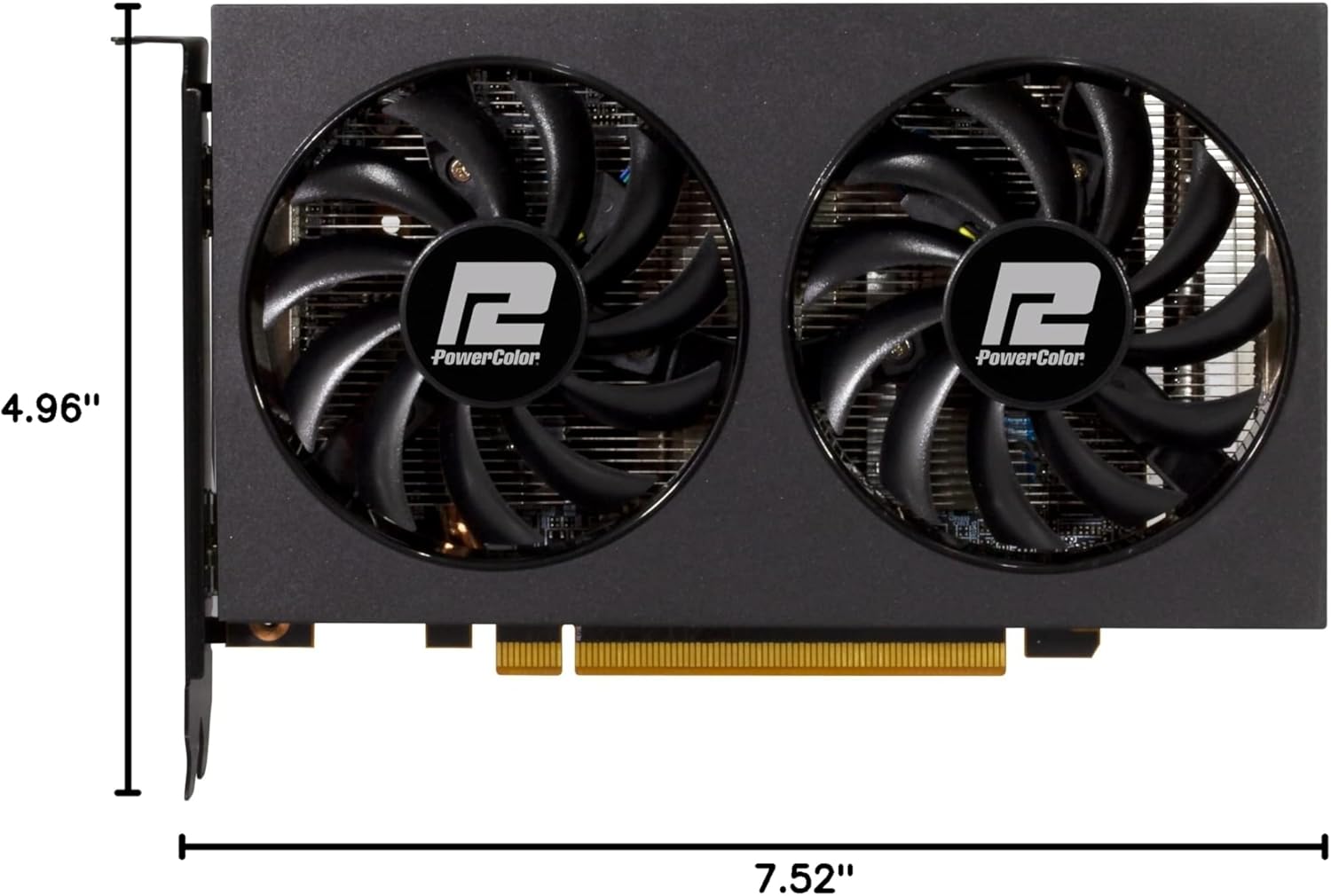
Image: A diagram illustrating the physical dimensions of the PowerColor Fighter RX 6500 XT graphics card.
3.2. Driver Installation
After successfully installing the hardware, you need to install the latest AMD Radeon Software drivers for optimal performance and access to all features.
- Download Drivers: Visit the official AMD website (www.amd.com/support) and download the latest Radeon Software for your RX 6500 XT graphics card.
- Uninstall Previous Drivers (if applicable): If you had a previous graphics card (especially from a different manufacturer), it is highly recommended to uninstall its drivers using a clean-up utility like Display Driver Uninstaller (DDU) in Windows Safe Mode. This prevents potential conflicts.
- Install Radeon Software: Run the downloaded installer. Follow the on-screen prompts. It is often recommended to perform a 'Factory Reset' during installation to ensure a clean driver setup.
- Restart System: Your system will likely require a restart after the driver installation is complete.
Video: A product demonstration video showcasing the PowerColor Fighter AMD Radeon RX 6500 XT graphics card. This video provides a visual overview of the card's features and physical appearance.
4. Operating Instructions
Once the drivers are installed, you can access the AMD Radeon Software to configure your graphics card settings for optimal gaming and visual experience.
- Launch Radeon Software: Right-click on your desktop and select "AMD Radeon Software" or find it in your Start Menu.
- Home Tab: Provides an overview of your system, driver status, and recently played games. You can check for driver updates here.
- Gaming Tab: Allows you to manage game profiles, adjust global graphics settings, and view game compatibility information.
- Graphics Tab: Fine-tune various graphics settings such as Radeon Anti-Lag, Radeon Chill, Radeon Boost, Image Sharpening, and Enhanced Sync to optimize performance and visual quality.
- Display Tab: Configure display options including AMD FreeSync (if your monitor supports it) and adjust refresh rates. Enabling FreeSync can provide smoother, tear-free gaming. Ensure your monitor's refresh rate is set to its maximum supported value for the best experience.
- Performance Tab: Monitor GPU and CPU utilization, temperatures, and VRAM usage. This section also offers tuning options for overclocking or undervolting your GPU.
5. Maintenance
Regular maintenance helps ensure the longevity and optimal performance of your graphics card.
- Dust Cleaning: Periodically clean dust from the fans and heatsink using compressed air. Ensure the system is powered off and unplugged before cleaning.
- Driver Updates: Keep your AMD Radeon Software drivers updated to benefit from performance improvements, bug fixes, and new features.
- Temperature Monitoring: Use the Radeon Software's Performance tab or third-party tools to monitor GPU temperatures, especially during heavy loads, to prevent overheating.
6. Troubleshooting
If you encounter issues with your graphics card, refer to the following common troubleshooting steps:
- No Display/Black Screen:
- Ensure all power cables (24-pin ATX, 8-pin CPU, 6-pin PCIe) are securely connected.
- Verify the graphics card is fully seated in the PCIe slot.
- Check that your display cable is connected to the graphics card, not the motherboard's integrated graphics port.
- Test with a different display cable or monitor if possible.
- Driver Issues:
- Perform a clean reinstallation of the AMD Radeon Software drivers (refer to Section 3.2).
- Ensure your Windows operating system is up to date.
- Performance Problems (Low FPS, Stuttering):
- Check GPU temperatures to ensure it's not throttling due to overheating.
- Verify that your game settings are appropriate for your hardware.
- Ensure AMD FreeSync is enabled in Radeon Software and on your monitor (if supported).
- Close unnecessary background applications.
- System Instability/Crashes:
- Ensure your power supply unit (PSU) meets the minimum wattage requirement (400W recommended).
- Check for any loose connections inside your PC.
- Update your motherboard BIOS to the latest version.
7. Warranty & Support
For warranty information, technical support, or further assistance, please refer to the official PowerColor website or contact their customer service. Keep your proof of purchase for warranty claims.
PowerColor Official Website: www.powercolor.com


