
1. Introduction
This manual provides essential instructions for setting up, operating, maintaining, and troubleshooting your Intel NUC 7 Essential Desktop Computer. Please read this guide thoroughly before using your device to ensure proper functionality and longevity.
The Intel NUC 7 Essential is a compact mini PC designed for everyday computing tasks, offering responsive performance with an Intel Celeron processor.
2. Package Contents
Verify that all items are present in the package:
- Intel NUC 7 Essential Desktop Computer (Model BOXNUC7CJYSAMN1)
- Power Adapter
- Quick Start Guide (if applicable)
3. Setup Guide
Follow these steps to set up your Intel NUC 7 Essential:
3.1 Connecting Peripherals
- Connect Display: Use an HDMI cable to connect your monitor or TV to one of the HDMI ports on the back of the NUC.
- Connect Keyboard and Mouse: Plug your USB keyboard and mouse into the available USB 3.0 ports. There are two on the front and two on the back.
- Connect to Network (Optional): For a wired connection, plug an Ethernet cable into the RJ45 port on the back. For wireless, ensure your NUC is within Wi-Fi range.

Image: Rear view of the Intel NUC 7 Essential, highlighting the power input, USB 3.0 ports, HDMI ports, and Ethernet port for connecting external devices.

Image: Front view of the Intel NUC 7 Essential, displaying the two front USB 3.0 ports, SD card slot, and power button for easy access.
3.2 Powering On
- Connect Power: Plug the power adapter into the NUC's power input port, then plug the adapter into a wall outlet.
- Power On: Press the power button located on the front of the NUC. The power indicator light will illuminate.

Image: A typical 'plug & play' setup showing the Intel NUC 7 Essential connected to a monitor, keyboard, and mouse, ready for use.
4. Operating Instructions
4.1 Basic Operation
- The NUC comes pre-installed with Windows 10 Home. Follow the on-screen prompts for initial Windows setup.
- To shut down, restart, or put the NUC to sleep, use the standard Windows power options.
4.2 Connectivity
- USB 3.0 Ports: Four ports are available for connecting external devices such as storage drives, printers, or webcams.
- HDMI Ports: Supports dual 4K displays for extended desktop or mirroring.
- Ethernet: Provides a stable wired network connection.
- Wi-Fi: Integrated wireless connectivity for internet access.
4.3 Audio
The Intel NUC 7 Essential supports 7.1 surround sound, providing a rich audio experience through connected HDMI displays or external audio devices.
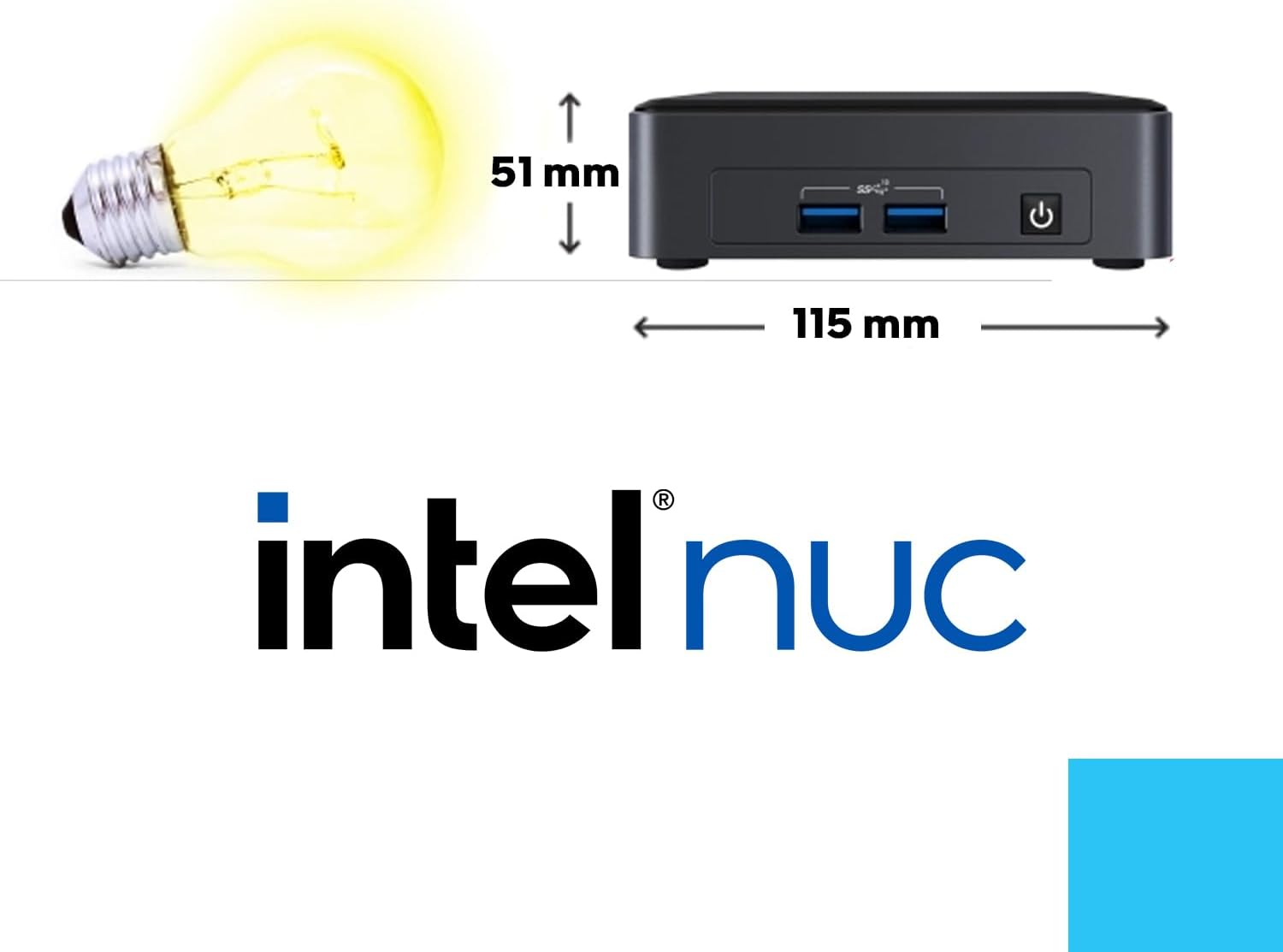
Image: The Intel NUC 7 Essential connected to a television and external speakers, demonstrating its support for 7.1 surround sound for an immersive audio experience.
5. Maintenance and Upgrades
5.1 Cleaning
To maintain optimal performance, regularly clean the exterior of your NUC with a soft, dry cloth. Ensure the device is powered off and unplugged before cleaning. Avoid using liquid cleaners directly on the device.
5.2 Memory (RAM) Upgrade
The NUC comes with 4GB DDR4 RAM. For improved multitasking and overall performance, especially when upgrading to Windows 11, consider upgrading the RAM to 8GB. Refer to the official Intel NUC documentation for specific memory module compatibility and installation instructions.
5.3 Storage Upgrade
The device includes 32GB flash memory (eMMC). For additional storage or faster data access, a 2.5-inch SSD can be installed internally. This upgrade does not affect the existing eMMC storage. Consult official Intel NUC guides for detailed installation procedures.

Image: An opened Intel NUC 7 Essential, illustrating the internal layout and the available bay for a 2.5-inch SSD upgrade.
6. Troubleshooting
If you encounter issues with your Intel NUC 7 Essential, refer to the following common solutions:
- Slow Performance after Windows 11 Upgrade: Upgrading to Windows 11 may impact performance on systems with 4GB RAM. Consider upgrading the RAM to 8GB for a smoother experience.
- Limited Storage Space: The internal eMMC storage is 32GB. If you require more space, install an internal 2.5-inch SSD or use external storage devices. Regularly clean up temporary files and old system files.
- Linux Booting Issues: Some Linux distributions may experience booting or hardware compatibility issues. Ensure your Linux distribution is compatible with the NUC's hardware.
- External HDD/SSD Not Working with Linux: If using Linux, external hard drives might experience power delivery issues. Try connecting the external drive to a powered USB hub or ensure the NUC's power adapter is correctly connected and providing sufficient power.
- No Display Output: Check HDMI cable connections to both the NUC and the monitor. Ensure the monitor is set to the correct input source.
- No Power: Verify the power adapter is securely connected to both the NUC and a working power outlet.
7. Specifications
Detailed technical specifications for the Intel NUC 7 Essential Desktop Computer (Model BOXNUC7CJYSAMN1):
| Feature | Specification |
|---|---|
| Model Number | BOXNUC7CJYSAMN1 |
| Processor | Intel Celeron J4005 Dual-core (2 Core) 2 GHz |
| RAM | 4 GB DDR4 SDRAM |
| Flash Memory Capacity | 32 GB (eMMC) |
| Graphics Coprocessor | Intel UHD Graphics 600/605 |
| Operating System | Windows 10 Home |
| Max Screen Resolution | 3840 x 2160 (4K) |
| USB 3.0 Ports | 4 |
| HDMI Ports | 2 |
| Ethernet | Yes |
| Wireless Connectivity | Wi-Fi |
| Audio | 7.1 Surround Sound |
| Item Weight | 2.43 pounds (approx. 1.1 kg) |
| Product Dimensions (LxWxH) | 4.61 x 4.41 x 2.01 inches (approx. 11.7 x 11.2 x 5.1 cm) |
| Hardware Platform | PC |

Image: Dimensions of the Intel NUC 7 Essential, illustrating its compact size with measurements of 115mm in length and 51mm in height.
8. Warranty and Support
For warranty information, please refer to the documentation included with your product or visit the official Intel support website. For technical assistance, driver downloads, and further support, please visit Intel Support.


