
1. Important Safety Information
Please read this manual thoroughly before operating the SMACO PCP Air Compressor. Failure to follow these instructions may result in serious injury or property damage. Keep this manual for future reference.
- Age Restriction: This product is intended for use by individuals over 18 years old.
- Electrical Safety: Ensure the power source matches the compressor's requirements (12V DC or 110V-220V AC). Always connect to a grounded outlet when using AC power. Do not operate with damaged cords or plugs.
- Ventilation: Operate the compressor in a well-ventilated area to prevent overheating. Avoid enclosed spaces.
- Pressure Limits: Never exceed the maximum operating pressure of 4500 PSI (30 MPa / 300 Bar). Over-pressurizing tanks can cause explosions.
- Cooling Cycle: The compressor requires a cool-down period. Do not operate continuously for more than 25 minutes. Allow 10-15 minutes for cooling after each 25-minute cycle.
- Moisture and Oil: This is an oil-free and water-free compressor. Do not add oil or water. Ensure the built-in oil-moisture filter is properly maintained.
- Connections: Ensure all connections are secure before operation. The inflatable interface diameter is 8mm.
- Supervision: Although the unit has an auto-shutoff feature, it is recommended to monitor the inflation process.
- Hot Surfaces: The compressor and hose can become hot during operation. Avoid direct contact.
2. Product Overview
2.1 Key Features
- Oil-Free & Water-Free Design: Features built-in high-power fans for efficient cooling, eliminating the need for external water pumps or oil.
- Pressure-Set & Auto-Shutoff: Set your desired pressure, and the compressor will automatically stop when reached.
- Fast Inflating Speed: Engine speed up to 2700r/min, air output 11L/min. Inflates a 0.5L container from 0 to 3000 PSI in approximately 11 minutes.
- Dual Power Capability: Operates on 12V DC from a car battery or 110V-220V AC household power.
- Lightweight and Portable: Weighs approximately 21 lbs with compact dimensions (9.6"L x 5.6"W x 10"H).
2.2 Components and Controls
Familiarize yourself with the main components of your SMACO PCP Air Compressor.

Figure 1: SMACO PCP Air Compressor and Accessories. This image displays the SMACO PCP Air Compressor unit along with its various accessories, including connection hoses, power cables, spare O-rings, and tools for maintenance.

Figure 2: Compressor Features Diagram. An illustrative diagram pointing out the main functional parts of the compressor, such as the adjustable voltage switch, pressure gauge, built-in oil moisture filter, wire spool design for cables, pressure valve, power switch, and safety valve.
- Pressure Gauge: Displays real-time pressure and allows setting target pressure.
- Bleed Valve: Used to release residual pressure after inflation.
- Start/Off Buttons: Controls the compressor's operation.
- Power Switch (I/O/II): Selects DC (I) or AC (II) power mode.
- Power Input Ports: For 12V DC (car battery clamps) and 110V-220V AC (standard power cord).
- Inflation Hose: Connects the compressor to the tank.
- Safety Valve: An explosion-proof disc designed to release pressure if it exceeds safe limits.
3. Setup Guide
3.1 Unpacking and Inspection
- Carefully remove all components from the packaging.
- Inspect the compressor and accessories for any signs of damage during shipping. Contact customer support if any damage is found.
- Ensure all listed accessories are present.
3.2 Initial Connections
Before operating, ensure proper connections for power and inflation.

Figure 3: Adjustable Gauge, Pressure Relief, and Safety Valve. Detailed images showing the adjustable pressure gauge for setting desired pressure, the pressure relief valve that automatically exhausts air when peak pressure is reached, and the safety valve with an explosion-proof disc.
- Connect the Inflation Hose: Securely attach the inflation hose to the compressor's output port and to the tank you intend to fill. Ensure a tight seal to prevent leaks.
- Choose Power Source:
- For AC Power (110V-220V): Plug the AC power cord into the compressor's AC input and then into a grounded wall outlet. The initial setting is typically for 110V AC.
- For DC Power (12V Car Battery): Connect the red clamp to the positive (+) terminal of your car battery and the black clamp to the negative (-) terminal. Ensure your car engine is running to provide stable power and prevent battery drain.
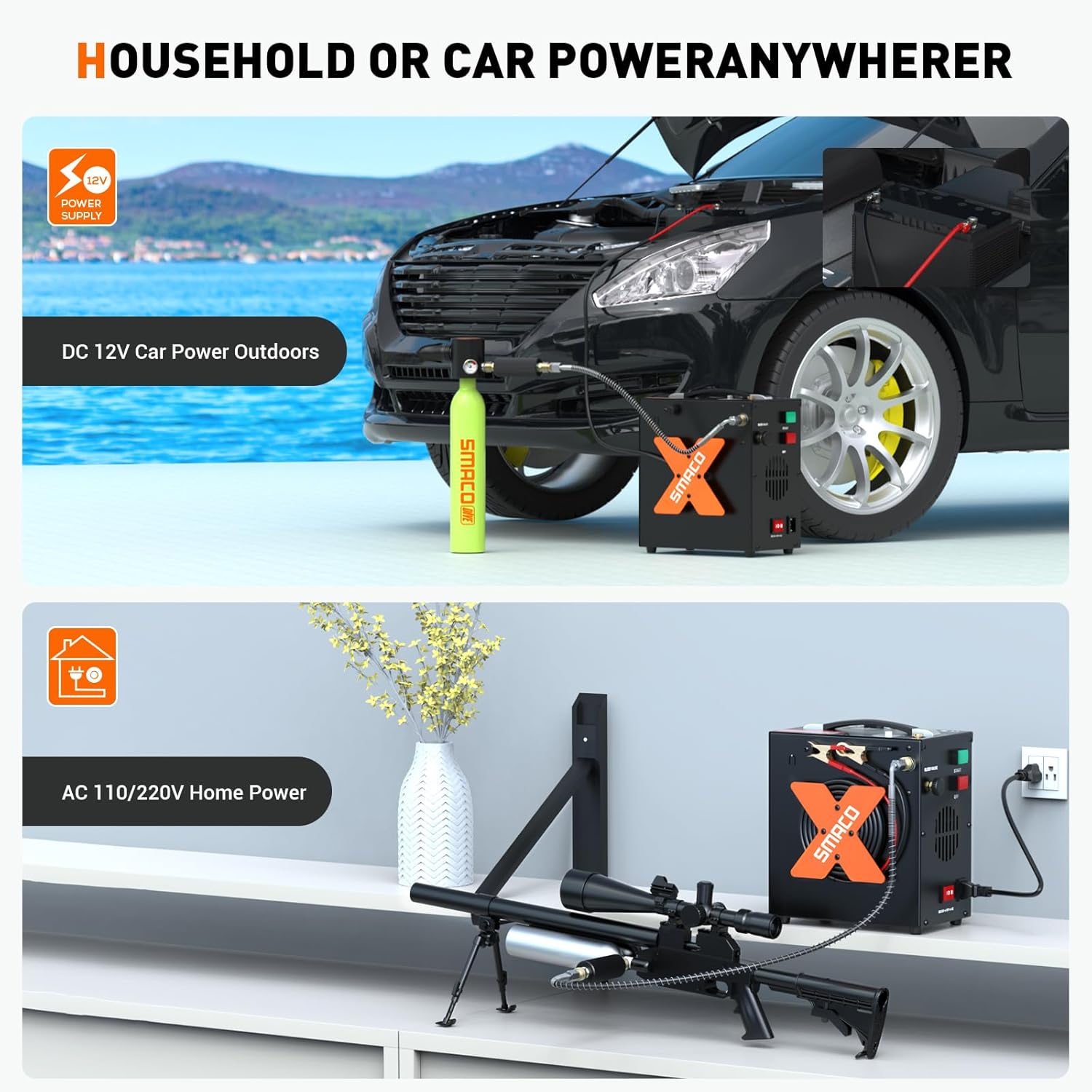
Figure 4: Dual Power Options. This image demonstrates the dual power capability of the compressor, showing it connected to a car battery for outdoor use and plugged into a standard AC outlet for indoor operation.
4. Operating Instructions
4.1 Pre-Operation Checklist
- Ensure all connections are secure.
- Verify the tank's maximum pressure rating.
- Confirm the compressor is in a well-ventilated area.
- Close the bleed valve before starting inflation.
4.2 Inflation Process
- Select Power Mode: Set the power switch to 'I' for DC (12V) or 'II' for AC (110V-220V).
- Set Target Pressure: Rotate the pressure setting knob on the gauge to your desired inflation pressure. The machine will automatically stop when this pressure is reached.
- Start Compressor: Press the 'START' button. The compressor will begin to operate, and the cooling fans will activate.
- Monitor Progress: Observe the real-time pressure on the gauge. Although auto-shutoff is present, it is good practice to monitor the process.
- Automatic Shutoff: The compressor will automatically stop filling when the preset pressure is achieved. The cooling fan will continue to run to dissipate heat.
- Manual Stop: To stop the compressor manually at any time, press the 'OFF' button.
- Release Pressure: After inflation is complete and the compressor has stopped, slowly open the bleed valve to release any residual pressure in the hose before disconnecting.
- Disconnect: Once pressure is fully released, disconnect the inflation hose from the tank and the compressor. Then, disconnect the power source.
4.3 Cooling Cycle
The compressor is designed with a duty cycle to prevent overheating. For optimal performance and longevity:
- Do not run the compressor for more than 25 minutes continuously.
- Allow the compressor to cool down for 10-15 minutes after each 25-minute operation cycle. The cooling fan will continue to run during this period.

Figure 5: Fan Cooling System. A visual representation of the compressor's internal fan cooling system, highlighting its oil-free operation, active cooling fans, integrated oil-moisture filter, and overall durable construction. A note indicates a 25-minute run / 10-minute cool-down duty cycle.
5. Maintenance
Regular maintenance ensures the longevity and reliable operation of your compressor.
5.1 Oil-Moisture Filter
- The compressor features a built-in oil-moisture filter. Periodically check and replace the filter elements as needed to ensure clean, dry air output.
- Refer to the included accessories for spare filter elements and instructions on replacement.
5.2 General Care and Storage
- Keep the compressor clean and free from dust and debris. Use a dry cloth for cleaning.
- Store the compressor in a cool, dry place, away from direct sunlight and moisture.
- Ensure power cables and hoses are neatly stored, utilizing the wire spool design if available.
6. Troubleshooting
If you encounter issues with your SMACO PCP Air Compressor, refer to the following common problems and solutions:
| Problem | Possible Cause | Solution |
|---|---|---|
| Compressor does not start. | No power, incorrect power mode selected, power switch off. | Check power connections, ensure power source is active (e.g., car engine running for DC), select correct power mode (I for DC, II for AC), press 'START'. |
| Compressor runs but does not inflate or inflates slowly. | Bleed valve open, loose hose connections, clogged filter, tank already full. | Close bleed valve, tighten all hose connections, check and replace filter elements, verify tank pressure. |
| Compressor overheats and shuts down prematurely. | Exceeded duty cycle, poor ventilation. | Allow compressor to cool down for 10-15 minutes. Ensure operation in a well-ventilated area. Do not exceed 25 minutes of continuous operation. |
| Air leaks from connections. | Loose connections, worn O-rings. | Tighten connections. Replace O-rings if they appear worn or damaged. |
| Safety valve activates. | Pressure exceeded maximum limit. | Immediately stop the compressor. Check the pressure gauge and ensure the target pressure is set correctly and does not exceed 4500 PSI. If the safety disc is blown, it must be replaced. |
If the problem persists after attempting these solutions, please contact SMACO customer support.
7. Technical Specifications
| Specification | Value |
|---|---|
| Brand | SMACO |
| Model Name | Heap-01 |
| Maximum Operating Pressure | 4500 PSI / 30 MPa / 300 Bar |
| Power Source | 12V DC or 110V-220V AC |
| Voltage | 110 Volts (AC) |
| Maximum Power | 250 Watts |
| Air Flow Capacity | 11 Liters Per Minute |
| Noise Level | 65 Decibels |
| Item Weight | 21.4 Pounds |
| Product Dimensions | 9.5"L x 5.6"W x 10"H |
| Compatible Hose Diameter | 8 Millimeters |
| Special Feature | Automatic Shut-Off |
| Material | Iron |
| Color | Black |
Note: Specifications are subject to change without notice.
8. Warranty and Customer Support
SMACO products are manufactured to high-quality standards. For information regarding warranty coverage, please refer to the warranty card included with your purchase or visit the official SMACO website.
If you have any questions, require technical assistance, or need to report an issue, please contact SMACO customer support through the retailer where you purchased the product or via the contact information provided on the official SMACO website.