
1. Introduction
This manual provides detailed instructions for the installation, operation, and maintenance of your DALY Smart BMS (Battery Management System) for LiFePo4 24S 72V 200A battery packs. This BMS is designed to protect and manage your lithium battery system, ensuring its safety and optimal performance. It features a programmable Bluetooth module for monitoring and parameter adjustments via a mobile application.
2. Safety Information
Always exercise caution when working with battery systems. Improper installation or handling can lead to serious injury or damage to equipment. Adhere to the following safety guidelines:
- Ensure all power sources are disconnected before installation or maintenance.
- Wear appropriate personal protective equipment (PPE), including insulated gloves and eye protection.
- Verify all wiring connections are correct and secure before applying power. Incorrect wiring can cause damage to the BMS and battery.
- Avoid short-circuiting battery terminals or BMS connections.
- Do not attempt to disassemble or modify the BMS.
- Install the BMS in a well-ventilated area, away from flammable materials.
- Consult a qualified professional if you are unsure about any installation or operation steps.
3. Product Overview
The DALY Smart BMS is a sophisticated battery management system designed for LiFePo4 24S 72V 200A battery packs. It integrates essential protection features and smart monitoring capabilities.
Key Features:
- High Current Capability: Supports up to 200A continuous discharge and 100A charge current.
- Programmable Protections: Over-charge, over-discharge, over-current, and temperature protection.
- Voltage Balancing: High detection precision for voltage balancing.
- Low Temperature Charging Protection: Prevents charging below -1°C.
- Smart Monitoring: Bluetooth module for real-time data monitoring and parameter settings via mobile app (iOS & Android).
- Common Port Design: Utilizes a single port for both charging and discharging.
- Cooling Fan: Integrated fan for thermal management during high current operations.
- SOC Calculation: Precise State of Charge (SOC) calculation with automatic learning function.
Components:
The package includes the DALY Smart BMS, balance wires, a Bluetooth module, a UART cable for PC connection, and an English version wiring manual.

Figure 3.1: Top view of the DALY Smart BMS with integrated cooling fan.
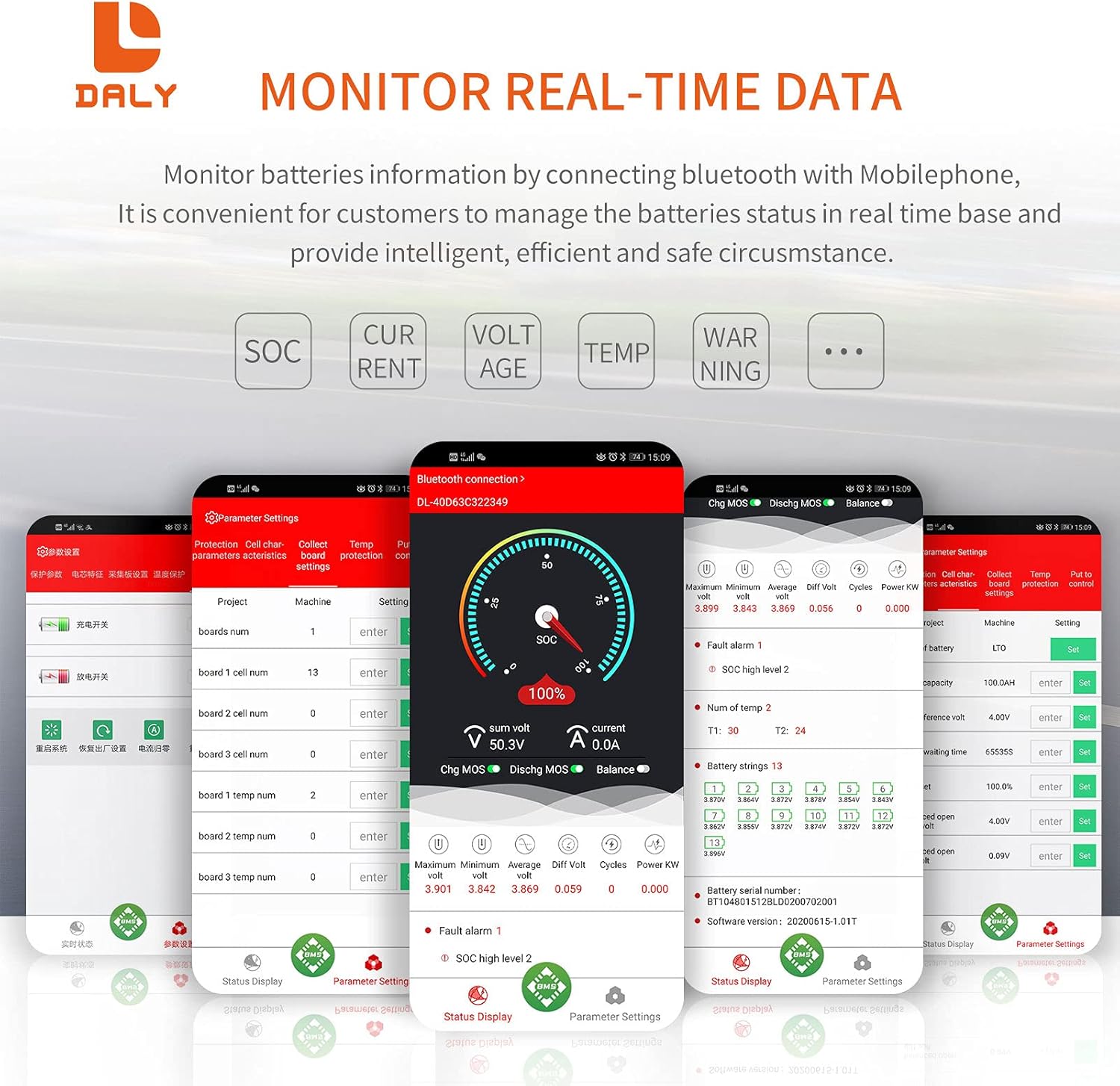
Figure 3.2: DALY Smart BMS showing the Bluetooth module connection and mobile app compatibility.

Figure 3.3: Overview of the 12 protection functions including over-charge, over-discharge, over-current, short-circuit, over-voltage, balance, NTC temperature, waterproof, moistureproof, fireproof, and dustproof features.

Figure 3.4: Exploded view detailing internal components such as the insulated flame-retardant shell, smart fan, pure aluminum heat sink, high current copper plate, BMS board, thermal conductive compound, and insulation fixing plate.
4. Setup and Installation
Careful wiring is crucial for the correct operation and safety of the BMS. Follow these steps precisely:
- Prepare the Battery Pack: Ensure your LiFePo4 24S 72V battery pack is assembled and individual cell voltages are balanced as much as possible before connecting the BMS.
- Connect Balance Wires:
- First, connect the black wire of the balance harness to the total negative pole (B-) of your battery pack.
- Then, connect the remaining balance wires (red wires) sequentially from B1 to B24 to the positive terminals of each cell in your battery pack. Ensure the order is correct.
- Important: Do not connect the balance harness to the BMS connection port yet.
- Connect Main Power Wires:
- Connect the main negative wire from the battery pack's total negative terminal to the B- terminal on the BMS.
- Connect the main negative wire for discharge/charge (common port) from the P- terminal on the BMS to your load/charger negative terminal.
- The main positive wire from the battery pack's total positive terminal connects directly to your load/charger positive terminal, bypassing the BMS.
- Connect Balance Harness to BMS: After all main power wires and balance wires are securely connected to the battery, plug the balance harness into the designated port on the BMS.
- Activate BMS: Press the activation button on the BMS board, or charge the battery system to activate the BMS for the first use.
- Bluetooth Module Connection: Insert the Bluetooth module into the UART port on the BMS.

Figure 4.1: Detailed wiring diagram for connecting the DALY Smart BMS to a 24S LiFePo4 battery pack, motor/load, and charger. Note the sequence of connections for safety.
Note: It is recommended to use appropriate tools for wiring, such as soldering machine (if applicable), scissors, double-sided tape, tin wire, and a multimeter for verification.
5. Operating Instructions
The DALY Smart BMS can be monitored and configured via a mobile application using its Bluetooth module or via a PC using the UART cable.
5.1 Mobile App (Bluetooth)
- Download App: Search for "DALY BMS" or "Smart BMS" in your mobile app store (iOS or Android) and install the application.
- Enable Bluetooth: Ensure Bluetooth is enabled on your mobile device.
- Connect to BMS: Open the app. It should automatically detect nearby DALY BMS devices. Select your BMS from the list. The initial password to change parameters is 123456.
- Monitor Data: The app displays real-time data such as total voltage, individual cell voltages, charge/discharge current, temperature, and State of Charge (SOC).
- Adjust Parameters: Access the "Parameter Settings" section to customize protection thresholds (e.g., over-charge voltage, over-discharge voltage, over-current limits, temperature limits).

Figure 5.1: Screenshots of the DALY Smart BMS mobile application displaying real-time monitoring data and parameter adjustment options.
5.2 PC Software (UART)
For advanced monitoring and configuration, connect the BMS to a PC using the provided UART cable. Download the corresponding PC software from the DALY website. The software offers similar functionalities to the mobile app but with a larger interface for detailed analysis.
The serial number of the BMS and the protection parameters (Li-ion, LiFePo4) have default values. The capacity AH of the battery pack needs to be set according to the actual capacity. If the capacity AH is not set correctly, the percentage of remaining power will be inaccurate. Other parameters can also be set to your needs.
6. Maintenance
Proper maintenance ensures the longevity and reliability of your DALY Smart BMS and battery system:
- Regular Monitoring: Periodically check the BMS data via the mobile app to ensure all parameters are within normal operating ranges.
- Keep Clean: Ensure the BMS and its connections are free from dust, dirt, and moisture.
- Ventilation: Ensure adequate airflow around the BMS, especially around the cooling fan, to prevent overheating.
- Connection Integrity: Periodically inspect all wiring connections for tightness and signs of corrosion or damage.
- Firmware Updates: Check the manufacturer's website for any available firmware updates for the BMS to ensure optimal performance and access to new features.
7. Troubleshooting
If you encounter issues with your DALY Smart BMS, refer to the following common troubleshooting steps:
- BMS Not Activating:
- Ensure all balance wires are correctly connected and the main power connections are secure.
- Press the activation button on the BMS board.
- Connect a charger to the battery pack; charging typically activates the BMS.
- Bluetooth Connection Issues:
- Verify the Bluetooth module is correctly inserted into the UART port.
- Ensure Bluetooth is enabled on your mobile device and the app has necessary permissions.
- Restart the mobile app and try reconnecting.
- Ensure no other devices are actively connected to the BMS via Bluetooth.
- Protection Triggered (e.g., Over-voltage, Under-voltage, Over-current):
- Check the mobile app for specific fault codes or warnings.
- Verify individual cell voltages are within safe operating limits.
- Reduce the load or charging current if an over-current protection is triggered.
- Inspect battery temperatures if temperature protection is active.
- Review and adjust programmable parameters in the app if they are set too restrictively for your application.
- Inaccurate SOC Reading:
- Ensure the battery pack's actual capacity (AH) is correctly set in the BMS parameters via the app.
- Allow the BMS to complete a few full charge/discharge cycles for its automatic learning function to calibrate the SOC more accurately.
If the issue persists after attempting these steps, contact DALY customer support for further assistance.
8. Specifications
| Feature | Specification |
|---|---|
| Product Model | 24S 72V 200A LiFePo4 Smart BMS |
| Battery Type | LiFePo4 |
| Series Configuration | 24S |
| Nominal Voltage | 72V |
| Continuous Discharge Current | 200A |
| Continuous Charge Current | 100A |
| Over-discharge Current Protection | 300A ± 30A (Configurable) |
| Over-charge Current Protection | 300A ± 30A (Configurable) |
| Overcharge Voltage Protection | 3.75V ± 0.05V per cell (Configurable) |
| Over-discharge Voltage Protection | 2.2V ± 0.1V per cell (Configurable) |
| Charge Voltage | 87.6V (Configurable) |
| Communication Interface | UART (for Bluetooth module and PC connection) |
| Dimensions | 221 x 130 x 32 mm (approx. 9.21 x 4.72 x 2.09 inches) |
| Item Weight | ~1884g (approx. 4.09 pounds) |
| Output Wire Gauge | 6AWG |
| Balance Wires Gauge/Length | 24AWG / 350mm |
| UPC | 766293717109 |

Figure 8.1: Fan specifications and physical dimensions of the DALY Smart BMS.
9. Warranty and Support
For warranty information, technical support, or any inquiries regarding your DALY Smart BMS, please contact the manufacturer directly or refer to their official website. Keep your purchase receipt as proof of purchase.
You can visit the DALY Store on Amazon for more information: DALY Store

Figure 9.1: Examples of product certifications for DALY products, including Waterproof Patent, ISO, FCC, RoHS, PSE, and CE.


