
Introduction
This user manual provides essential information for the safe and effective use, setup, maintenance, and storage of your Boards DCS Optimal SUP Inflatable Paddle Board. Please read this manual thoroughly before first use to ensure optimal performance and longevity of your product.
The DCS Optimal SUP is designed for water enthusiasts, offering stability and comfort for various water environments, including lakes and seas. Its inflatable design allows for easy transport and storage.
Safety Information
- Always wear a personal flotation device (PFD) when using the paddle board.
- Do not exceed the maximum weight capacity of 180 kg (396 lbs).
- Always attach the safety leash to your ankle and the board to prevent separation in water.
- Be aware of weather conditions and water currents. Do not use in strong winds, currents, or during thunderstorms.
- Avoid sharp objects that could puncture the board.
- Children should only use the board under direct adult supervision.
- Familiarize yourself with local regulations and waterways before use.
Package Contents
Your Boards DCS Optimal SUP package includes the following components:
- 1 x DCS-Sup Board (Inflatable Paddle Board)
- 1 x Backpack (for transport and storage)
- 1 x Bravo Pump (for inflation)
- 1 x Repair Kit (convenient for minor repairs)
- 1 x Ankle Leash (safety band)
- 1 x Removable Center Fin
- 1 x Adjustable Paddle

Image: Complete package contents of the DCS Optimal SUP board.
Setup Instructions
1. Inflating the Board
- Unroll the paddle board on a clean, flat surface.
- Locate the high-pressure valve on the board (typically at the tail). Ensure the valve pin is in the 'up' position (closed) for inflation.
- Connect the Bravo pump hose to the valve by twisting it clockwise until secure.
- Begin pumping. The board will take shape quickly. Continue pumping until the recommended pressure is reached (refer to the board's valve area for specific PSI, typically 12-15 PSI). The pump's gauge will show the pressure.
- Once inflated, quickly disconnect the pump hose and ensure the valve cap is securely fastened to prevent air leakage and protect the valve.
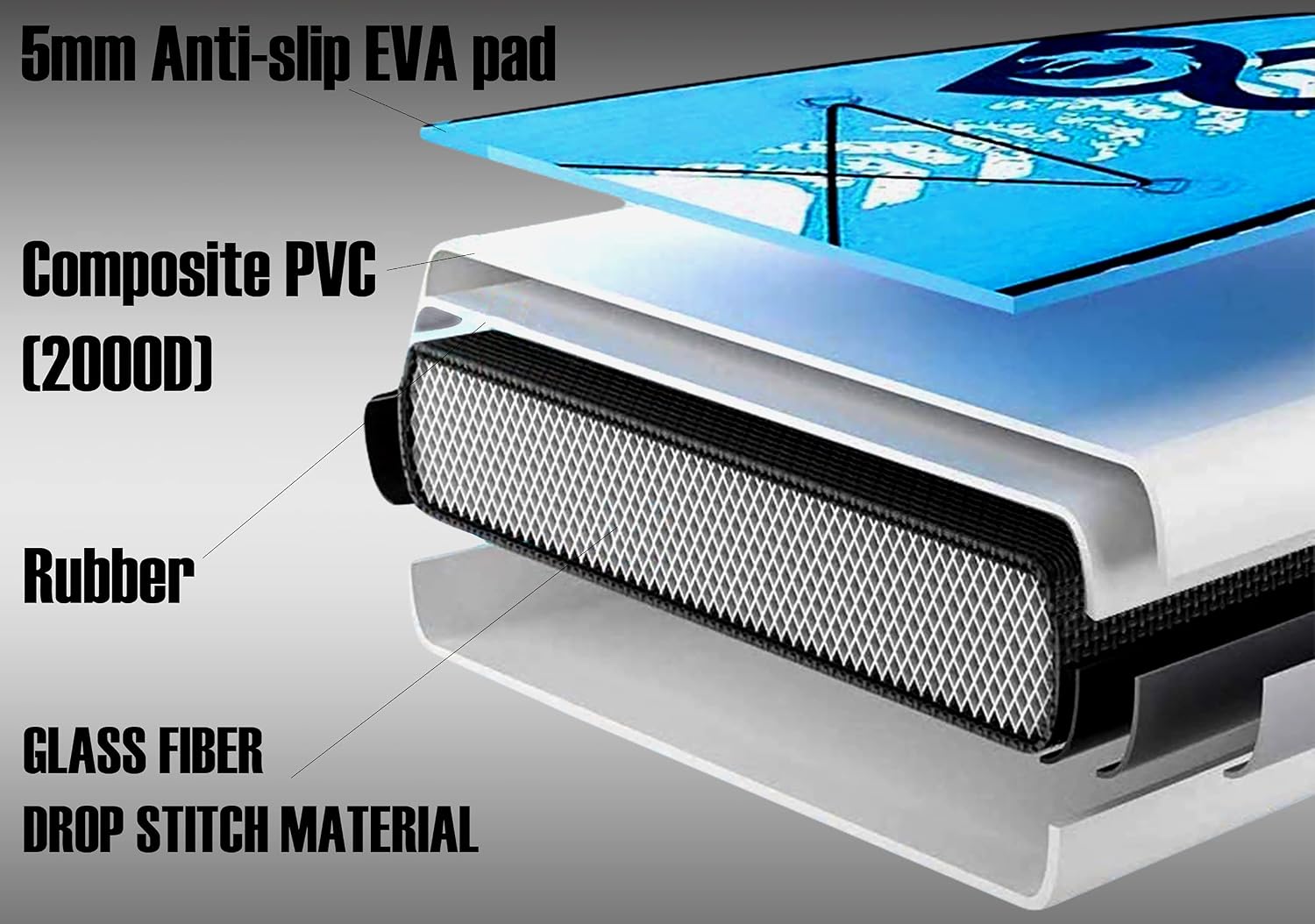
Image: Cross-section illustrating the durable construction of the SUP board.
2. Installing the Fin
- The DCS Optimal SUP features a removable center fin and two fixed side fins.
- Slide the removable center fin into its fin box slot at the rear of the board. Secure it with the attached clip or pin. Ensure it clicks into place firmly.
- No tools are required for fin installation.
3. Assembling the Paddle
- The adjustable paddle comes in multiple sections. Connect the sections by pushing them together until the locking pins engage.
- Adjust the paddle length to your height. A general rule is that the paddle handle should reach your wrist when your arm is extended overhead. Secure the adjustment clamp.
4. Attaching the Ankle Leash
- Attach one end of the ankle leash to the D-ring at the tail of the board.
- Secure the other end of the leash comfortably around your ankle. This is a crucial safety measure.

Image: Key features and dimensions of the DCS Optimal SUP board.
Operating Instructions
Carrying the Board
Use the central neoprene carry handle to transport the inflated board to the water. For longer distances, use the provided backpack to carry the deflated board.

Image: Person carrying the SUP board on the beach.
Getting on the Board
- Start in shallow water. Place the paddle across the board in front of you.
- Kneel on the board just behind the center handle, keeping your hands on the board for stability.
- Once stable on your knees, slowly stand up one foot at a time, placing your feet shoulder-width apart over the center of the board. Keep your knees slightly bent and your core engaged.
Paddling Techniques
- Hold the paddle with one hand on the top of the handle and the other on the shaft. The blade should be angled away from you.
- For straight paddling, alternate strokes on each side of the board. Reach forward with the paddle, immerse the blade fully, and pull it back towards your feet.
- Use your core muscles, not just your arms, for more efficient paddling.
Turning
- To turn, paddle on one side only. To turn right, paddle on the left side of the board. To turn left, paddle on the right side.
- For sharper turns, perform a "sweep stroke" by paddling in a wide arc from the nose to the tail of the board.

Image: Two people enjoying the SUP board, demonstrating its stability and capacity.

Image: The board's stability allows for activities like SUP yoga.
Maintenance
Cleaning
- After each use, rinse the board thoroughly with fresh water to remove salt, sand, and dirt.
- Use a mild soap and soft brush if necessary for stubborn stains.
- Ensure the board is completely dry before deflating and storing to prevent mold and mildew.
Storage
- To deflate, open the valve and press the pin down to the 'open' position. Allow air to escape naturally, or use the pump in reverse (if applicable) to speed up deflation.
- Once deflated, roll the board tightly from the nose towards the tail, expelling any remaining air.
- Store the board in its backpack in a cool, dry place, away from direct sunlight and extreme temperatures.
- Do not store the board folded or creased for extended periods, as this can damage the material.
Repair Kit Use
- The included repair kit is for minor punctures.
- Clean and dry the area around the puncture.
- Cut a patch from the repair material slightly larger than the puncture, with rounded corners.
- Apply adhesive (not included, typically PVC glue) evenly to the patch and the damaged area.
- Press the patch firmly onto the puncture, ensuring no air bubbles. Hold in place until dry.
- Allow at least 24 hours for the adhesive to cure before reinflating.
Troubleshooting
| Problem | Possible Cause | Solution |
|---|---|---|
| Board not inflating / losing air quickly | Valve pin in 'down' (open) position; Valve cap not secured; Leak/puncture. | Ensure valve pin is 'up' for inflation. Secure valve cap. Check for leaks using soapy water and repair with kit. |
| Paddle sections not connecting | Debris in connection points; Misalignment. | Clean connection points. Ensure proper alignment and push firmly until pins engage. |
| Fin not securing | Debris in fin box; Misalignment of fin. | Clean fin box. Ensure fin is correctly oriented and slides fully into the slot before securing. |
Specifications
| Feature | Detail |
|---|---|
| Model Number | 701 |
| Dimensions (Inflated) | 305 x 81 x 12 cm (120 x 32 x 4.7 inches) |
| Maximum Weight Recommendation | 180 Kilograms (396 lbs) |
| Material | PVC (2000D), Neoprene, Polyester, EVA (5mm anti-slip pad), Glass Fiber (Drop Stitch) |
| Color | White |
| Skill Level | Beginner |
| Special Features | Anti-slip EVA pad, X-shaped fiberglass drop stitch technology, High-pressure valve, Bungee cords for luggage, Neoprene carry handle, Removable center fin. |
Warranty and Support
Specific warranty information for the Boards DCS Optimal SUP is not provided in the product details. Please refer to your purchase receipt or contact the retailer/manufacturer directly for warranty terms and conditions.
For technical support or further assistance, please contact the manufacturer, DCS, or your point of purchase.


