1. Introduction
The Miuzei NA-KMS32 Electronics Starter Kit is designed for enthusiasts and learners interested in Arduino and Raspberry Pi projects. This comprehensive kit includes over 235 components and offers 58 detailed lessons, providing a robust platform for hands-on learning in electronics and programming. It is ideal for developing practical skills in circuit building, sensor integration, and microcontroller programming.

2. Kit Contents
This kit provides a wide array of components essential for various electronics projects. All modules are pre-soldered for ease of use, allowing for quick assembly via pin headers. Additionally, three double-sided PCBs are included for projects requiring soldering.
Key Components Included:
- LCD Display
- Resistors (various values)
- LEDs (various colors)
- Sensors (e.g., DHT11 temperature/humidity, ultrasonic, PIR motion)
- Relay Module
- Breadboard
- Power Supply Module
- GPIO Extension Board
- Stepper Motor and Servo Motor
- Joystick Module
- RFID Module
- Keypad Module
- Jumper Wires
- And many more discrete components.


3. Setup
To begin using your Miuzei NA-KMS32 kit, you will need an Arduino board or a Raspberry Pi (not included). The kit is designed for easy, solder-free prototyping using the included breadboard and jumper wires. For detailed instructions on specific projects and component connections, refer to the comprehensive online lessons provided.
Getting Started:
- Access Tutorials: The kit includes 58 lessons for both Arduino and Raspberry Pi. These tutorials are available online and cover a wide range of projects from basic circuits to advanced sensor applications. You can find the tutorials by visiting the URL provided in the kit documentation or on the product page.
- Connect Microcontroller: Connect your Arduino board or Raspberry Pi to your computer. Ensure you have the necessary software (Arduino IDE for Arduino, Python/C environment for Raspberry Pi) installed.
- Breadboard Wiring: Use the breadboard to assemble your circuits. Components can be easily inserted into the breadboard holes, and jumper wires are used to make connections between components and to your microcontroller.
- Power Supply: Ensure your circuit receives appropriate power. The kit includes a power supply module for the breadboard, or you can power components directly from your microcontroller's GPIO pins as specified in the lessons.
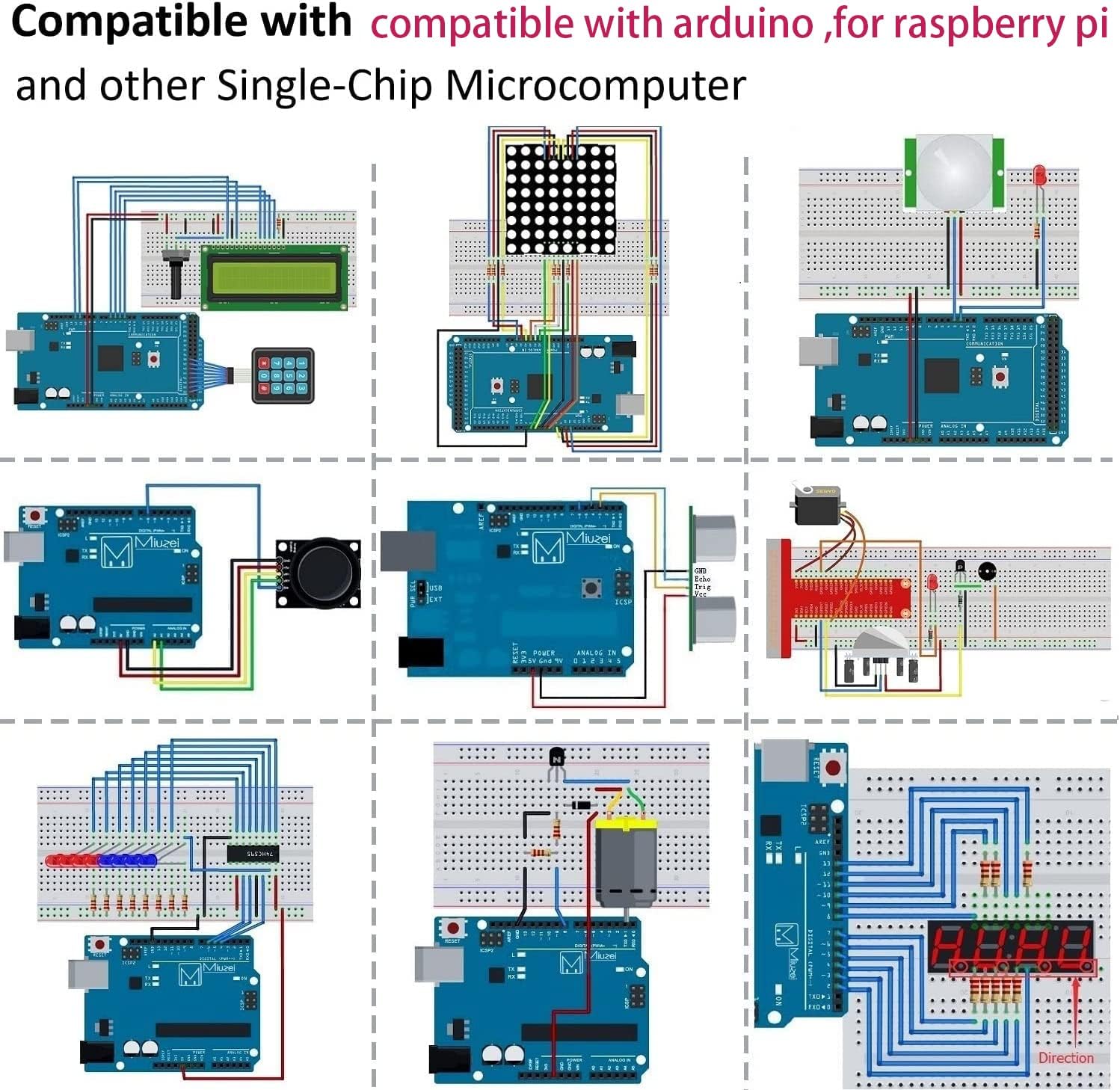

4. Operating Principles
The Miuzei NA-KMS32 kit is designed to teach fundamental electronics and programming concepts through practical application. Each lesson guides you through building a circuit and writing code to control components or read sensor data. You will learn about digital and analog inputs/outputs, communication protocols, and basic control logic.
Examples of Learning Modules:
- LED Control: Learn to blink LEDs, create light patterns, and control brightness using Pulse Width Modulation (PWM).
- Sensor Readings: Interface with various sensors (e.g., temperature, humidity, ultrasonic distance) to collect environmental data.
- Display Output: Utilize the LCD display and 7-segment displays to show text and numerical information.
- Motor Control: Experiment with stepper and servo motors for precise movement control.
- Input Devices: Work with buttons, joysticks, and keypads to provide user input to your projects.
- RFID Applications: Explore basic RFID technology for identification and access control.


5. Maintenance
Proper care and storage of your electronics kit will ensure its longevity and continued functionality.
- Storage: Always store components in the provided transparent box. The individual compartments help keep parts organized and prevent damage.
- Anti-static Protection: Sensitive electronic components should be stored in anti-static bags (if provided) to prevent damage from electrostatic discharge.
- Cleanliness: Keep components free from dust and moisture. Use a soft, dry cloth for cleaning if necessary. Avoid using liquids or abrasive cleaners.
- Handling: Handle components by their edges or body whenever possible, avoiding direct contact with pins or sensitive surfaces.
6. Troubleshooting
If you encounter issues while working on your projects, consider the following troubleshooting steps:
- Check Connections: Ensure all jumper wires are securely connected to the correct pins on both the breadboard and the microcontroller. Loose connections are a common cause of problems.
- Power Supply: Verify that your microcontroller and components are receiving adequate power. Check battery levels or USB power connections.
- Code Review: Carefully review your code for any syntax errors, logical flaws, or incorrect pin assignments. Use the debugging features of your IDE.
- Component Orientation: Some components, like LEDs and diodes, are polarity-sensitive. Ensure they are inserted in the correct orientation.
- Refer to Lessons: Consult the specific lesson for the project you are working on. The tutorials often include common troubleshooting tips for that particular circuit.
- Isolate the Problem: If a complex circuit isn't working, try to break it down into smaller, simpler parts to identify the faulty section or component.
7. Specifications
| Feature | Detail |
|---|---|
| Brand | Miuzei |
| Model Number | NA-KMS32 |
| Compatible Devices | Arduino, Raspberry Pi |
| Connections | USB (for microcontroller) |
| Total USB Ports | 1 (on power module) |
| Operating System Compatibility | Linux (for Raspberry Pi), various (for Arduino IDE) |
| Number of Components | 235+ |
| Number of Lessons | 58 (26 for Arduino, 32 for Raspberry Pi) |
| Power Requirement | 1 x 9V battery (not included) or USB power |
8. Support
For further assistance, detailed tutorials, or specific project guidance, please refer to the official Miuzei support resources. The online lessons are your primary resource for learning and project development.
- Online Tutorials: Access the comprehensive lessons via the URL provided in your kit or on the product page.
- Manufacturer Website: Visit the Miuzei official website for product updates, FAQs, and contact information.
- Community Forums: Engage with online communities dedicated to Arduino and Raspberry Pi for peer support and project ideas.
9. Warranty Information
Specific warranty details for the Miuzei NA-KMS32 Electronics Starter Kit are not explicitly provided in the product information. For warranty claims or inquiries, please retain your proof of purchase and contact the retailer from whom you purchased the kit or the Miuzei customer support directly. They will be able to provide the most accurate and up-to-date warranty terms and conditions.


