
Introduction
This manual provides essential information for the safe and effective installation, operation, and maintenance of your Walfront die-cast aluminum chainsaw carburetor. Please read this manual thoroughly before attempting any installation or operation to ensure proper function and safety.
This carburetor is designed as a direct replacement part for various chainsaw models, ensuring optimal performance and durability. It is compatible with 5200, 4500, 5800, 52CC, 45CC, and 58CC chainsaws.

Image: Walfront chainsaw carburetor, illustrating its intended use in a chainsaw.
Product Overview
The Walfront chainsaw carburetor is a high-quality replacement component engineered for reliability and performance. It features a durable die-cast aluminum construction and an anodized surface for enhanced wear resistance.
- Material: High-quality die-cast aluminum, ensuring durability and resistance to damage.
- Surface Treatment: Anodized for good wear resistance, allowing reliable operation in adverse conditions.
- Compatibility: Specifically designed to fit 5200, 4500, 5800, 52CC, 45CC, and 58CC chainsaw models.
- Installation: Lightweight and simple construction facilitates easy installation and direct replacement of existing carburetors.
- Performance: Engineered to help your chainsaw achieve higher operational performance.
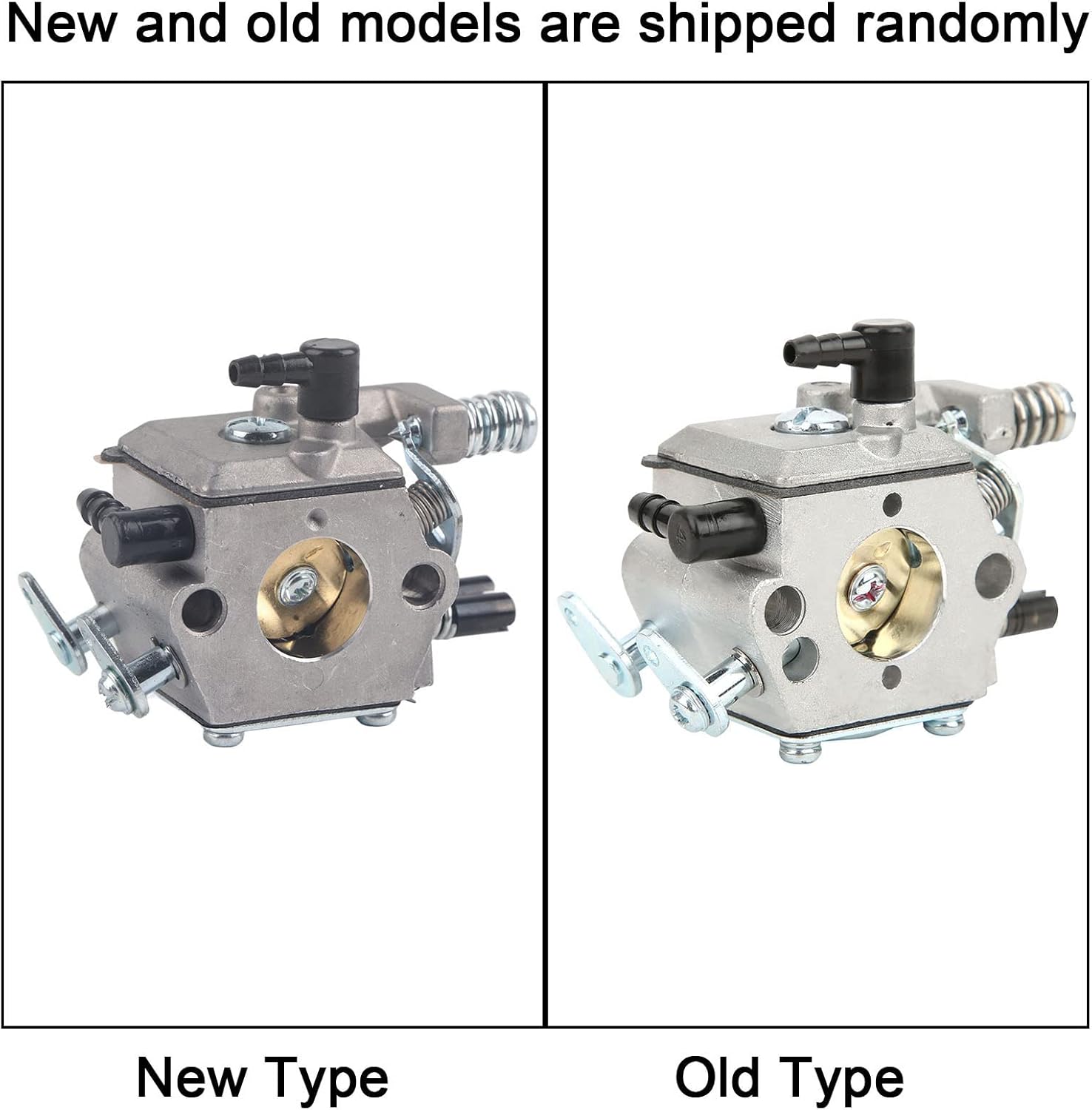
Image: Detailed view of the Walfront chainsaw carburetor highlighting its features and compatibility.
Please note that due to manufacturing updates, new and old models of the carburetor may be shipped randomly. Both types are fully compatible and functionally identical for the specified chainsaw models.

Image: Comparison of new and old carburetor models, showing minor aesthetic differences but identical functionality.
Safety Information
Always prioritize safety when working with power tools and fuel systems. Failure to follow safety instructions can result in serious injury or property damage.
- Wear appropriate personal protective equipment (PPE), including safety glasses, gloves, and hearing protection.
- Ensure the chainsaw is turned off, the spark plug cap is disconnected, and the engine is cool before beginning any work.
- Work in a well-ventilated area, away from open flames or sparks, especially when handling fuel.
- Refer to your chainsaw's original manufacturer manual for specific safety guidelines related to your model.
- Keep children and bystanders away from the work area.
Setup and Installation
Replacing a chainsaw carburetor requires basic mechanical knowledge. If you are unsure about any step, it is recommended to seek professional assistance.
Tools Required:
- Screwdriver set (flathead and Phillips)
- Socket wrench set
- Pliers
- Clean rags
- Fuel-resistant sealant (optional, for fuel lines)
Installation Steps:
- Preparation: Ensure the chainsaw is off, cool, and the spark plug wire is disconnected. Drain any fuel from the tank.
- Access the Carburetor: Remove the air filter cover and air filter. Depending on your chainsaw model, you may need to remove additional covers or components to gain full access to the carburetor.
- Disconnect Fuel Lines: Carefully disconnect the fuel lines from the old carburetor. Be prepared for residual fuel to leak. Note the routing of the fuel lines for reinstallation.
- Disconnect Throttle Linkage: Detach the throttle linkage and any choke linkages from the old carburetor. Take a photo or make a diagram if necessary to remember the connections.
- Remove Old Carburetor: Unscrew the mounting bolts or nuts holding the carburetor in place. Carefully remove the old carburetor, along with any gaskets.
- Clean Mounting Area: Clean the mounting surface on the engine to ensure a good seal with the new carburetor. Remove any old gasket material.
- Install New Carburetor: Place new gaskets (if provided or required) onto the mounting studs. Position the new Walfront carburetor onto the studs.
- Reconnect Linkages: Reattach the throttle and choke linkages to the new carburetor. Ensure they move freely and correctly.
- Reconnect Fuel Lines: Reconnect the fuel lines to the appropriate ports on the new carburetor. Ensure connections are secure to prevent leaks.
- Secure Carburetor: Tighten the mounting bolts or nuts evenly to secure the carburetor. Do not overtighten.
- Reassemble: Reinstall the air filter, air filter cover, and any other components removed during disassembly.

Image: Front view of the Walfront carburetor, illustrating its components for installation.
Operating Instructions
After installation, proper starting and operation procedures are crucial for optimal performance and longevity of your chainsaw and its new carburetor.
Initial Start-up:
- Refuel: Fill the chainsaw fuel tank with the correct fuel mixture as specified by your chainsaw manufacturer.
- Prime (if applicable): If your chainsaw has a primer bulb, press it several times until fuel is visible in the return line.
- Choke: Engage the choke lever to the "Full Choke" position.
- Start: Pull the starter cord firmly until the engine "pops" or attempts to start. Do not pull more than 3-5 times on full choke.
- Half Choke: Move the choke lever to the "Half Choke" or "Run" position (depending on your model).
- Restart: Pull the starter cord again until the engine starts and runs.
- Warm-up: Allow the engine to warm up for a minute or two before engaging the throttle fully.
Carburetor Adjustment (if necessary):
Your new carburetor is typically pre-set from the factory. However, minor adjustments may be needed for optimal performance based on altitude, temperature, and fuel type. Consult your chainsaw's original manual for specific adjustment procedures. Generally, carburetors have three adjustment screws:
- L (Low Speed Mixture): Adjusts fuel mixture at idle and low RPMs.
- H (High Speed Mixture): Adjusts fuel mixture at high RPMs.
- T (Idle Speed): Adjusts the engine's idle speed.
Adjustments should be made incrementally (e.g., 1/8 turn at a time) with the engine running, listening for smooth operation and proper acceleration. Incorrect adjustments can damage the engine.

Image: Close-up of the carburetor, indicating potential adjustment points.
Maintenance
Regular maintenance of your chainsaw and its carburetor will ensure long-term reliability and performance.
- Air Filter: Regularly clean or replace the air filter to prevent dirt and debris from entering the carburetor. A clogged air filter can cause poor engine performance.
- Fuel Filter: Inspect and replace the fuel filter periodically. A dirty fuel filter can restrict fuel flow to the carburetor.
- Fuel Lines: Check fuel lines for cracks, leaks, or hardening. Replace damaged lines promptly.
- Spark Plug: Inspect and clean or replace the spark plug as recommended by your chainsaw manufacturer. A fouled spark plug can affect combustion.
- Carburetor Cleaning: If performance issues arise, the carburetor may need cleaning. This typically involves disassembling the carburetor, cleaning jets and passages with carburetor cleaner, and replacing gaskets. This is an advanced task and should only be performed by experienced individuals.
Troubleshooting
Here are some common issues and their potential solutions related to carburetor function:
| Problem | Possible Cause | Solution |
|---|---|---|
| Engine won't start | No fuel, clogged fuel filter, fouled spark plug, incorrect choke setting, carburetor issues. | Check fuel level and mixture. Replace fuel filter. Clean/replace spark plug. Adjust choke. Inspect carburetor for blockages. |
| Engine starts then dies | Improper fuel mixture, clogged fuel filter, air leak, idle speed too low. | Adjust carburetor mixture screws (L/H). Replace fuel filter. Check for air leaks around carburetor/intake. Adjust idle speed (T). |
| Poor acceleration / Lacks power | Clogged air filter, incorrect high-speed mixture (H), restricted exhaust, dirty carburetor jets. | Clean/replace air filter. Adjust high-speed mixture (H). Check exhaust for blockages. Clean carburetor. |
| Engine runs rough / Idles poorly | Incorrect low-speed mixture (L), dirty carburetor, air leak, fouled spark plug. | Adjust low-speed mixture (L). Clean carburetor. Check for air leaks. Clean/replace spark plug. |
| Fuel leaks | Loose fuel lines, damaged gaskets, cracked carburetor body. | Tighten fuel line clamps. Replace gaskets. Inspect carburetor for damage; replace if cracked. |
If these troubleshooting steps do not resolve the issue, it is recommended to consult a qualified service technician.
Specifications
| Feature | Detail |
|---|---|
| Brand | Walfront |
| Model Compatibility | Chainsaw 5200, 4500, 5800, 52CC, 45CC, 58CC |
| Material | Die-cast Aluminum |
| Surface Treatment | Anodic Oxidation (Anodized) |
| Item Weight | 105 g |
| Specific Use | Chainsaw Carburetor Replacement |
| Included Components | 1 Carburetor |
Warranty and Support
For warranty information or technical support regarding your Walfront chainsaw carburetor, please refer to the retailer's return policy or contact Walfront customer service directly through their official channels. Keep your purchase receipt as proof of purchase.
For additional product information or to explore other Walfront products, visit the Walfront Store on Amazon.