
1. Introduction
The Kidde P3010CU is a combination smoke and carbon monoxide (CO) alarm designed to provide early warning of both smoke and CO hazards. This unit integrates photoelectric sensing technology for detecting visible fire particles, typically associated with smoldering fires, and an electrochemical sensor for detecting carbon monoxide gas. Powered by a 10-year sealed lithium battery, this alarm eliminates the need for battery replacement throughout its operational life and ensures continuous protection even during power failures.
When a hazard is detected, the alarm sounds a loud 85-decibel alert and provides clear voice announcements such as "Fire! Fire!" for smoke or fire events, and "Warning! Carbon Monoxide!" for CO detection. An end-of-life announcement, "Replace Alarm!", indicates when the unit has reached the end of its operational lifespan. The integrated Smart-Hush button allows for temporary silencing of nuisance alarms, such as those caused by routine cooking or shower steam.
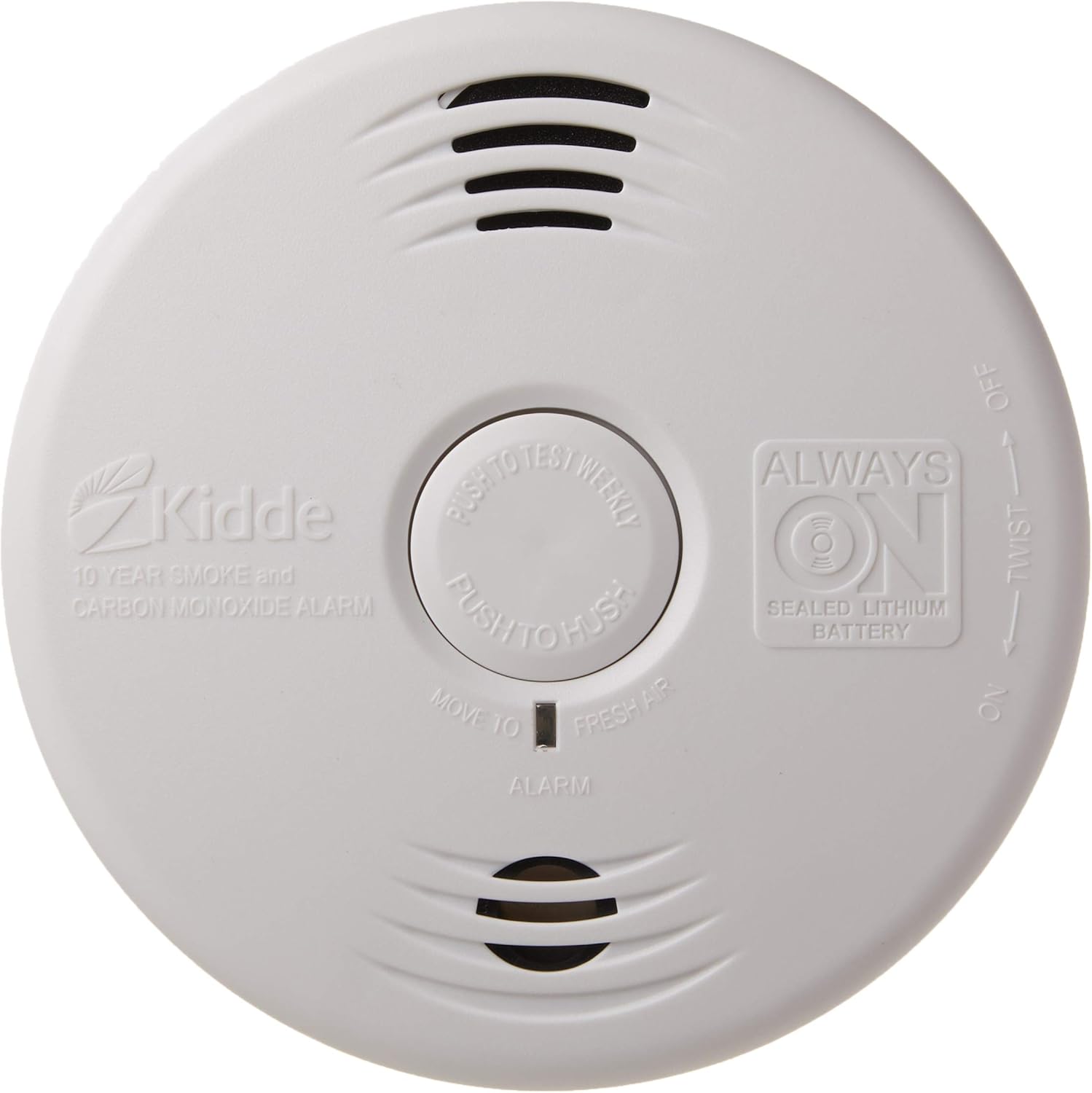
2. Safety Information
This alarm is designed to detect smoke and carbon monoxide. It is not designed to detect heat, flames, or other gases. For optimal safety, install combination smoke and carbon monoxide alarms on every level of your home and near all sleeping areas. Carbon monoxide is an odorless, colorless, and tasteless gas that can be fatal. Never ignore an alarm.
- WARNING: Carbon monoxide cannot be seen or smelled but can kill you.
- Do not paint the alarm. Paint can clog the openings and interfere with the sensors.
- Do not place alarms within 6 feet of fuel-burning appliances or sources of steam.
- Test the alarm weekly to ensure proper operation.

3. Product Features
- Dual Sensor Technology: Combines photoelectric smoke sensing and electrochemical CO sensing in one unit.
- 10-Year Sealed Battery: Provides continuous power for the life of the alarm, eliminating battery changes.
- Voice Alerts: Clearly announces the type of hazard detected (Fire or Carbon Monoxide).
- 85-Decibel Alarm: Loud audible warning to alert occupants.
- Automatic Activation: The alarm powers on automatically when attached to its mounting bracket.
- Test/Hush Button: Allows for easy weekly testing and temporary silencing of nuisance alarms.
- End-of-Life Notification: Unit announces "Replace Alarm!" when it reaches the end of its 10-year lifespan.
4. Setup and Installation
Follow these steps to properly set up and install your Kidde P3010CU alarm:
- Select Location: Refer to the Home Safety Product Placement Guide (Figure 2) for recommended installation locations. Install on every level of your home, inside and outside sleeping areas. Avoid areas prone to steam, high humidity, or within 6 feet of fuel-burning appliances.
- Mounting Bracket: Secure the mounting bracket to a wall or ceiling using the provided screws.
- Activate Alarm: The alarm automatically activates when it is twisted onto the mounting bracket. Ensure the alarm is fully engaged and clicks into place. Some users may find it helpful to manually push the activation tab on the back of the unit before mounting.
- Test Alarm: After installation, press and hold the Test/Hush button (Figure 1) for a few seconds until the alarm sounds. This confirms the unit is functioning correctly.

5. Operating Instructions
Understanding the alarm's indicators and alerts is crucial for effective home safety.
Normal Operation
- The green LED indicator will flash once every 10 minutes, indicating the alarm is powered and functioning correctly.

Alarm Modes and Voice Alerts
- Smoke Alarm: 3 long beeps, followed by the voice announcement "Fire! Fire!", repeating.
- Carbon Monoxide (CO) Alarm: 4 quick beeps, followed by the voice announcement "Warning! Carbon Monoxide!", repeating.
- Low Battery: A chirp will sound every 60 seconds, accompanied by the voice announcement "Low Battery!". The LED will blink every 30 seconds. This indicates the unit is nearing its end of life and needs replacement.
- End of Life: Two chirps every 30 seconds, accompanied by the voice announcement "Replace Alarm!". This signifies that the alarm has reached its 10-year operational limit and must be replaced.
- Fault Mode: The alarm will chirp and flash the LED every 30 seconds, indicating a potential malfunction.
Test/Hush Button Functionality
- Testing: Press and hold the central Test/Hush button for a few seconds. The alarm will cycle through its alert sounds and voice announcements. Release the button to stop the test. Test weekly.
- Hushing Nuisance Alarms: If the alarm sounds due to non-emergency conditions (e.g., cooking fumes, shower steam), press the Test/Hush button. The unit will announce "Hush Mode activated" and silence for approximately 8 minutes. If the smoke or CO concentration remains high after the hush period, the alarm will reactivate.
6. Maintenance
Regular maintenance ensures the continued reliability of your alarm.
- Weekly Testing: Press the Test/Hush button weekly to confirm the alarm is functioning.
- Annual Cleaning: Clean the alarm annually. Use a soft brush attachment on a vacuum cleaner or compressed air to remove dust and debris from the alarm openings. Do not use cleaning solvents or spray directly onto the unit.
- End of Life Replacement: The alarm has a 10-year operational life. When the unit announces "Replace Alarm!" or the low battery chirp persists, the entire unit must be replaced. The 10-year lifespan begins from the date the alarm is powered on.
- Disposal: At the end of its life, permanently disable and discharge the alarm's battery as indicated on the back of the unit (Figure 3) before disposal. Follow local regulations for battery and electronic waste disposal.
7. Troubleshooting
If your alarm is not functioning as expected, refer to the following common issues and solutions:
| Problem | Possible Cause | Solution |
|---|---|---|
| Alarm sounds without visible smoke or CO. | Nuisance alarm from cooking fumes, steam, high humidity, or dust. | Press the Test/Hush button to temporarily silence. Ventilate the area. Clean the alarm. Relocate if nuisance alarms persist. |
| Alarm chirps every 60 seconds and says "Low Battery!". | Alarm has reached its end of life. | The sealed battery cannot be replaced. Replace the entire alarm unit immediately. |
| Alarm chirps and LED flashes every 30 seconds (Fault Mode). | Internal malfunction. | Clean the alarm. If the fault persists, the unit may be defective. Replace the alarm. |
| Alarm sounds for actual smoke or CO event. | Presence of smoke or carbon monoxide. | 1. Operate Test/Hush button to confirm it is not a test. 2. Call emergency services (Fire Department or 911). 3. Immediately move to fresh air, outdoors or by an open window or outside door. Do not re-enter until the area is cleared by emergency personnel. |
8. Specifications
- Model: P3010CU
- Power Source: 10-Year Sealed Lithium Battery (non-replaceable)
- Sensor Type: Photoelectric (Smoke), Electrochemical (Carbon Monoxide)
- Alarm Loudness: 85 Decibels at 10 feet
- Operating Humidity: 10% to 95% relative humidity, non-condensing
- Operating Temperature: 40°F (4.4°C) to 100°F (37.8°C)
- Product Dimensions: 1.6"D x 5.22"W x 5.22"H (4.06 cm D x 13.26 cm W x 13.26 cm H)
- Item Weight: 4.7 ounces (134 Grams)
- Certifications: UL 2034, UL217, NFPA72, NFPA101, State of California Fire Marshal, FHA, HUD.

9. Warranty Information
The Kidde P3010CU Smoke & Carbon Monoxide Detector comes with a 10-year limited manufacturer's warranty. This warranty applies to the alarm unit itself and does not constitute a battery performance claim, as the battery is sealed for the life of the unit. The warranty period begins when the alarm is first powered on. If the exact power-on date is unknown, it is recommended to assume the alarm needs replacement after 10 years from the manufacturing date or purchase date, whichever is earlier.
10. Support and Contact
For technical assistance, warranty claims, or further information regarding your Kidde P3010CU alarm, please refer to the contact information below:
- Manufacturer Address: Kidde, 1016 Corporate Park Drive, Mebane NC 27302, USA.
- Emergency Services: In case of an actual fire or carbon monoxide alarm, immediately evacuate the premises and call your local emergency services (e.g., Fire Department or 911).


