1. Product Overview
The MikroTik Cloud Router Switch CRS328-24P-4S+RM is a versatile 28-port switch designed for network environments requiring high performance and flexible power options. It features 24 Gigabit Ethernet ports with various Power over Ethernet (PoE) output capabilities and 4 10Gbps SFP+ ports for high-speed fiber or Ethernet connections.
This device supports a "Dual boot" feature, allowing users to choose between RouterOS for advanced routing and Layer 3 features, or SwOS for a simplified, switch-specific operating system.
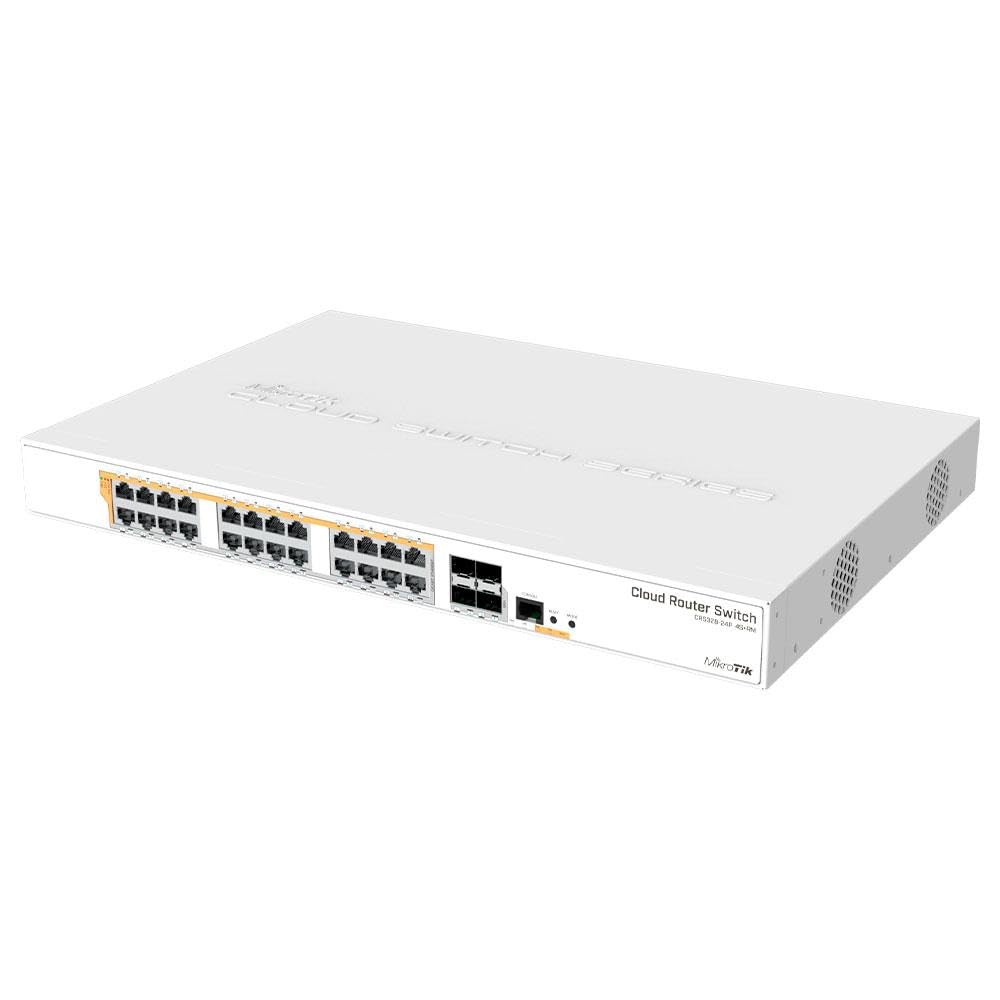
Figure 1: Front panel of the MikroTik Cloud Router Switch CRS328-24P-4S+RM. This image displays the 24 Gigabit Ethernet ports, 4 SFP+ ports, console port, and reset button.
2. Package Contents
Verify that all components are present in the package:
- MikroTik Cloud Router Switch CRS328-24P-4S+RM unit
- Power cable (100-240V AC)
- Rackmount ears (for 1U rack installation)
- Mounting screws
Note: SFP+ modules and Ethernet cables are not included and must be purchased separately.
3. Setup and Installation
3.1. Safety Information
- Ensure proper ventilation around the device.
- Connect the device to a grounded power outlet.
- Do not operate the device in environments exceeding 60°C (140°F).
3.2. Rackmount Installation
The CRS328-24P-4S+RM is designed for 1U rackmount installation.
- Attach the provided rackmount ears to the sides of the switch using the included screws.
- Secure the switch into a standard 19-inch rack using appropriate rack screws (not included).
3.3. Power Connection
Connect the included power cable to the AC input on the rear of the switch and then to a 100-240V AC power source. The device will power on automatically.
3.4. Initial Configuration Access
To access the device for initial configuration:
- Ethernet: Connect an Ethernet cable from your computer to any of the Gigabit Ethernet ports. The device will typically acquire an IP address via DHCP or use a default fallback IP.
- Console: For direct console access, connect a serial console cable to the RJ45 console port on the front panel. Use a terminal emulator (e.g., PuTTY) with settings: 115200 baud, 8 data bits, 1 stop bit, no parity, flow control: none.
4. Operating the Switch
4.1. Operating System Selection (Dual Boot)
The CRS328-24P-4S+RM supports "Dual boot" with RouterOS and SwOS. You can select the desired operating system during boot-up or via the RouterBOOT loader settings.
- SwOS: Provides a simplified interface with switch-specific features. Ideal for pure Layer 2 switching environments.
- RouterOS: Offers advanced routing and Layer 3 features, suitable for complex network configurations.
Refer to the MikroTik documentation for detailed instructions on switching between operating systems.
4.2. Ethernet Port Functionality (PoE)
The 24 Gigabit Ethernet ports offer various Power over Ethernet (PoE) output options:
- Passive PoE
- Low voltage PoE
- 802.3af/at (Type 1 "PoE" / Type 2 "PoE+") with auto-sensing
PoE-Out is passed over mode B pins (4,5+) (7,8-). Each port can provide up to 30 W of power. The device provides a guaranteed 450 W total power for PoE devices (3x150 W per every 8 Ethernet ports).
4.3. SFP+ Port Functionality
The four SFP+ ports provide up to 10 Gbps connectivity options. These ports are compatible with either optical fiber SFP+ modules or Ethernet SFP+ modules (not included).
5. Maintenance
5.1. Firmware Updates
Regularly check the MikroTik website for the latest firmware updates for both RouterOS and SwOS. Keeping the firmware updated ensures optimal performance, security, and access to new features.
Instructions for updating firmware are available in the official MikroTik documentation for RouterOS and SwOS.
5.2. Cleaning
To maintain proper airflow and prevent overheating, periodically clean the device. Use a soft, dry cloth to wipe the exterior. For dust accumulation in vents, use compressed air. Ensure the device is powered off before cleaning.
5.3. Reset Button
The reset button on the front panel can be used for various functions depending on when it is pressed during boot-up. Refer to the MikroTik documentation for specific reset procedures (e.g., resetting to factory defaults, entering RouterBOOT loader).
6. Troubleshooting
6.1. No Power
- Verify the power cable is securely connected to both the switch and a working power outlet.
- Check the power source for functionality.
6.2. No Network Connectivity
- Ensure Ethernet cables are properly connected to the ports and the link/activity LEDs are illuminated.
- Check the configuration of the switch (VLANs, IP settings) to ensure it matches your network requirements.
- If using SFP+ ports, verify that compatible and functional SFP+ modules are installed and connected correctly.
6.3. PoE Devices Not Powering On
- Confirm that the connected device is PoE-compatible (802.3af/at or passive PoE, depending on configuration).
- Check the PoE settings on the switch for the specific port to ensure PoE output is enabled and configured correctly.
- Verify that the total power consumption of all connected PoE devices does not exceed the switch's maximum PoE budget (450 W).
6.4. Accessing Configuration Interface
- If you cannot access the web interface, try connecting via the console port.
- Ensure your computer's IP address is in the same subnet as the switch's management IP.
- If the password is lost, a factory reset might be necessary (refer to MikroTik documentation).
7. Specifications
| Feature | Detail |
|---|---|
| Model | CRS328-24P-4S+RM |
| Ethernet Ports | 24 x Gigabit Ethernet (10/100/1000 Mbps) |
| SFP+ Ports | 4 x 10 Gbps SFP+ |
| PoE Output | Passive PoE, Low Voltage PoE, 802.3af/at (Type 1 "PoE" / Type 2 "PoE+") |
| Max Power per PoE Port | 30 W |
| Total PoE Budget | 450 W (3x150 W per 8 Ethernet ports) |
| Power Supply | 100-240 V AC, 500 W built-in |
| Max Power Consumption (Device only) | 44 W |
| Operating System | Dual boot (RouterOS / SwOS) |
| Dimensions | 1.1 x 9.7 x 6.5 inches (28 x 246 x 165 mm) |
| Weight | 9.53 pounds (4.33 kg) |
| Operating Temperature | -20°C to +60°C (-4°F to +140°F) |
| Case Material | Metal |
8. Warranty Information
MikroTik products typically come with a limited manufacturer's warranty. For specific warranty terms and conditions, please refer to the official MikroTik website or the documentation included with your purchase. Keep your proof of purchase for warranty claims.
9. Technical Support
For technical assistance, firmware downloads, and additional documentation, please visit the official MikroTik website:
You can also find community forums and knowledge bases for peer support and common issues.


