Introduction
This user manual provides comprehensive instructions for setting up, operating, maintaining, and troubleshooting your ASUS ZenWiFi AX6600 Tri-Band Mesh WiFi 6 System (XT8 2PK). The ZenWiFi AX (XT8) is designed to deliver extremely fast and stable wireless networking performance throughout your entire home, offering coverage up to 5,500 sq ft. Featuring the latest WiFi 6 technology, this mesh WiFi system significantly improves coverage, speed, and stability.
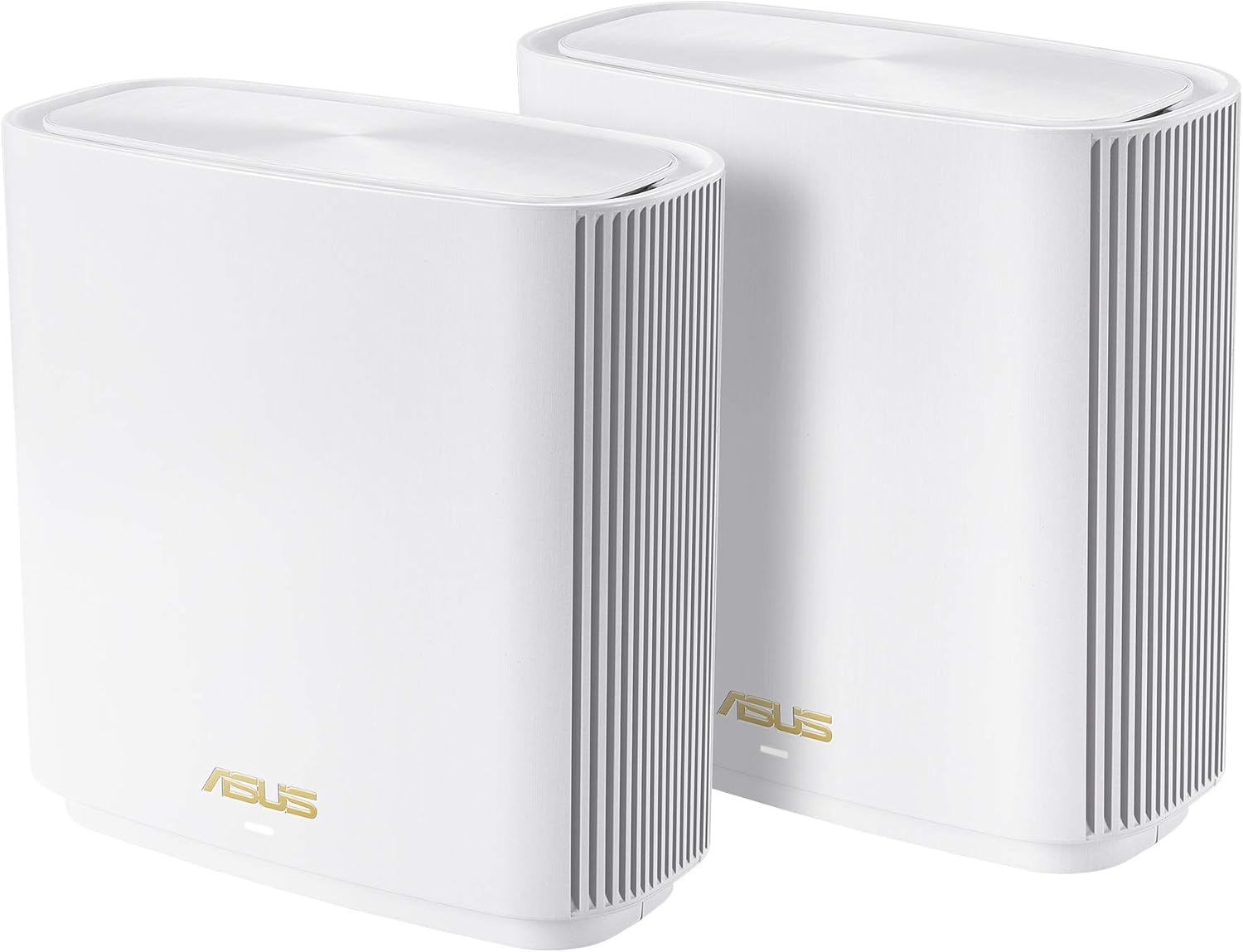
Image: Two ASUS ZenWiFi AX6600 (XT8) mesh routers, showcasing their sleek white design.
Package Contents
Verify that all items are present in your package:
- ZenWiFi AX White Mesh Router (2 units)
- RJ-45 cable
- Power adapter (2 units)
- Warranty card
- Quick start guide
Product Overview
The ASUS ZenWiFi AX6600 system consists of two identical mesh routers designed for optimal performance and coverage. Each unit features multiple ports for wired connections and a power input.

Image: Rear panel of the ZenWiFi AX router, highlighting the DC-IN port, Power On/Off button, LAN ports (1-3), 2.5G/1G WAN port, and USB 3.0/2.0 port.
Port and Button Descriptions:
- DC-IN Port: Connects to the power adapter.
- Power On/Off Button: Toggles the device power.
- LAN Ports (1-3): For connecting wired devices such as computers, gaming consoles, or smart TVs.
- 2.5G/1G WAN Port: Connects to your modem or internet service provider's equipment for internet access. Supports high-speed connections.
- USB 3.0/2.0 Port: For connecting USB devices like external hard drives for network storage or 4G/5G dongles for mobile tethering.
Key Features
- Tri-band Mesh WiFi System: Delivers strong WiFi to every corner of your home, providing a total wireless speed of 6600Mbps.

Image: Illustration of the ZenWiFi AX system providing whole-home coverage up to 5500 sq. ft. and 6+ rooms, utilizing a dedicated backhaul for stable connection between units.
- Next-Gen Wi-Fi 6 Technology: With OFDMA and MU-MIMO, ZenWiFi AX enables more efficient, stable, and faster transmission, even when multiple devices are transmitting data simultaneously.

Image: Visual comparison highlighting the speed and capacity improvements of Revolutionary WiFi 6 technology.
- Hassle-Free Control: Easy 3-step setup and management via the ASUS Router App.
- Always Up-to-date Protection: Includes lifetime free network security powered by Trend Micro, ensuring your privacy on connected devices is protected.
- Maximum Range: Covers up to 5500 Sq Ft.
- Power Supply: AC Input: 110V~240V (50~60Hz), DC Output: 19 V with max. 1.75 A current, or 12 V with max. 3 A current.
Setup Guide
Setting up your ASUS ZenWiFi AX6600 system is designed to be quick and straightforward, typically completed in three steps using the ASUS Router App.
Initial Setup Steps:
- Unpack and Connect:
- Place your ZenWiFi units in central locations within your home for optimal coverage.
- Connect one of the ZenWiFi units to your modem using the provided RJ-45 cable, plugging it into the 2.5G/1G WAN port.
- Connect the power adapters to both ZenWiFi units and plug them into power outlets. Turn on the units.
- Download the ASUS Router App:
- Download the ASUS Router App from your mobile device's app store (Google Play Store for Android or Apple App Store for iOS).
- Follow In-App Instructions:
- Open the ASUS Router App and follow the on-screen prompts to detect your ZenWiFi system.
- The app will guide you through creating your WiFi network name (SSID) and password, and configuring other essential settings.

Image: A hand holding a smartphone displaying the ASUS Router App's "Good Connection!" message, indicating successful network setup.
For detailed setup instructions, refer to the Quick Start Guide included in your package or the full User Manual PDF available online: ASUS ZenWiFi AX6600 User Guide (PDF).
Operation
Once set up, your ZenWiFi AX6600 system operates as a unified mesh network, providing seamless WiFi coverage. You can manage your network settings and access advanced features through the ASUS Router App or a web browser interface.
Key Operational Features:
- AiMesh Technology: The ZenWiFi system utilizes AiMesh to create a flexible and scalable whole-home WiFi network. You can add compatible ASUS AiMesh routers to expand your coverage further.
- AiProtection Pro: This built-in network security feature, powered by Trend Micro, provides commercial-grade protection for all devices connected to your network. It includes:
- Malicious Sites Blocking: Prevents access to known malicious websites.
- Two-Way IPS: Protects against inbound and outbound cyber threats.
- Infected Device Prevention and Blocking: Isolates infected devices to prevent data theft or attacks.

Image: A user interacting with a tablet, overlaid with icons representing AiProtection Pro's advanced parental control and internet security features.
- Advanced Parental Controls: Manage internet access for family members with customizable settings:
- Content Filtering: Block specific categories of websites.
- Time Scheduling: Set internet access schedules for individual devices.
- Usage Statistics: Monitor internet activity.
- Multiple SSIDs: Create up to three separate WiFi networks for different purposes (e.g., main network, guest network, IoT devices).
Maintenance
Regular maintenance helps ensure the longevity and optimal performance of your ASUS ZenWiFi system.
- Firmware Updates: Regularly check for and install firmware updates via the ASUS Router App or web interface. Updates often include performance improvements, security patches, and new features.
- Cleaning: Keep the units clean and free from dust. Use a soft, dry cloth. Avoid liquid cleaners or abrasive materials.
- Ventilation: Ensure the units are placed in well-ventilated areas and that their ventilation holes are not obstructed to prevent overheating.
- Restarting: Periodically restart your ZenWiFi units (e.g., once a month) to refresh network connections and clear temporary data, which can improve stability.
Troubleshooting
If you encounter issues with your ZenWiFi AX6600 system, try the following common troubleshooting steps:
- No Internet Connection:
- Check if your modem is working correctly.
- Ensure the RJ-45 cable is securely connected from your modem to the WAN port of the primary ZenWiFi unit.
- Restart both your modem and the ZenWiFi units.
- Weak WiFi Signal or Dead Zones:
- Relocate the ZenWiFi units to optimize coverage. Avoid placing them near large metal objects, concrete walls, or other electronic devices that may cause interference.
- Ensure the units are within optimal range of each other for the mesh backhaul connection.
- Cannot Access Router Settings:
- Ensure your device is connected to the ZenWiFi network.
- Try accessing the router via the ASUS Router App or by typing
router.asus.cominto your web browser. - Clear your browser's cache and cookies, or try a different browser.
- Forgotten WiFi Password or Admin Login:
- You can reset the WiFi password via the ASUS Router App.
- If you forget the admin login, you may need to perform a factory reset on the router. Refer to the Quick Start Guide for factory reset instructions. Note: A factory reset will erase all your custom settings.
Specifications
| Feature | Detail |
|---|---|
| Product Dimensions | 6.3 x 2.95 x 6.36 inches |
| Item Weight | 6 pounds |
| Model Number | ZenWiFi AX 2PK White (XT8 (W-2-PK)) |
| Frequency Band Class | Tri-Band |
| Wireless Communication Standard | 802.11a, 802.11ac, 802.11ax, 802.11g, 802.11n |
| Compatible Devices | Personal Computer, Smartphone, Tablet |
| Frequency | 5 GHz |
| Recommended Uses | Business, Home |
| Connectivity Technology | Ethernet, USB, Wi-Fi |
| Maximum Range | 5500 Sq Ft |
Warranty and Support
Your ASUS ZenWiFi AX6600 system comes with a warranty. Please refer to the included Warranty Card for specific terms and conditions. ASUS also provides lifetime free network security powered by Trend Micro.
For technical support, driver downloads, and further information, please visit the official ASUS support website or refer to the User Guide PDF: ASUS ZenWiFi AX6600 User Guide (PDF).
Important Information
Legal Disclaimer:
Actual data throughput and WiFi coverage will vary from network conditions and environmental factors, including the volume of network traffic, building material and construction, and network overhead, resulting in lower actual data throughput and wireless coverage.


