
1. Introduction and Safety Information
Thank you for choosing the ANENG V8 Digital Multimeter. This device is designed for safe and accurate measurement of AC/DC voltage, AC/DC current, resistance, capacitance, frequency, temperature, diode, continuity, and battery testing. Please read this manual thoroughly before use to ensure proper operation and to prevent potential hazards.
1.1 Safety Precautions
- Always ensure the multimeter is in good working condition before use. Inspect test leads for damage.
- Do not apply voltage or current that exceeds the maximum rated values for the multimeter.
- Exercise extreme caution when working with voltages above 36V DC or 25V AC RMS, as these can pose a shock hazard.
- Always disconnect power to the circuit and discharge all high-voltage capacitors before measuring resistance, continuity, diodes, or capacitance.
- Ensure the rotary switch is in the correct position for the desired measurement before connecting the test leads to the circuit.
- Do not operate the multimeter in explosive gas, vapor, or dusty environments.
- Replace batteries immediately when the low battery indicator appears to ensure accurate readings.
2. Product Overview
2.1 Package Contents
The ANENG V8 Digital Multimeter package typically includes the following items:
- ANENG V8 Digital Multimeter
- Test Leads (Red and Black)
- Temperature Probe
- Carrying Case
- User Manual

Image: ANENG V8 Digital Multimeter with its standard accessories, including test leads, a temperature probe, and a protective carrying case.
2.2 Controls and Display
The multimeter features an 8000-count LCD backlight display for clear readings in various lighting conditions. Key controls include a rotary switch for function selection and buttons for range, data hold, and other features.

Image: Detailed view of the multimeter's front panel, highlighting the LCD screen, the central rotary selector, and various control buttons.
3. Setup
3.1 Battery Installation
The ANENG V8 Digital Multimeter is powered by batteries. To install or replace batteries:
- Ensure the multimeter is turned off and disconnect all test leads.
- Locate the battery compartment cover on the back of the device.
- Use a screwdriver to loosen the screw(s) securing the battery cover.
- Remove the cover.
- Insert new batteries, observing the correct polarity (+ and -) as indicated inside the compartment. The device typically uses AA batteries.
- Replace the battery cover and secure it with the screw(s).
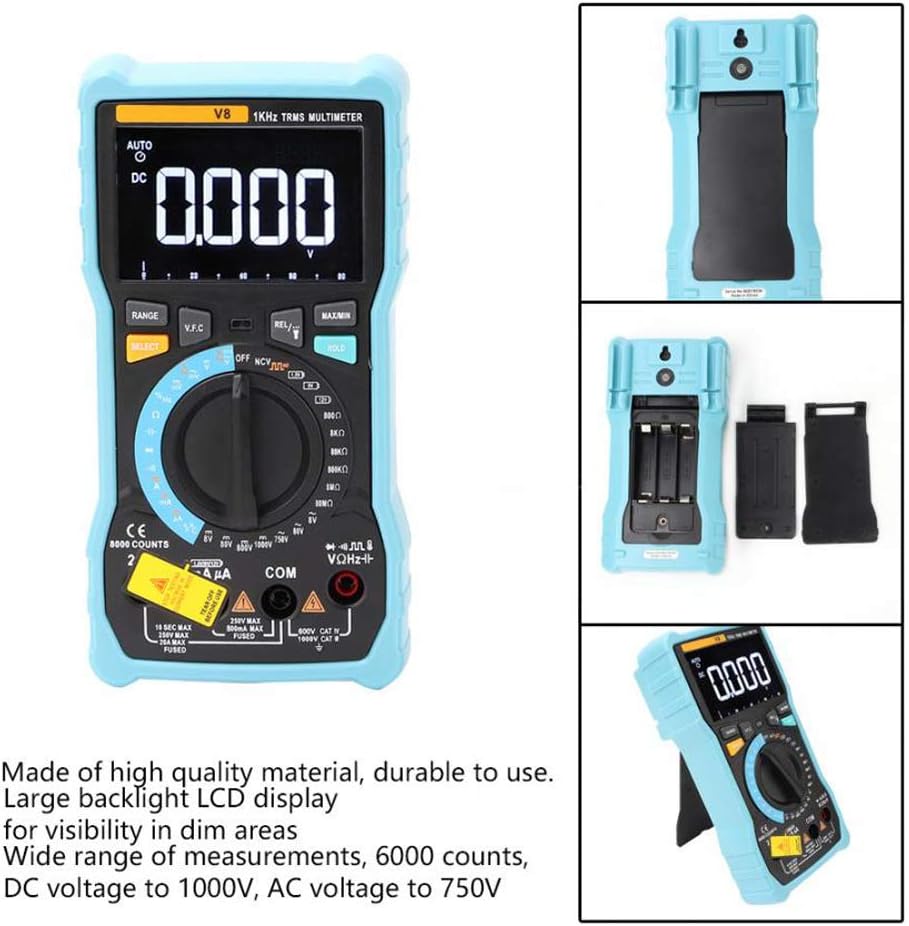
Image: The rear view of the multimeter with the battery compartment open, illustrating the correct placement for three AA batteries.
4. Operating Instructions
Before any measurement, ensure the test leads are correctly inserted into the input jacks and the rotary switch is set to the appropriate function.
4.1 Measuring DC/AC Voltage
- Set the rotary switch to the 'V–' (DC Voltage) or 'V~' (AC Voltage) position.
- Connect the red test lead to the 'VΩmA' jack and the black test lead to the 'COM' jack.
- Connect the test leads in parallel to the circuit or component you wish to measure.
- Read the voltage value on the display.
4.2 Measuring DC/AC Current
- Set the rotary switch to the 'A–' (DC Current) or 'A~' (AC Current) position. For milliampere (mA) or microampere (µA) measurements, select the corresponding range.
- For current up to 800mA, connect the red test lead to the 'VΩmA' jack. For current up to 20A, connect the red test lead to the '20A' jack. Connect the black test lead to the 'COM' jack.
- Disconnect power to the circuit. Open the circuit where you want to measure current. Connect the multimeter in series with the circuit.
- Apply power to the circuit and read the current value on the display.
4.3 Measuring Resistance
- Set the rotary switch to the 'Ω' (Resistance) position.
- Connect the red test lead to the 'VΩmA' jack and the black test lead to the 'COM' jack.
- Ensure the circuit is de-energized and all capacitors are discharged. Connect the test leads across the component to be measured.
- Read the resistance value on the display.
4.4 NCV (Non-Contact Voltage) Detection
- Set the rotary switch to the 'NCV' position.
- Move the top end of the multimeter near the conductor or outlet.
- The multimeter will emit an audible beep and the NCV indicator light will flash if AC voltage is detected, indicating the presence of live voltage without physical contact.
4.5 Temperature Measurement
- Set the rotary switch to the '°C/°F' (Temperature) position.
- Connect the temperature probe to the 'VΩmA' and 'COM' jacks, observing polarity if applicable.
- Place the tip of the temperature probe on or near the object whose temperature you wish to measure.
- Read the temperature value on the display.
4.6 Other Functions
- Capacitance: Set the rotary switch to the 'F' position. Connect leads across the discharged capacitor.
- Frequency/Duty Cycle: Set the rotary switch to the 'Hz/%' position. Connect leads to the signal source.
- Diode Test: Set the rotary switch to the 'Diode' position. Connect leads across the diode.
- Continuity Test: Set the rotary switch to the 'Continuity' position. Connect leads across the circuit. An audible beep indicates continuity.
- Battery Test: Set the rotary switch to the 'Battery' position. Connect leads to the battery terminals (1.5V, 9V, or 12V).
- Data Hold: Press the 'HOLD' button to freeze the current reading on the display. Press again to release.
- Backlight/Flashlight: Press the backlight button to turn on/off the display backlight or flashlight.
- Auto Power Off: The multimeter will automatically power off after a period of inactivity to conserve battery life.
5. Maintenance
5.1 Cleaning
Wipe the case with a damp cloth and mild detergent. Do not use abrasives or solvents. Keep the input terminals free of dirt and moisture.
5.2 Fuse Replacement
If the current measurement function fails, the fuse may need replacement. Refer to the specifications for the correct fuse type and rating. Fuse replacement should only be performed by qualified personnel.
5.3 Storage
When not in use for extended periods, remove the batteries to prevent leakage and store the multimeter in a dry, cool place.
6. Troubleshooting
- No Display: Check battery installation and charge. Replace batteries if necessary.
- Incorrect Readings: Ensure the rotary switch is set to the correct function and range. Check test lead connections. Verify battery charge.
- Current Measurement Not Working: Check the fuse. Replace if blown (refer to fuse replacement section).
- NCV Not Detecting: Ensure the NCV function is selected and the multimeter is close enough to the AC voltage source.
7. Specifications
| Parameter | Value |
|---|---|
| Display | 8000 Counts LCD with Backlight |
| DC Voltage (V) | 8.000V / 80.00V / 800.0V / 1000V |
| DC Voltage (mV) | 800mV |
| AC Voltage (V) | 8.000V / 80.00V / 750V |
| AC Voltage (mV) | 800mV |
| DC Current (A) | 8.000A / 20.00A |
| DC Current (mA) | 8.000mA / 80.00mA / 800.0mA |
| DC Current (µA) | 800µA / 8000µA |
| AC Current (A) | 8.000A / 20.00A |
| AC Current (mA) | 8.000mA / 80.00mA / 800.0mA |
| AC Current (µA) | 800µA / 8000µA |
| Resistance | 800.0Ω / 8.000kΩ / 80.00kΩ / 800.0kΩ / 8.000MΩ / 80.00MΩ |
| Capacitance | 9.999nF / 99.99nF / 999.9nF / 9.999µF / 99.99µF / 999.9µF / 9.999mF / 99.99mF |
| Frequency | 9.999Hz / 99.99Hz / 999.9Hz / 9.999kHz / 99.99kHz / 999.9kHz / 9.999MHz |
| Duty Cycle | 1% ~ 99% |
| Temperature Range | -20°C ~ 1000°C (-4°F ~ 1832°F) |
| Battery Test | 1.5V / 9V / 12V |
| Ranging | Auto / Manual |
| Update Rate | 3 times/second |
| True RMS | Yes |
| Data Hold | Yes |
| Backlight/Flashlight | Yes |
| Low Battery Alert | Yes |
| Auto Power Off | Yes |
| Material | ABS / PVC |
| Power Source | Battery Powered |
8. Warranty and Support
This product is covered by a standard manufacturer's warranty against defects in materials and workmanship. Please refer to the warranty card included with your purchase for specific terms and conditions. For technical support or service inquiries, please contact your retailer or the manufacturer's customer service department.
9. Official Product Videos
No official product videos from the seller are available for embedding at this time.


