
1. Introduction
This manual provides essential information for the safe installation, operation, and maintenance of your Banshee Trojan T-105 GC2 Deep Cycle Flooded Lead Acid Batteries. These batteries are engineered for applications requiring sustained power over extended periods, including golf carts, recreational vehicles (RVs), marine systems, solar and wind energy storage, floor machines, man lifts, and aircraft tugs.
Adherence to the guidelines outlined in this manual will help ensure optimal performance and longevity of your batteries.
2. Safety Information
WARNING: Flooded lead-acid batteries contain sulfuric acid and produce explosive gases. Failure to follow safety instructions can result in serious injury or death.
- DANGER/POISON: Batteries contain sulfuric acid, which is corrosive and can cause severe burns. Avoid contact with skin, eyes, or clothing. In case of contact, flush immediately with water and seek medical attention.
- EXPLOSIVE GASES: Batteries generate hydrogen gas during charging and discharging, which is highly flammable. Keep sparks, flames, and smoking materials away from batteries. Ensure the installation area is well-ventilated to prevent gas accumulation.
- Always wear appropriate Personal Protective Equipment (PPE), including safety glasses, face shield, and acid-resistant gloves, when handling batteries.
- Keep batteries out of reach of children.
- Do not tip batteries; keep them level to prevent electrolyte leakage.
- Ensure vent caps are tight and properly seated.
- Batteries are heavy (approximately 62 pounds each). Use proper lifting techniques or equipment to prevent injury.

Image: Top view of a Banshee Trojan T-105 battery, clearly showing the embedded low-profile terminals and the safety warning label regarding danger, poison, and explosive gases.
3. Product Overview
The Banshee Trojan T-105 is a 6-volt, 225 amp-hour (at a 20-hour rate) deep-cycle flooded lead-acid battery. It is designed to provide reliable, long-lasting continuous power for various applications. The battery features an embedded low-profile terminal with a 5/16 inch bolt for secure connections.
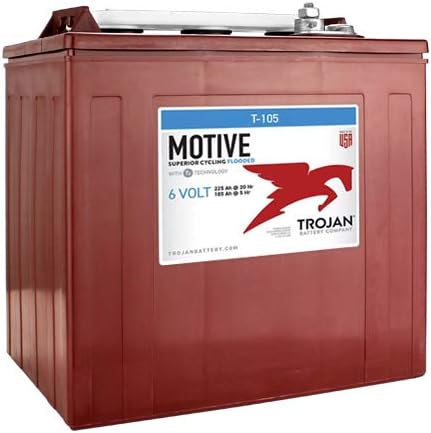
Image: Front view of a single Banshee Trojan T-105 battery, displaying the product label with specifications like "Motive Superior Cycling Flooded" and "6 Volt 225 Ah @ 20 Hr".

Image: Angled view of a single Banshee Trojan T-105 battery, showcasing its maroon case and the design of the embedded low-profile terminals.
4. Setup and Installation
Proper installation is critical for battery performance and safety.
- Unpacking and Inspection: Carefully unpack the batteries. Inspect each battery for any signs of damage, such as cracks, leaks, or deformed terminals. Do not install damaged batteries.
- Preparation: Ensure the installation area is clean, dry, and well-ventilated. Wear appropriate PPE (safety glasses, gloves).
- Mounting: Securely place the batteries in a designated battery tray or compartment. Ensure they are stable and cannot move during operation. Allow for adequate air circulation around each battery.
- Wiring:
- For higher voltage systems (e.g., 24V or 48V), connect multiple 6V batteries in series. Connect the positive (+) terminal of one battery to the negative (-) terminal of the next battery.
- Ensure all cable connections are clean, tight, and free of corrosion. Use the provided nuts to secure the cables to the embedded low-profile terminals (5/16 inch bolt). Loose connections can cause overheating and power loss.
- Connect the final positive and negative terminals to your system's main power cables.
- Always connect the negative cable last to minimize the risk of sparks.
- Terminal Type: The T-105 battery uses an embedded low-profile terminal with a 5/16 inch bolt. Ensure your cables and connectors are compatible.

Image: A set of four Banshee Trojan T-105 batteries, illustrating how multiple units might be supplied for system installation.
5. Operating Instructions
To maximize the life and performance of your deep cycle batteries, follow these operating guidelines:
- Initial Charge: Fully charge new batteries before their first use. This conditions the battery and ensures maximum capacity.
- Discharge Levels: Avoid deep discharges below 50% State of Charge (SOC). Consistently discharging batteries below this level can significantly reduce their lifespan.
- Charging: Use a charger specifically designed for flooded lead-acid batteries. Ensure the charger's voltage and current settings are appropriate for a 6V battery or the total voltage of your battery bank. Always ensure adequate ventilation during charging.
- Temperature: Battery performance and lifespan are affected by temperature. Operate batteries within recommended temperature ranges (typically 77°F / 25°C). Extreme temperatures can reduce capacity and accelerate degradation.
6. Maintenance
Flooded lead-acid batteries require regular maintenance to achieve their rated lifespan and performance.
- Watering: This is the most critical maintenance task for flooded batteries.
- Check electrolyte levels regularly, typically monthly, or more frequently in hot climates or with heavy use.
- Only add distilled water. Never add acid.
- Fill cells to the indicated level, usually just above the plates. Do not overfill, especially before charging, as electrolyte expands during charging.
- A battery filler or baster can help with precise filling.
- Equalizing Charges: Periodically perform an equalizing charge. This is a controlled overcharge that helps to balance the voltage across all cells and prevent sulfation, which can reduce capacity. Consult your charge controller or inverter manual for instructions on performing an equalizing charge.
- Cleaning: Keep battery tops and terminals clean and dry.
- Corrosion on terminals can impede current flow. Remove corrosion with a wire brush and a solution of baking soda and water (1 tablespoon baking soda per cup of water).
- Rinse the cleaned areas with clean water and dry thoroughly.
- Apply a thin coat of anti-corrosion grease to the terminals after cleaning and tightening connections.
- Inspection: Regularly inspect batteries for any physical damage, cracks, leaks, or loose connections. Address any issues promptly.
7. Troubleshooting
Common issues and potential solutions for your Banshee Trojan T-105 batteries:
- Battery Not Holding Charge:
- Check electrolyte levels; add distilled water if low.
- Verify that the charger is functioning correctly and is appropriate for flooded lead-acid batteries.
- Ensure all cable connections are clean and tight.
- Perform an equalizing charge to address potential cell imbalance or sulfation.
- Reduced Capacity or Short Run Time:
- This may indicate sulfation due to undercharging or consistent deep discharges. Review charging habits.
- Ensure proper maintenance routines, especially watering and equalizing charges, are being followed.
- Batteries naturally lose some capacity with age.
- Corrosion on Terminals:
- Clean terminals as described in the Maintenance section.
- Ensure connections are tight to prevent arcing and further corrosion.
8. Specifications
| Specification | Value |
|---|---|
| Brand | Banshee |
| Model | T-105 |
| Voltage | 6 Volt |
| Battery Capacity | 225 Amp Hours (at 20-hour rate) |
| BCI Group Size | GC2H |
| Product Dimensions (L x W x H) | 11.07" x 7.13" x 10.3" (281mm x 181mm x 262mm) |
| Item Weight | 62 pounds (28.1 kg) |
| Number of Cells | 3 |
| Terminal Type | Embedded Low Profile (5/16" bolt) |
| UPC | 843443163471 |

Image: A Banshee Trojan T-105 battery with its key dimensions clearly labeled: 10.3 inches height, 7.13 inches depth, and 11.07 inches width.
9. Warranty and Support
Warranty Period: These batteries are covered by an 18-month warranty from the date of purchase.
Customer Support: For technical assistance, warranty claims, or any questions regarding your Banshee Trojan T-105 batteries, please contact your authorized dealer or Banshee customer support. When contacting support, please have your model number (T-105) and proof of purchase readily available.