
1. Introduction
1.1 Product Overview
The Hach DR300 Pocket Colorimeter is a portable, waterproof instrument designed for precise measurement of Free and Total Chlorine in water samples. It provides reliable results for various water quality applications, including groundwater, surface water, and municipal water testing.
1.2 Key Features
- Accurate Chlorine Measurement: Precisely detects Free Chlorine from 0.05–4.00 mg/L and Total Chlorine from 0.1–10.0 mg/L.
- Rugged and Waterproof Design: Built to withstand harsh conditions with an IP67 rating, making it durable for field testing in tough environments.
- Intuitive and Simple to Operate: Features a user-friendly interface and a large, backlit display for easy readings in any lighting.
- Compatible with Hach Reagents: Designed to work seamlessly with EPA-approved Hach reagents and test methods to ensure valid and consistent results.
- Portable and Reliable: Compact and lightweight for quick deployment, offering the dependability needed for professional water quality analysis.

Front view of the Hach DR300 Pocket Colorimeter, displaying its screen and control buttons.
2. What's Included
The Hach DR300 Pocket Colorimeter kit typically includes the following components:
- DR300 Pocket Colorimeter unit
- Sturdy custom carrying case
- 4 AAA batteries (pre-installed or included separately)
- 2 glass sample cells
- 2 plastic sample cells
- Instruction Manual (this document)
Note: Reagents for chlorine testing must be purchased separately.

The Hach DR300 Pocket Colorimeter and its accessories, including sample cells and user manual, neatly organized within its custom carrying case.
3. Setup and Preparation
3.1 Battery Installation
The DR300 operates on 4 AAA batteries. Ensure they are correctly installed according to the polarity markings inside the battery compartment. The battery compartment is located on the rear of the device.
3.2 Initial Power On
Press the power button (usually marked with a power symbol) to turn on the device. The display should illuminate and show the initial measurement screen.
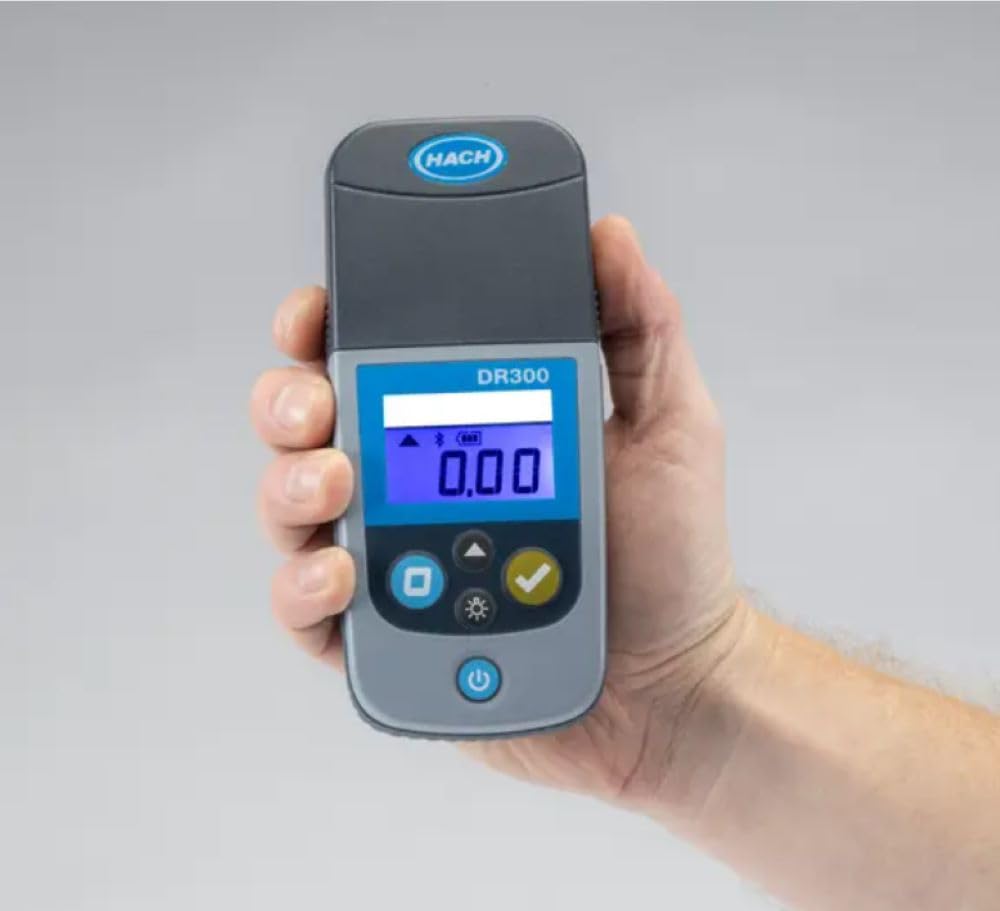
A hand demonstrating the ergonomic design and portability of the Hach DR300 Pocket Colorimeter.
4. Operation
4.1 General Measurement Procedure
The DR300 uses a photometric method for chlorine analysis. Always ensure sample cells are clean and free of scratches or fingerprints. Use Hach-approved reagents for accurate results.
4.2 Measuring Free Chlorine
- Fill a clean sample cell with 10 mL of the water sample. This is your blank.
- Place the blank into the cell holder and close the lid.
- Press the zero button (often marked with a square or 'ZERO') to zero the instrument. The display will show "0.00".
- Remove the blank. Add the appropriate Hach DPD Free Chlorine reagent to a second 10 mL sample cell containing the water sample. Swirl to mix.
- Wait for the specified reaction time (refer to reagent instructions, typically 1 minute).
- Place the reacted sample into the cell holder and close the lid.
- Press the read button (often marked with a checkmark or 'READ'). The instrument will display the Free Chlorine concentration in mg/L.
4.3 Measuring Total Chlorine
- Follow steps 1-3 from the Free Chlorine measurement to zero the instrument.
- Remove the blank. Add the appropriate Hach DPD Total Chlorine reagent to a second 10 mL sample cell containing the water sample. Swirl to mix.
- Wait for the specified reaction time (refer to reagent instructions, typically 3 minutes).
- Place the reacted sample into the cell holder and close the lid.
- Press the read button. The instrument will display the Total Chlorine concentration in mg/L.

A technician in a hard hat and safety glasses using the Hach DR300 Pocket Colorimeter to test water quality in an industrial environment, demonstrating its field applicability.
5. Maintenance
5.1 Cleaning the Instrument
Wipe the exterior of the colorimeter with a damp cloth. Do not use abrasive cleaners or solvents. Ensure the sample cell compartment is clean and dry before storage.
5.2 Cleaning Sample Cells
Wash sample cells thoroughly with distilled or deionized water after each use. Avoid scratching the glass or plastic surfaces, as this can affect measurement accuracy.
5.3 Storage
Store the DR300 and its accessories in the provided carrying case in a cool, dry place, away from direct sunlight and extreme temperatures.
6. Troubleshooting
| Problem | Possible Cause | Solution |
|---|---|---|
| Instrument does not power on | Dead batteries | Replace batteries (4 AAA). |
| "Error" message on display | Sample cell dirty or scratched; Reagent expired or incorrect; Incorrect procedure | Clean sample cell; Check reagent expiry and type; Review operation steps. |
| Inaccurate readings | Sample cell not clean; Incorrect zeroing; Reagent issue; Temperature variation | Ensure sample cells are spotless; Re-zero the instrument; Use fresh, correct reagents; Allow samples to reach ambient temperature. |
| Display is dim or unreadable | Low batteries; Backlight setting | Replace batteries; Adjust backlight setting if available. |
7. Specifications
- Model: Cl, Free+Total, MR
- Measurement Range (Free Chlorine): 0.05–4.00 mg/L Cl₂
- Measurement Range (Total Chlorine): 0.1–10.0 mg/L Cl₂
- Waterproof Rating: IP67
- Power Source: 4 x AAA batteries (included)
- Dimensions (Package): 9.09 x 6.93 x 5.75 inches
- Weight (Package): 2.88 Pounds
- Manufacturer: Hach
8. Warranty and Support
For warranty information, technical support, or to purchase replacement parts and reagents, please contact Hach customer service or visit the official Hach website. Refer to the contact information provided with your product documentation or on the manufacturer's website.
You can visit the HACH Store on Amazon for more information: HACH Official Store