
HACH LPV445.97.00110
Hach DR300 Pocket Colorimeter Instruction Manual
Model: LPV445.97.00110 | Brand: HACH
1. Introduction
The Hach DR300 Pocket Colorimeter is a portable, waterproof instrument designed for precise and reliable water quality testing. It maintains Hach's legacy of accuracy while offering modern data transfer capabilities. This manual provides essential information for setting up, operating, maintaining, and troubleshooting your DR300 Pocket Colorimeter, ensuring optimal performance for your chlorine measurement needs.

The Hach DR300 Pocket Colorimeter, designed for reliable and accurate water quality analysis.
2. What's in the Box
Your Hach DR300 Pocket Colorimeter kit comes ready-to-use in a sturdy custom carrying case. Please verify that all the following components are included:
- DR300 Pocket Colorimeter Unit
- 4 AAA Batteries (pre-installed)
- 2 Glass Sample Cells (2427606)
- 2 Plastic Sample Cells
- Instruction Manual
- Hach Communication Dongle (LPV446.99.00012)
- Sturdy Custom Carrying Case
Note: Reagents for testing are not included and must be purchased separately.

The complete Hach DR300 kit, neatly organized in its durable carrying case.
3. Setup
Before first use, ensure the batteries are properly installed and prepare your sample cells for accurate measurements.
3.1 Battery Installation
The DR300 operates on 4 AAA batteries, which are typically included and pre-installed. If replacement is needed, open the battery compartment on the back of the unit and insert new batteries, observing polarity.
3.2 Preparing Sample Cells
For accurate results, it is crucial to properly clean your sample cells before each test. Even new cells should be cleaned to remove any manufacturing residues.
- Wash sample cells three times with deionized water.
- Wash sample cells at least twice with the sample water you intend to test. This prevents dilution of low-level analytes.
- Wipe the exterior of the sample cell with a lint-free Kimwipe or similar cloth to remove fingerprints, dust, or fibers. This ensures light passes through cleanly during measurement.

The Hach DR300 Pocket Colorimeter, ready for use.
4. Operating Instructions: Chlorine Test (Free Chlorine)
This section details the procedure for performing a Free Chlorine test using the DPD Free Chlorine Reagent powder pillows and your DR300 Colorimeter.
4.1 Zeroing the Instrument
- Fill a clean sample cell with 10 mL of your sample water.
- Cap the sample cell and wipe its exterior with a Kimwipe.
- Open the lid of the DR300's sample compartment.
- Insert the prepared sample cell into the compartment, aligning the key on the cell with the slot in the instrument.
- Close the instrument lid to minimize external light interference.
- Press the ZERO button (blue square button). The display will show "0.00" once zeroing is complete. This step teaches the instrument what a zero reading looks like for your specific water sample.
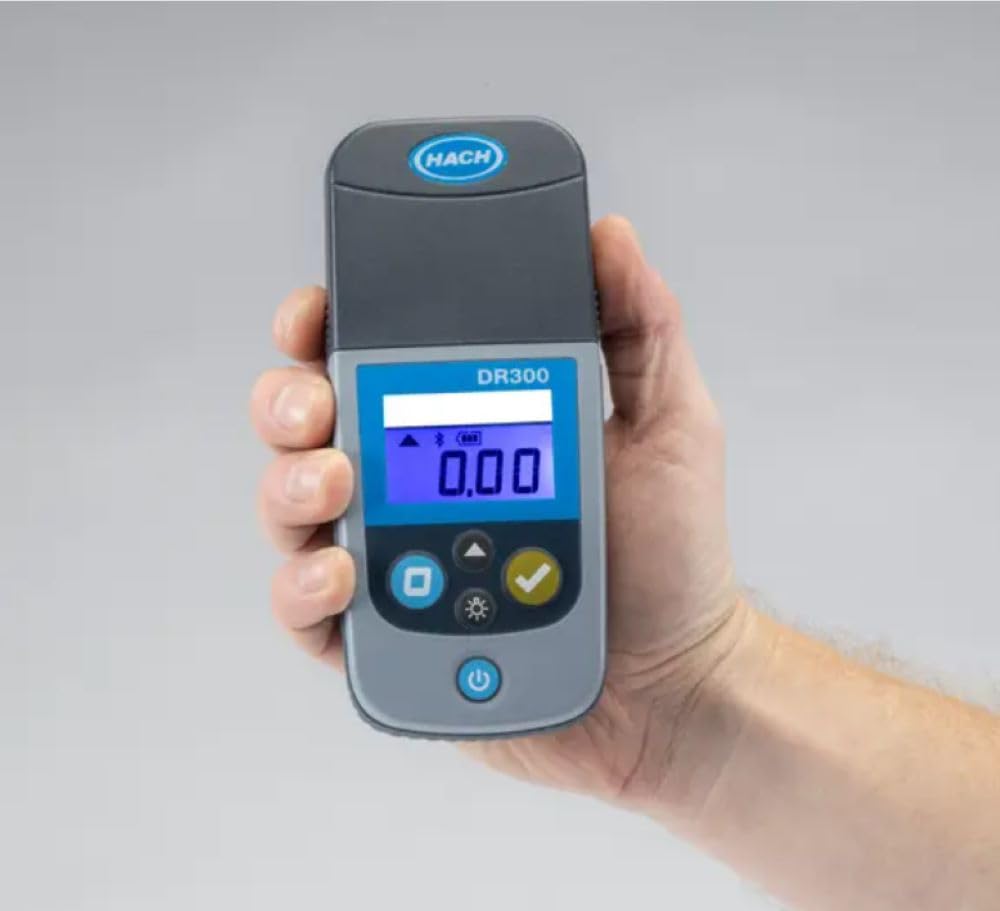
The compact Hach DR300 fits comfortably in hand for easy operation.
4.2 Adding Reagent and Measuring
- Remove the sample cell from the instrument and open its cap.
- Open one DPD Free Chlorine Reagent powder pillow. Gently tap the packet to ensure all powder is at the bottom.
- Carefully pour the entire contents of the powder pillow into the sample cell.
- Cap the sample cell and gently invert it several times to mix the reagent. Avoid vigorous shaking to prevent air bubbles, which can interfere with readings. The sample should turn pink if chlorine is present.
- Wipe the exterior of the sample cell again with a Kimwipe.
- Insert the reacted sample cell back into the DR300's compartment, aligning the key.
- Close the instrument lid.
- Press the READ button (green checkmark button). The instrument will display the Free Chlorine concentration in mg/L. For Free Chlorine, the reading should be taken within 60 seconds of adding the reagent.

The DR300 is suitable for use in various field environments.
4.3 Official Product Video: Chlorine Test Demonstration
This video, provided by Hach Company, demonstrates the process of performing a chlorine test using the DR300 Pocket Colorimeter, including sample preparation, zeroing, reagent addition, and reading the results.

Accurate measurements can be performed efficiently in a lab environment.
5. Maintenance
Proper maintenance ensures the longevity and accuracy of your DR300 Pocket Colorimeter.
5.1 Cleaning the Instrument
- Wipe the exterior of the instrument with a damp cloth as needed. Do not use abrasive cleaners or solvents.
- Keep the sample compartment clean and free of debris. Use a soft, lint-free cloth to gently wipe the optical surfaces.
5.2 Sample Cell Care
- Always clean sample cells immediately after use to prevent residue buildup.
- Store sample cells in a clean, dry place to prevent contamination or scratching.
6. Troubleshooting
If you encounter issues with your DR300, refer to the following common problems and solutions:
| Problem | Possible Cause | Solution |
|---|---|---|
| Inaccurate Readings | Dirty sample cells, incorrect reagent, air bubbles, improper zeroing. | Ensure cells are clean and lint-free. Use correct reagent for the test and sample volume. Avoid vigorous shaking. Re-zero the instrument before adding reagent. |
| Instrument Not Powering On | Dead or improperly installed batteries. | Replace batteries with new AAA batteries, ensuring correct polarity. |
| Display Error Message | Specific error codes indicate different issues. | Consult the full instruction manual for a complete list of error codes and their corresponding troubleshooting steps. |
7. Specifications
- Product Dimensions: 5 x 12 x 12 inches
- Item Weight: 2.9 Pounds
- Model Number: LPV445.97.00110
- Batteries: 4 AAA batteries required (included)
- Manufacturer: Hach
- Country of Origin: Thailand
- Waterproof Rating: IP67 (Rugged and waterproof, withstands drops, rain, and dirt)
- Chlorine Measurement Range: Free Chlorine (0.02–2.00 mg/L Low Range), Total Chlorine (0.1–8.0 mg/L High Range)
8. Warranty & Support
The Hach DR300 Pocket Colorimeter is manufactured by Hach Company, a trusted name in water quality analysis. For specific warranty information, technical support, or to inquire about replacement parts and reagents, please refer to the official Hach Company website or contact their customer service directly. Protection plans may also be available for extended coverage.
Related documentsLPV445.97.00110


Ask a question about this manual
Ask about setup, troubleshooting, compatibility, parts, safety, or missing instructions. Manuals+ will review the question and use this page’s manual context to help answer it.